Temple
Japan has more than 70,000 Buddhist temples. Buddhism
originated in India and blossomed in China and Korea before
making its way to Japan 1,500 years ago. Japan sent many
envoys to China to learn its culture and philosophies, who
later returned to the country and propagated Chinese architec-
ture, art, crafts, and other technologies. Much of the Buddhist
architecture built during the era remains admired even to this
day. Of particular importance are an array of temples and halls
of the Mitokusan Sanbutsuji Temple complex in the Touhaku
District in Shimane Prefecture, built from 706 to 849 AD. At the
deepest recesses of the temple grounds lies Nageiredo Hall,
clinging to a sheer cliff, which is built using kakezukuri, a
construction method that forms a latticed frame by combining
pillars and beams for the platform of the building. One can
imagine how dangerous and difficult it must have been to
build in such an inaccessible place. Two other temples on the
site, Jizodo and Monjudo, have pillars supporting their main
buildings. These vertical supports are connected by horizontal
tie beams with mortice and tenon joints, which give them a
structural aesthetic. Inspired by these temples of Mt. Mitoku
built among the beautiful natural surroundings and sheer
cliffs, Time & Style crafted this collection of six different-
ly-sized low tables.
The basic structure of the low tables alludes to classical
Japanese wooden architecture, with its four long, thin legs
supporting a tabletop. After careful investigation, the width of
the legs and tie beams is decided to 27 millimeters. The legs
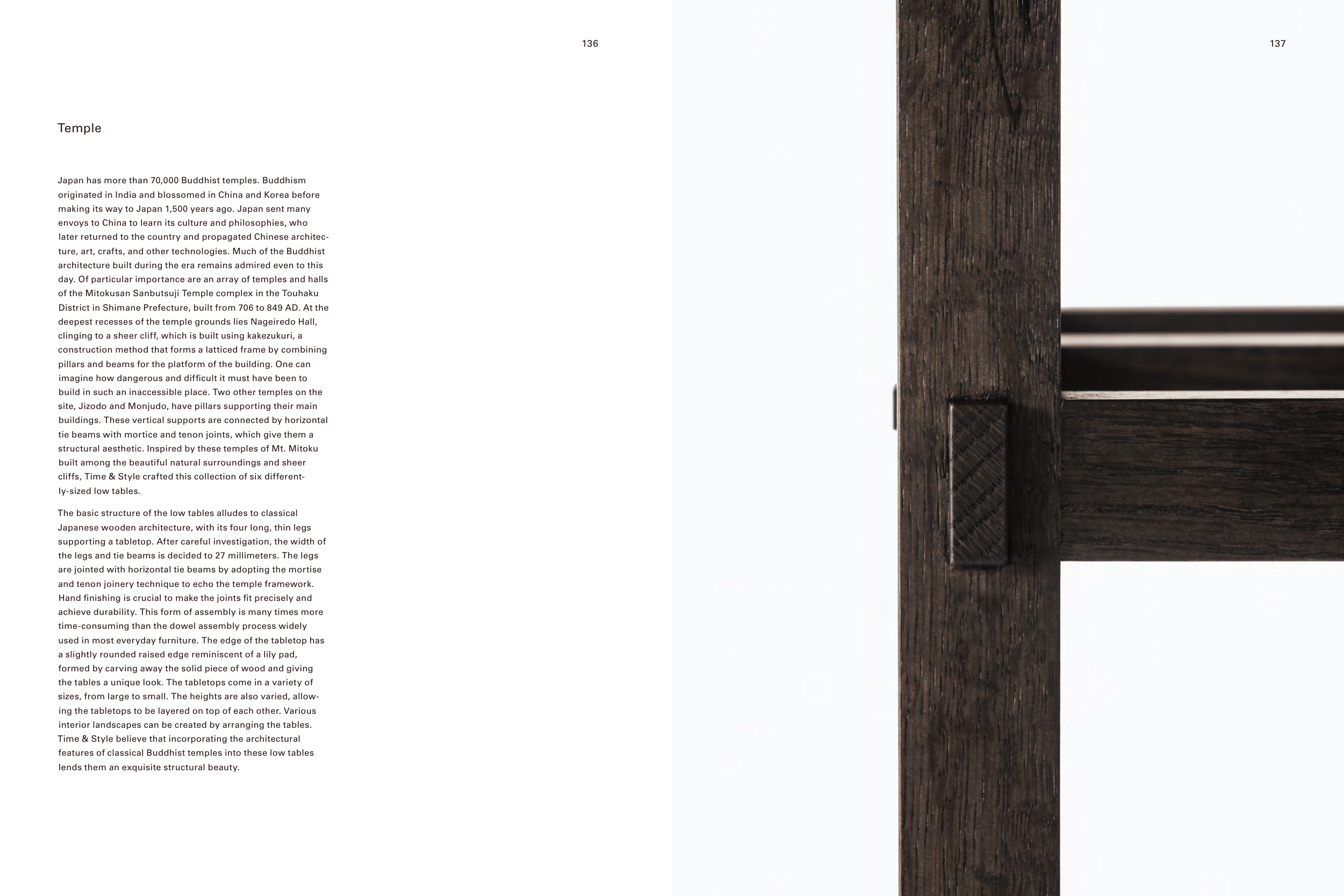
are jointed with horizontal tie beams by adopting the mortise
and tenon joinery technique to echo the temple framework.
Hand finishing is crucial to make the joints fit precisely and
achieve durability. This form of assembly is many times more
time-consuming than the dowel assembly process widely
used in most everyday furniture. The edge of the tabletop has
a slightly rounded raised edge reminiscent of a lily pad,
formed by carving away the solid piece of wood and giving
the tables a unique look. The tabletops come in a variety of
sizes, from large to small. The heights are also varied, allow-
ing the tabletops to be layered on top of each other. Various
interior landscapes can be created by arranging the tables.
Time & Style believe that incorporating the architectural
features of classical Buddhist temples into these low tables
lends them an exquisite structural beauty.
136
137