Shoji
In traditional Japanese wooden houses from medieval to
modern times, spaces were created with mobile partitions,
shoji or fusuma screens, situated between pillars. Byobu
(folding screen) is also a daily tool used to separate a single
interior space according to the lifestyle or purpose, and over
time, it has developed as decorative elements in a large
interior space, with beautiful natural landscapes and scenes
from Japanese stories painted on its surface, many of which
have become masterpieces of Japanese art.
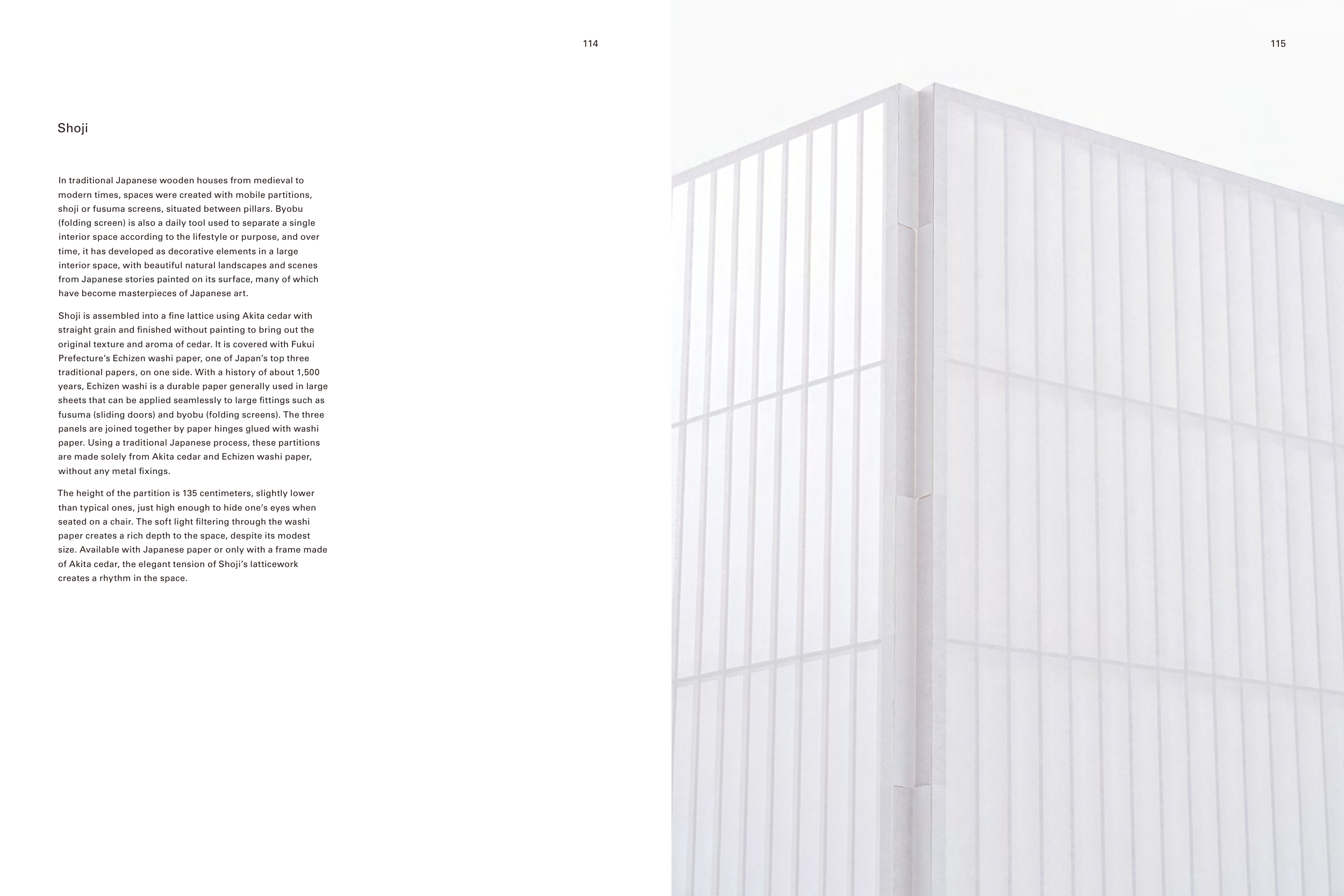
Shoji is assembled into a fine lattice using Akita cedar with
straight grain and finished without painting to bring out the
original texture and aroma of cedar. It is covered with Fukui
Prefecture’s Echizen washi paper, one of Japan’s top three
traditional papers, on one side. With a history of about 1,500
years, Echizen washi is a durable paper generally used in large
sheets that can be applied seamlessly to large fittings such as
fusuma (sliding doors) and byobu (folding screens). The three
panels are joined together by paper hinges glued with washi
paper. Using a traditional Japanese process, these partitions
are made solely from Akita cedar and Echizen washi paper,
without any metal fixings.
The height of the partition is 135 centimeters, slightly lower
than typical ones, just high enough to hide one’s eyes when
seated on a chair. The soft light filtering through the washi
paper creates a rich depth to the space, despite its modest
size. Available with Japanese paper or only with a frame made
of Akita cedar, the elegant tension of Shoji’s latticework
creates a rhythm in the space.
114
115