Oke
Richly endowed with a humid environment, the Yoshino
forests of Nara Prefecture are home to Yoshino cedars with
straight, dense grains. Traditionally used as building materials
for castles and temples, Yoshino cedar has been a part of
people’s lives for hundreds of years.
Oke (bucket) and taru (barrel), ranging from small ones to
draw and hold water to larger ones to brew sake and soy
sauce, have been deeply rooted in the Japanese culture until
today. The oke buckets are made by a craftsperson who makes
the materials and an okeyuishi who uses the materials to make
the buckets and barrels. After the characteristic of wood is
carefully identified and hand shaved to maximize its beauty,
the wood panels are handed over to the next process done by
okeyuishi, who then assembles them together to make the
side panels, then builds them up, wraps a taga (hoop) around
to tighten them. Inserting the bottom panel tightens the taga
and completes the process. Its sensibly designed structure
allows the tool to be repaired and used for a long time.
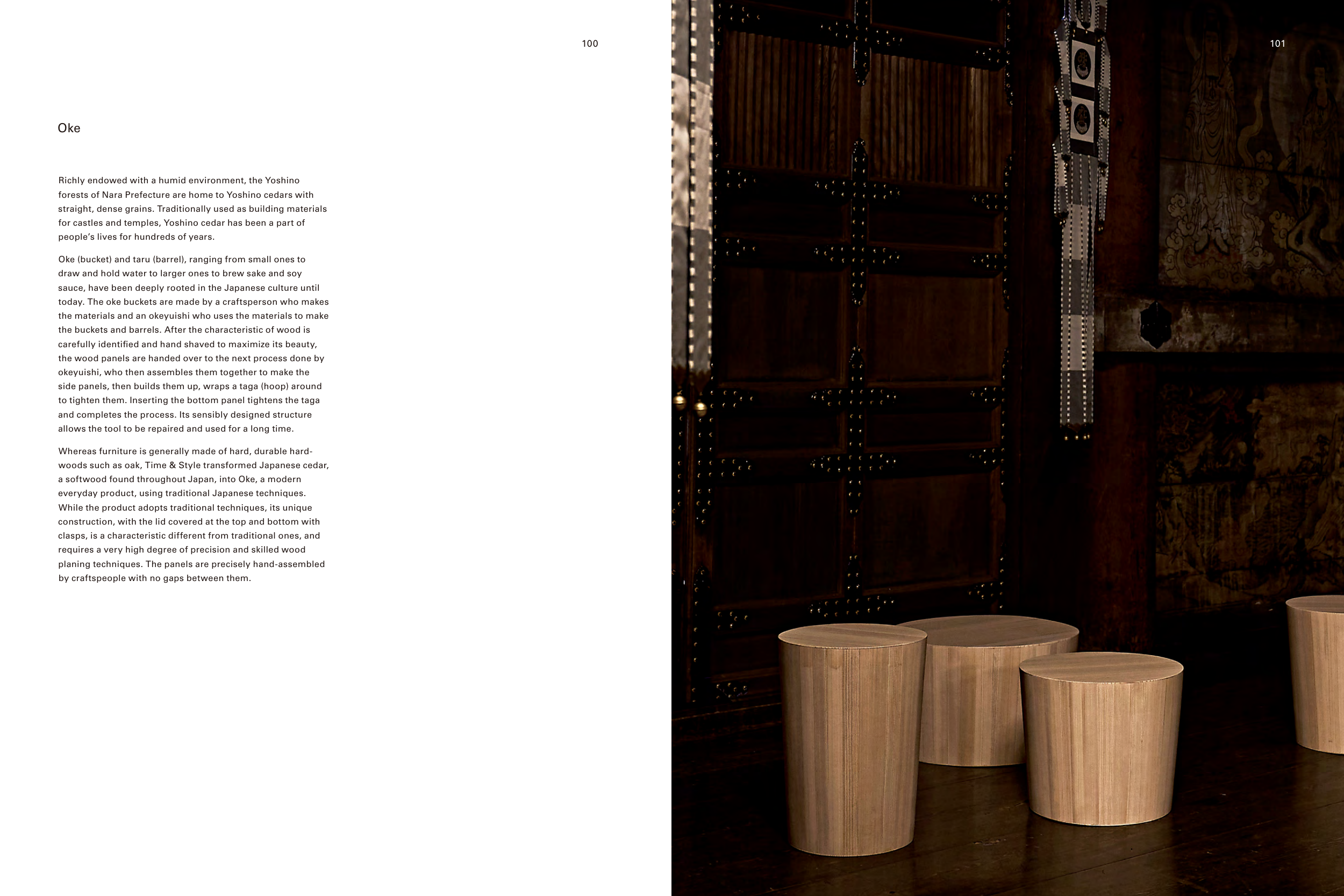
Whereas furniture is generally made of hard, durable hard-
woods such as oak, Time & Style transformed Japanese cedar,
a softwood found throughout Japan, into Oke, a modern
everyday product, using traditional Japanese techniques.
While the product adopts traditional techniques, its unique
construction, with the lid covered at the top and bottom with
clasps, is a characteristic different from traditional ones, and
requires a very high degree of precision and skilled wood
planing techniques. The panels are precisely hand-assembled
by craftspeople with no gaps between them.
100
101