Bronze casting sculpture
The beginning of the casting technique in Takaoka, Toyama
Prefecture, dates back to approximately 400 years ago. It
started with the production of agricultural tools such as hoes
and sickles. It later came to be used to make Buddhist statues
and fittings. Thus, the casting technique is still used to make
art objects and monuments today.
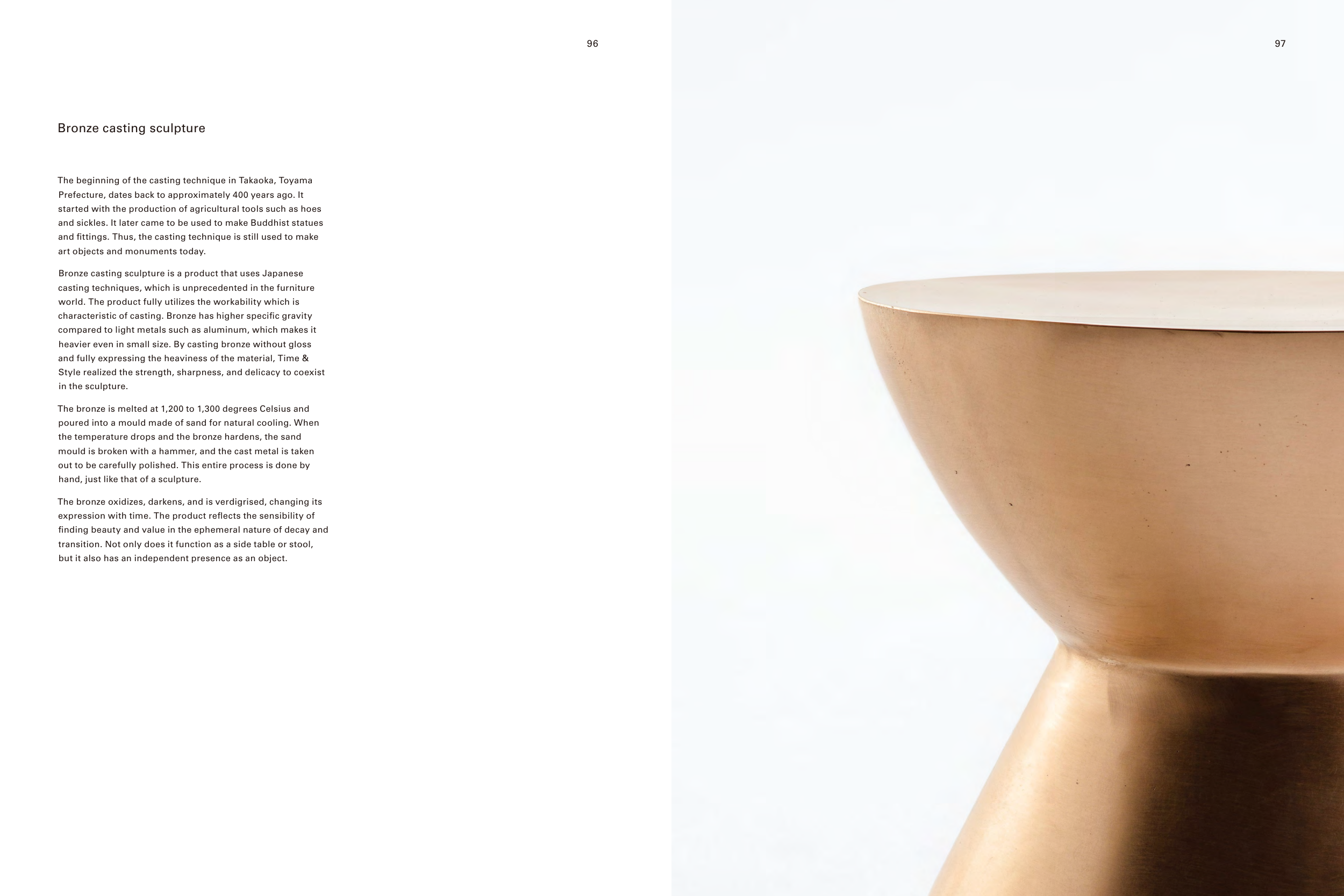
Bronze casting sculpture is a product that uses Japanese
casting techniques, which is unprecedented in the furniture
world. The product fully utilizes the workability which is
characteristic of casting. Bronze has higher specific gravity
compared to light metals such as aluminum, which makes it
heavier even in small size. By casting bronze without gloss
and fully expressing the heaviness of the material, Time &
Style realized the strength, sharpness, and delicacy to coexist
in the sculpture.
The bronze is melted at 1,200 to 1,300 degrees Celsius and
poured into a mould made of sand for natural cooling. When
the temperature drops and the bronze hardens, the sand
mould is broken with a hammer, and the cast metal is taken
out to be carefully polished. This entire process is done by
hand, just like that of a sculpture.
The bronze oxidizes, darkens, and is verdigrised, changing its
expression with time. The product reflects the sensibility of
finding beauty and value in the ephemeral nature of decay and
transition. Not only does it function as a side table or stool,
but it also has an independent presence as an object.
96
97