A chair in the forest
Jomon period, from 16,000 years ago to 3,000 years ago, was
a time in Japan when the people lived with very little influence
from China or the Asian continent. During this period, people
did not cultivate rice but instead lived on berries and nuts
from primeval forests of broad-leaved trees. Their diet also
involved hunting forest animals and fish from the sea and
rivers. Jomon people were what we would call ‘forest people’
today. Although rice cultivation was introduced to Japan and
rice became the staple diet, people have continued to have a
symbiotic relationship with the forest. Many necessities of
daily life such as houses, tableware, and utensils have been all
made from wood. Forest and trees have had a significant
impact on the indigenous religion of Shintoism. At Shinto
shrines, there always have been enormous trees that are
hundreds of years old, worshipped as sacred trees.
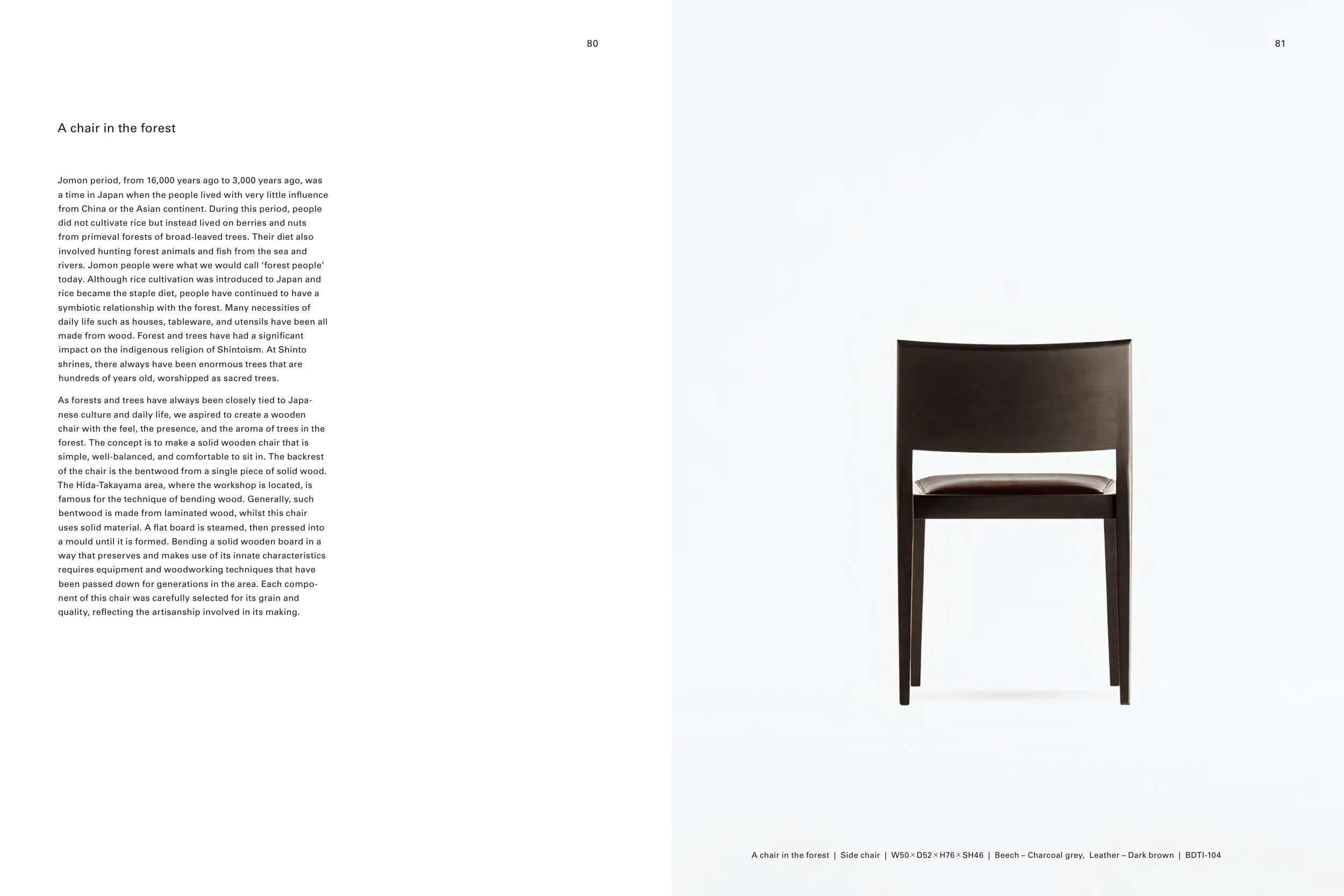
As forests and trees have always been closely tied to Japa-
nese culture and daily life, we aspired to create a wooden
chair with the feel, the presence, and the aroma of trees in the
forest. The concept is to make a solid wooden chair that is
simple, well-balanced, and comfortable to sit in. The backrest
of the chair is the bentwood from a single piece of solid wood.
The Hida-Takayama area, where the workshop is located, is
famous for the technique of bending wood. Generally, such
bentwood is made from laminated wood, whilst this chair
uses solid material. A flat board is steamed, then pressed into
a mould until it is formed. Bending a solid wooden board in a
way that preserves and makes use of its innate characteristics
requires equipment and woodworking techniques that have
been passed down for generations in the area. Each compo-
nent of this chair was carefully selected for its grain and
quality, reflecting the artisanship involved in its making.
A chair in the forest | Side chair | W50×D52×H76×SH46 | Beech – Charcoal grey, Leather – Dark brown | BDTI-104
80
81