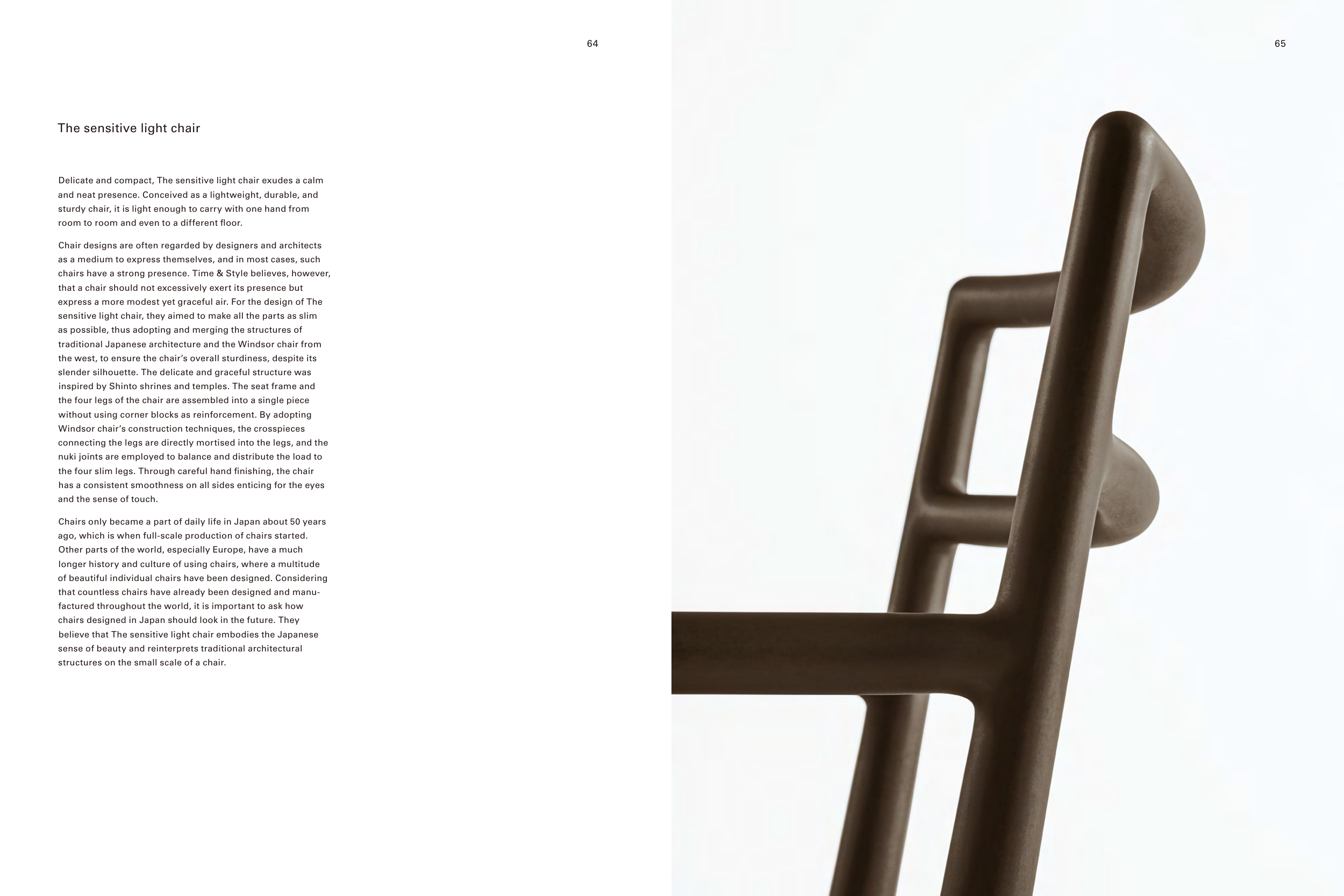
Delicate and compact, The sensitive light chair exudes a calm
and neat presence. Conceived as a lightweight, durable, and
sturdy chair, it is light enough to carry with one hand from
room to room and even to a different floor.
Chair designs are often regarded by designers and architects
as a medium to express themselves, and in most cases, such
chairs have a strong presence. Time & Style believes, however,
that a chair should not excessively exert its presence but
express a more modest yet graceful air. For the design of The
sensitive light chair, they aimed to make all the parts as slim
as possible, thus adopting and merging the structures of
traditional Japanese architecture and the Windsor chair from
the west, to ensure the chair’s overall sturdiness, despite its
slender silhouette. The delicate and graceful structure was
inspired by Shinto shrines and temples. The seat frame and
the four legs of the chair are assembled into a single piece
without using corner blocks as reinforcement. By adopting
Windsor chair’s construction techniques, the crosspieces
connecting the legs are directly mortised into the legs, and the
nuki joints are employed to balance and distribute the load to
the four slim legs. Through careful hand finishing, the chair
has a consistent smoothness on all sides enticing for the eyes
and the sense of touch.
Chairs only became a part of daily life in Japan about 50 years
ago, which is when full-scale production of chairs started.
Other parts of the world, especially Europe, have a much
longer history and culture of using chairs, where a multitude
of beautiful individual chairs have been designed. Considering
that countless chairs have already been designed and manu-
factured throughout the world, it is important to ask how
chairs designed in Japan should look in the future. They
believe that The sensitive light chair embodies the Japanese
sense of beauty and reinterprets traditional architectural
structures on the small scale of a chair.
The sensitive light chair
64
65