Sea of tranquility
The structure and design of this table are inspired by the torii
gates that stand at the entrance of shrines. The gates symbol-
ize the boundary between the ordinary world and the holy
precinct. Generally, torii gates have a simple yet beautiful
design that is durable to the strong winds, rains, and earth-
quakes that occur often in Japan. The materials are primarily
Japanese conifers, hinoki cypress, or cedar, whose logs are
used as columns. The larger ones have columns wider than
60–80 centimeters in diameter, with the age of the tree rang-
ing between 100–500 years old. The two thick columns are
horizontally tied with beams called kasagi and shimaki at the
top. Under the beams, a strengthening brace called the nuki
pierce connects the two columns.
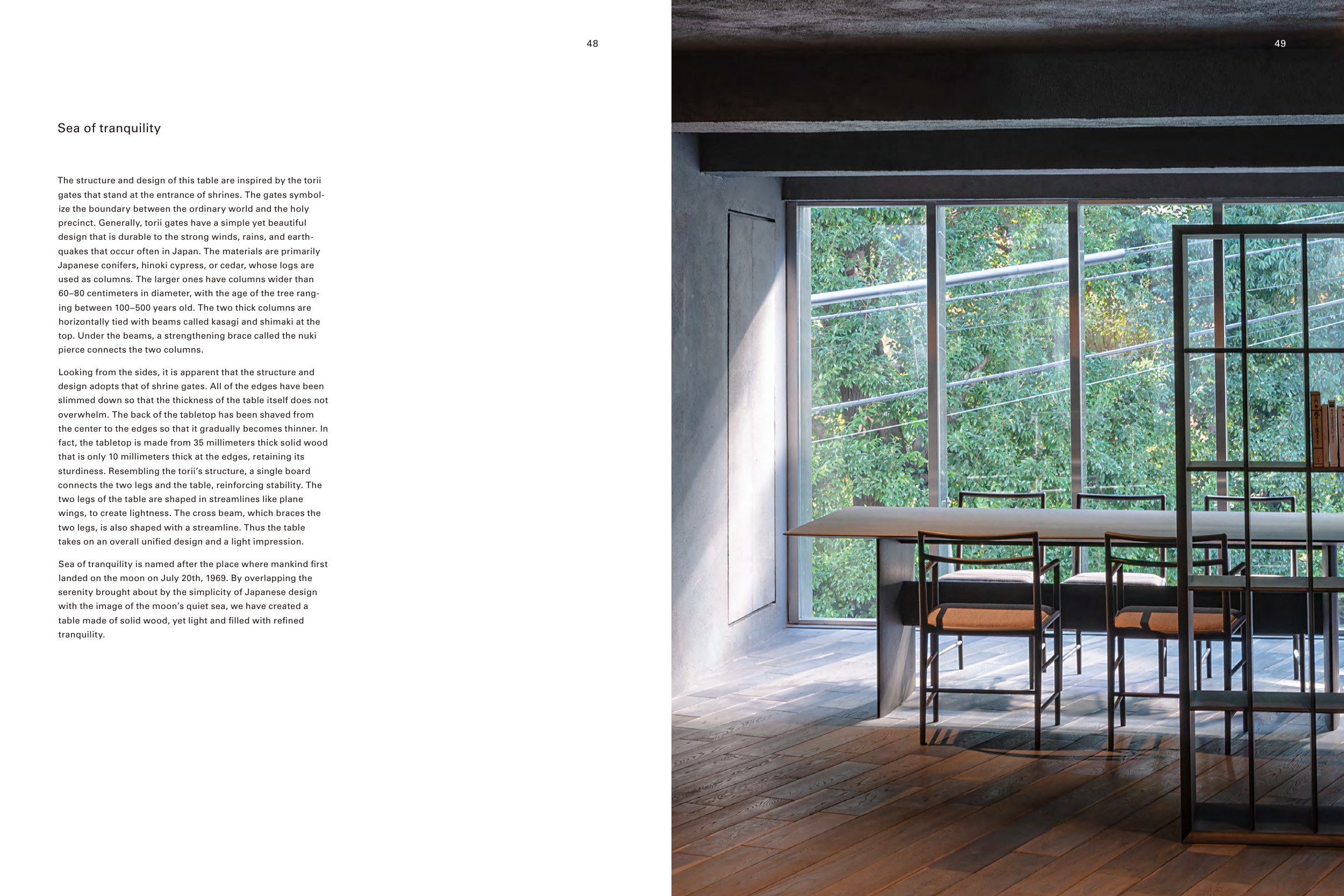
Looking from the sides, it is apparent that the structure and
design adopts that of shrine gates. All of the edges have been
slimmed down so that the thickness of the table itself does not
overwhelm. The back of the tabletop has been shaved from
the center to the edges so that it gradually becomes thinner. In
fact, the tabletop is made from 35 millimeters thick solid wood
that is only 10 millimeters thick at the edges, retaining its
sturdiness. Resembling the torii’s structure, a single board
connects the two legs and the table, reinforcing stability. The
two legs of the table are shaped in streamlines like plane
wings, to create lightness. The cross beam, which braces the
two legs, is also shaped with a streamline. Thus the table
takes on an overall unified design and a light impression.
Sea of tranquility is named after the place where mankind first
landed on the moon on July 20th, 1969. By overlapping the
serenity brought about by the simplicity of Japanese design
with the image of the moon’s quiet sea, we have created a
table made of solid wood, yet light and filled with refined
tranquility.
48
49
49