Bombori
Japanese traditional lights with a paper shade had been used
in Japan until modern electric lights became common. Initially,
light fittings were only available for the wealthy, but by around
four hundreds years ago, they had become widespread
amongst the ordinary as well. That traditional lamp is made of
paper stretched across a wooden or metal frame, covering the
light source in an enclosure called hibukuro (a bag of fire). The
hibukuro was to prevent the wind from blowing out the fire so
that it could also be used outdoors.
Today, woodworking artisans continue to make it, although
they are rarely used in ordinary households, but in a ryokan
(traditional Japanese inn) and ryotei (traditional Japanese
restaurants) where that traditional lamp with light bulbs are
used. Arriving at the entrance of a Japanese ryokan, guests
would find the traditional floor lamp, welcoming the guests
with their soft and faint reddish light shimmering through the
delicate paper. The feeling of nostalgia is evoked by the
traditional lamp placed beside pillows, in the corner of rooms,
or pendant lights from the ceiling in a traditional Japanese
room.
The history of Japanese woodworking dates back to around a
thousand years ago, which is when an aristocratic culture
flourished. The tradition of exquisite woodworking has sur-
vived until the present day, although it is shrinking. A cabinet-
maker is an artisan who has the precise woodworking skills to
create furniture, wooden fittings for a house, and daily house-
hold utensils. They join pieces of wood together to achieve
both beauty and strength. Without the fine skills, Japanese
woodworking culture could not have developed.
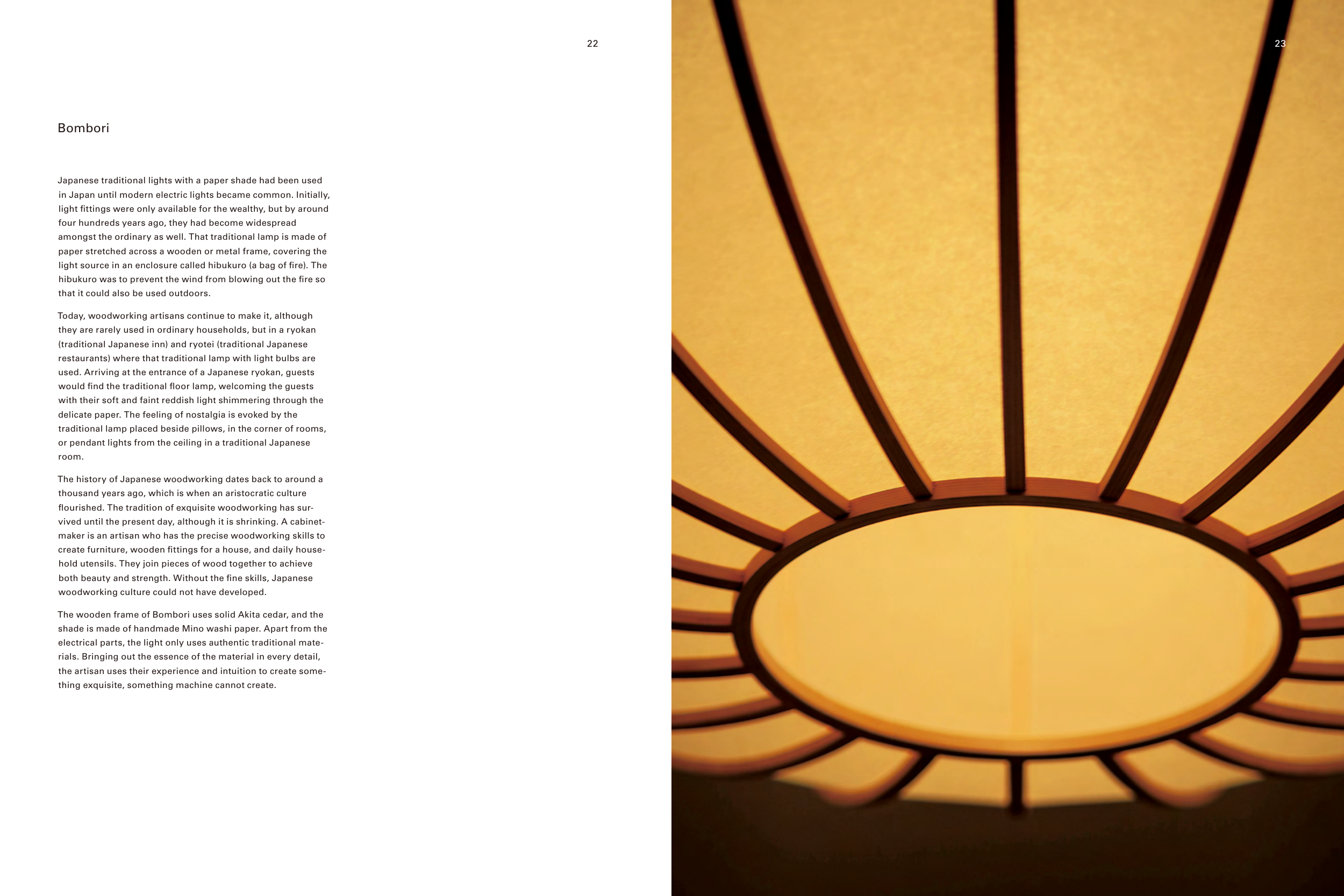
The wooden frame of Bombori uses solid Akita cedar, and the
shade is made of handmade Mino washi paper. Apart from the
electrical parts, the light only uses authentic traditional mate-
rials. Bringing out the essence of the material in every detail,
the artisan uses their experience and intuition to create some-
thing exquisite, something machine cannot create.
22
23