124
125
decisions at every stage of manufacture
ensuring superior products in a way that
only thoughtful human intervention can.
A famously challenging material with a
wide range of natural variations and life-
long movement, solid wood is unforgiving,
yet its rewards are many. What can compare
to the silky touch, the entirely unique
surface characteristics that nod to the
life of the tree, the subtle shimmer of
an oil finish, the nutty fragrance released
when sanding, or the relationship that
forms between object and memory as history
begins to leave its mark? The expressive
physicality, workability, and enduring
strength of wood have made it a favourite
for furniture making throughout time, from
the bentwood chairs of Michael Thonet,
to the architectural furniture of Frank
Lloyd Wright, to the soulful creations
of George Nakashima that combine refined
elements with wild sections of trunk
replete with knots and cracks secured with
butterfly joints. Each author works with
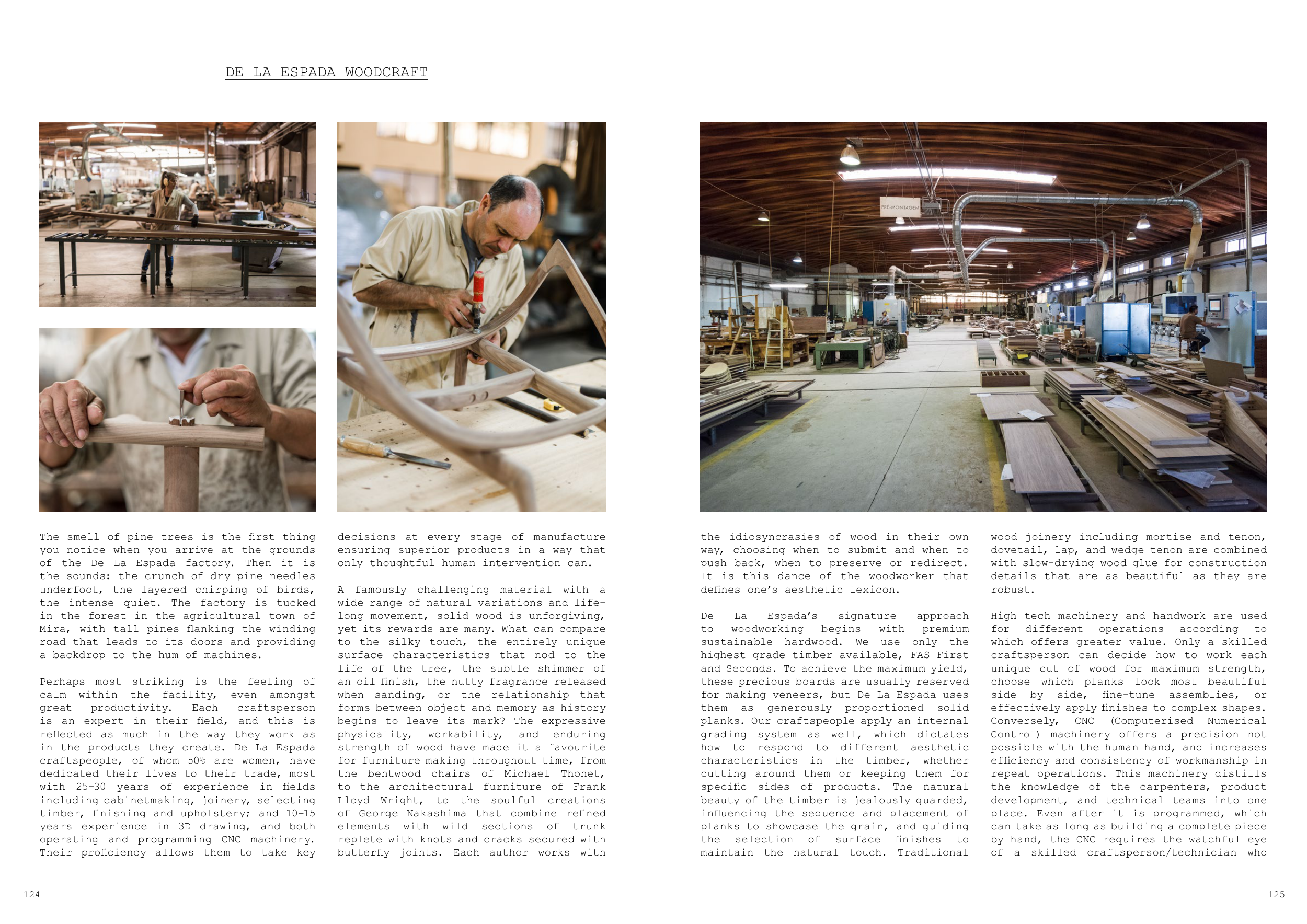
The smell of pine trees is the first thing
you notice when you arrive at the grounds
of the De La Espada factory. Then it is
the sounds: the crunch of dry pine needles
underfoot, the layered chirping of birds,
the intense quiet. The factory is tucked
in the forest in the agricultural town of
Mira, with tall pines flanking the winding
road that leads to its doors and providing
a backdrop to the hum of machines.
Perhaps most striking is the feeling of
calm within the facility, even amongst
great
productivity.
Each
craftsperson
is an expert in their field, and this is
reflected as much in the way they work as
in the products they create. De La Espada
craftspeople, of whom 50% are women, have
dedicated their lives to their trade, most
with 25-30 years of experience in fields
including cabinetmaking, joinery, selecting
timber, finishing and upholstery; and 10-15
years experience in 3D drawing, and both
operating and programming CNC machinery.
Their proficiency allows them to take key
DE LA ESPADA WOODCRAFT
the idiosyncrasies of wood in their own
way, choosing when to submit and when to
push back, when to preserve or redirect.
It is this dance of the woodworker that
defines one’s aesthetic lexicon.
De
La
Espada’s
signature
approach
to
woodworking
begins
with
premium
sustainable hardwood. We use only the
highest grade timber available, FAS First
and Seconds. To achieve the maximum yield,
these precious boards are usually reserved
for making veneers, but De La Espada uses
them as generously proportioned solid
planks. Our craftspeople apply an internal
grading system as well, which dictates
how to respond to different aesthetic
characteristics in the timber, whether
cutting around them or keeping them for
specific sides of products. The natural
beauty of the timber is jealously guarded,
influencing the sequence and placement of
planks to showcase the grain, and guiding
the selection of surface finishes to
maintain the natural touch. Traditional
wood joinery including mortise and tenon,
dovetail, lap, and wedge tenon are combined
with slow-drying wood glue for construction
details that are as beautiful as they are
robust.
High tech machinery and handwork are used
for
different
operations
according
to
which offers greater value. Only a skilled
craftsperson can decide how to work each
unique cut of wood for maximum strength,
choose which planks look most beautiful
side by side, fine-tune assemblies, or
effectively apply finishes to complex shapes.
Conversely, CNC (Computerised Numerical
Control) machinery offers a precision not
possible with the human hand, and increases
efficiency and consistency of workmanship in
repeat operations. This machinery distills
the knowledge of the carpenters, product
development, and technical teams into one
place. Even after it is programmed, which
can take as long as building a complete piece
by hand, the CNC requires the watchful eye
of a skilled craftsperson/technician who