58
59
“Architecture is about life. It’s about all the possibilities of
life. And everything about life could be connected to architecture.”
three dimensions, [but] in four dimensions.
And it’s very important to understand that
you are never static in the space…when you
design a project you have to understand
that you are going to pass from one space
to another so it means that you’re not going
to only design each one of the spaces, but
also the relationship between the spaces.
And movement will make you perceive the
spaces in different ways.”
Manuel has an ongoing relationship with
hotelier João Rodrigues, which has given
birth to a number of holiday homes that
interact with the landscape, reflect the
local vernacular, and provide unique,
sensual experiences. “I have a very
close relationship with João. It is very
important to work with a client, this
dialogue to establish with a client, and
with them — it’s not only João but also
his wife [Andreia] — we have these kind
of dialogues where we really work on the
problem until it is very clear what is
necessary to do, and then we do. It is
also because we design not for, let’s say,
a permanent use, it’s always for this
touristic use. There is a kind of freedom
in a way in design that it is also nice to
have an experience.”
De
La
Espada
had
the
pleasure
of
photographing
our
furniture
at
two
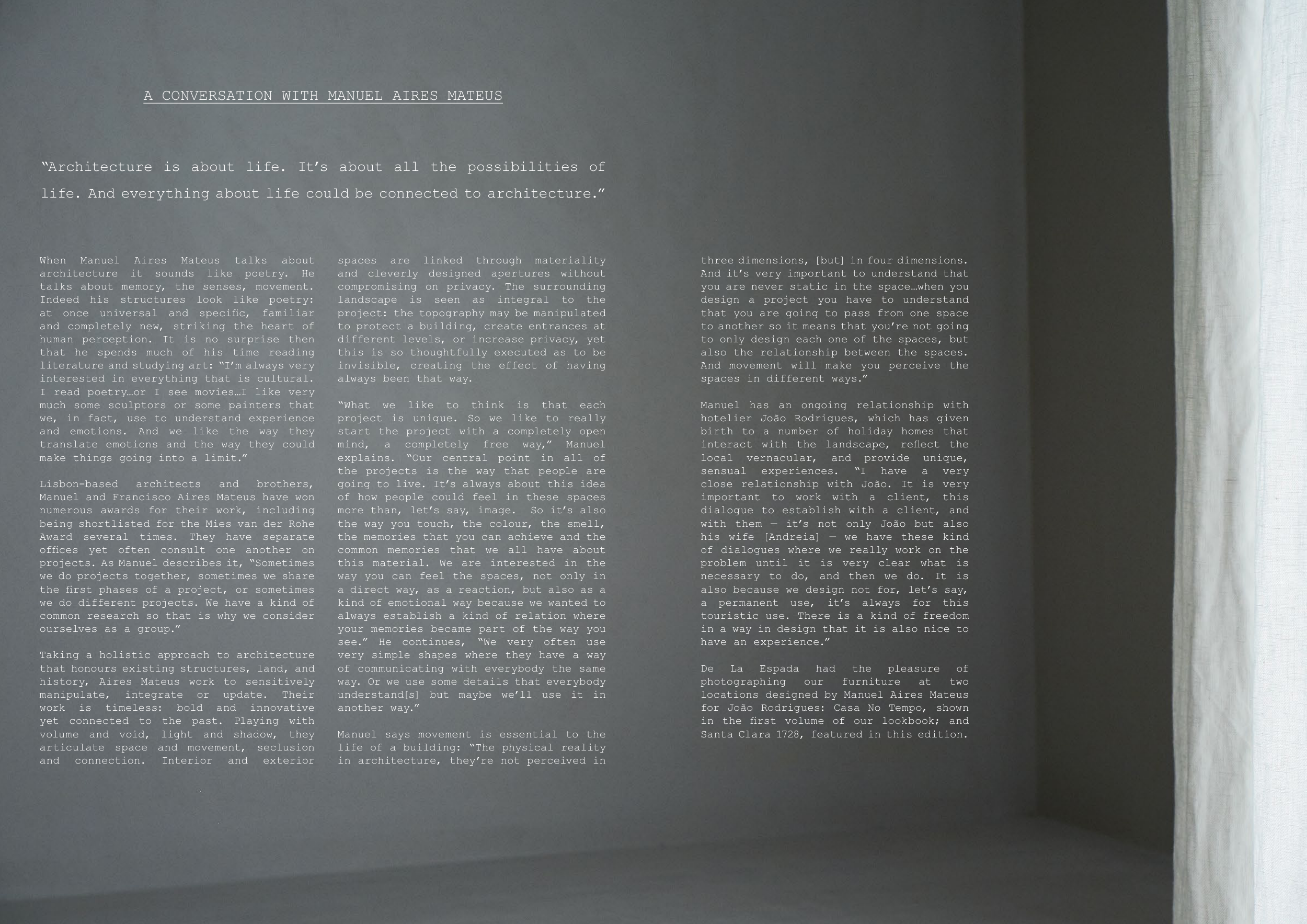
locations designed by Manuel Aires Mateus
for João Rodrigues: Casa No Tempo, shown
in the first volume of our lookbook; and
Santa Clara 1728, featured in this edition.
spaces are linked through materiality
and cleverly designed apertures without
compromising on privacy. The surrounding
landscape is seen as integral to the
project: the topography may be manipulated
to protect a building, create entrances at
different levels, or increase privacy, yet
this is so thoughtfully executed as to be
invisible, creating the effect of having
always been that way.
“What we like to think is that each
project is unique. So we like to really
start the project with a completely open
mind, a completely free way,” Manuel
explains. “Our central point in all of
the projects is the way that people are
going to live. It’s always about this idea
of how people could feel in these spaces
more than, let’s say, image. So it’s also
the way you touch, the colour, the smell,
the memories that you can achieve and the
common memories that we all have about
this material. We are interested in the
way you can feel the spaces, not only in
a direct way, as a reaction, but also as a
kind of emotional way because we wanted to
always establish a kind of relation where
your memories became part of the way you
see.” He continues, “We very often use
very simple shapes where they have a way
of communicating with everybody the same
way. Or we use some details that everybody
understand[s] but maybe we’ll use it in
another way.”
Manuel says movement is essential to the
life of a building: “The physical reality
in architecture, they’re not perceived in
When Manuel Aires Mateus talks about
architecture it sounds like poetry. He
talks about memory, the senses, movement.
Indeed his structures look like poetry:
at once universal and specific, familiar
and completely new, striking the heart of
human perception. It is no surprise then
that he spends much of his time reading
literature and studying art: “I’m always very
interested in everything that is cultural.
I read poetry…or I see movies…I like very
much some sculptors or some painters that
we, in fact, use to understand experience
and emotions. And we like the way they
translate emotions and the way they could
make things going into a limit.”
Lisbon-based
architects
and
brothers,
Manuel and Francisco Aires Mateus have won
numerous awards for their work, including
being shortlisted for the Mies van der Rohe
Award several times. They have separate
offices yet often consult one another on
projects. As Manuel describes it, “Sometimes
we do projects together, sometimes we share
the first phases of a project, or sometimes
we do different projects. We have a kind of
common research so that is why we consider
ourselves as a group.”
Taking a holistic approach to architecture
that honours existing structures, land, and
history, Aires Mateus work to sensitively
manipulate, integrate or update. Their
work is timeless: bold and innovative
yet connected to the past. Playing with
volume and void, light and shadow, they
articulate space and movement, seclusion
and connection. Interior and exterior
A CONVERSATION WITH MANUEL AIRES MATEUS