134
135
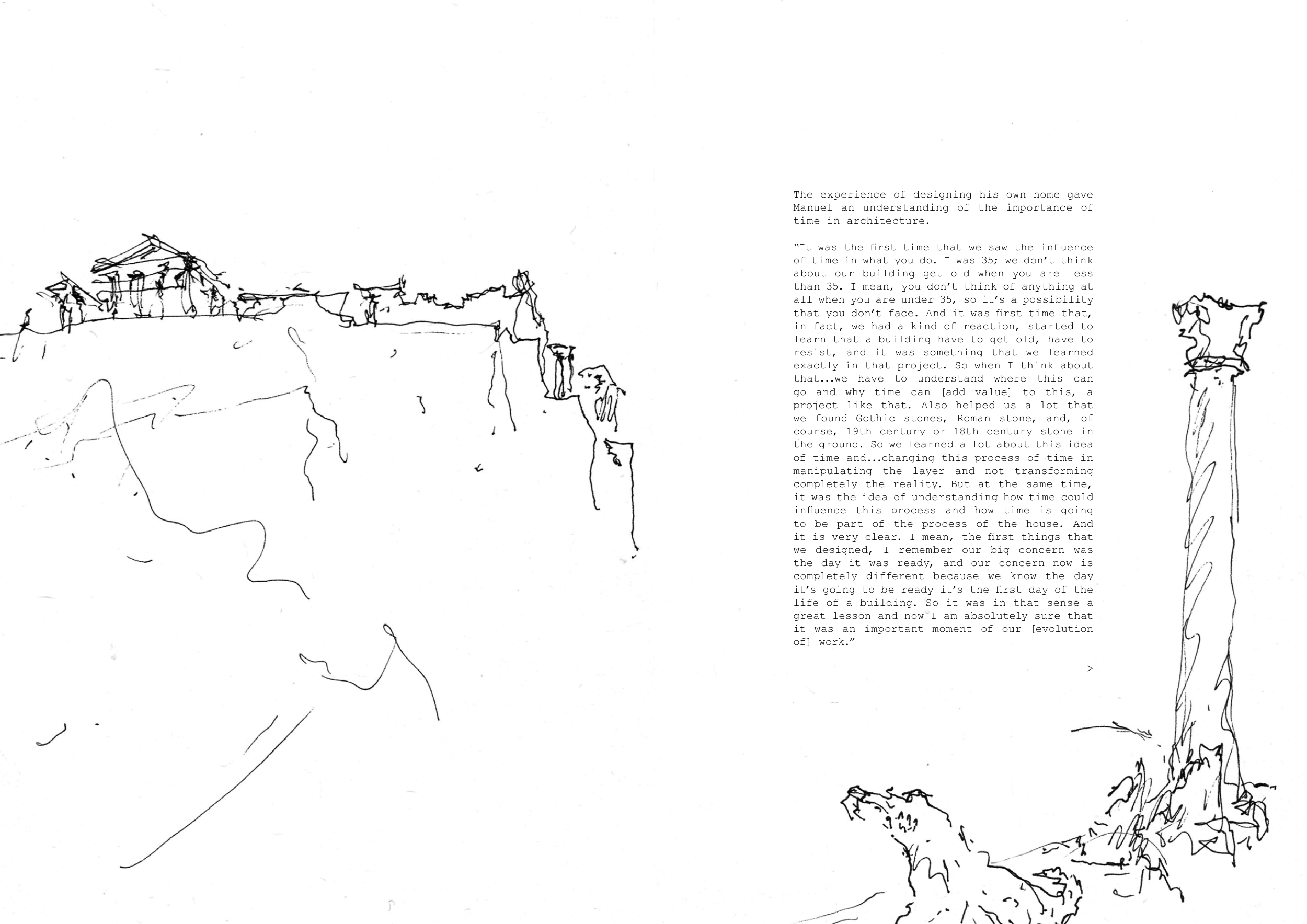
The experience of designing his own home gave
Manuel an understanding of the importance of
time in architecture.
“It was the first time that we saw the influence
of time in what you do. I was 35; we don’t think
about our building get old when you are less
than 35. I mean, you don’t think of anything at
all when you are under 35, so it’s a possibility
that you don’t face. And it was first time that,
in fact, we had a kind of reaction, started to
learn that a building have to get old, have to
resist, and it was something that we learned
exactly in that project. So when I think about
that...we have to understand where this can
go and why time can [add value] to this, a
project like that. Also helped us a lot that
we found Gothic stones, Roman stone, and, of
course, 19th century or 18th century stone in
the ground. So we learned a lot about this idea
of time and...changing this process of time in
manipulating the layer and not transforming
completely the reality. But at the same time,
it was the idea of understanding how time could
influence this process and how time is going
to be part of the process of the house. And
it is very clear. I mean, the first things that
we designed, I remember our big concern was
the day it was ready, and our concern now is
completely different because we know the day
it’s going to be ready it’s the first day of the
life of a building. So it was in that sense a
great lesson and now I am absolutely sure that
it was an important moment of our [evolution
of] work.”
>