64
“I like the mark of age on things. Things
you allow to get a bit worn are much easier
to live with and I think they gain some
value somehow, just by their being around a
long time. Materials play a very important
role in this. A material like solid wood
just gets more beautiful with age. Wood,
when it gets scratched and discoloured, I
think it gets better and better.”
Perhaps it was growing up in the English
seaside town of Portsmouth, with its mass
concrete structures and naval warships
that gave Matthew Hilton an appreciation
for materials. Raised on a visual diet of
strong, resilient structures with texture
and history ingrained in their every
turn and crevice, Hilton developed a deep
connection to these qualities. He also
became fascinated by the encompassing sea,
its paradox of powerful weight and delicate
weightlessness.
One of Britain’s most celebrated industrial
designers, Matthew Hilton is a Royal Designer
for Industry, an honour shared by only 200
designers, among them Lucienne Day, Jonathan
Ive, Richard Rogers, and Vivienne Westwood.
He was part of the emergent British design
scene in the 1980s, alongside the likes
of Jasper Morrison, Terence Woodgate, and
Konstantin Grcic, who collectively put the
UK on the international design map. It is
illustrious company; Hilton is among the
greats who define the visual language of
our world. Yet, in spite of this, Matthew
himself is quiet and self-deprecating, with
a single-minded focus on his work. Design
is a key form of self-expression for someone
who admits, “I don’t communicate very well
with words.”
Matthew Hilton comes from a visual family:
his grandfather was a fine artist working
with paints, and his mother was an antique
specialist. Engaged in the arts from an
early age, Hilton has a long-standing
passion for photography, first capturing the
world around him as an adolescent with a
fixed-lens Box Brownie, and since building
up a collection of cameras that are “solid,
well-made, easy to control, good ergonomics,
and wear well.” He uses photography to
develop a visual sketchbook that informs
his furniture design.
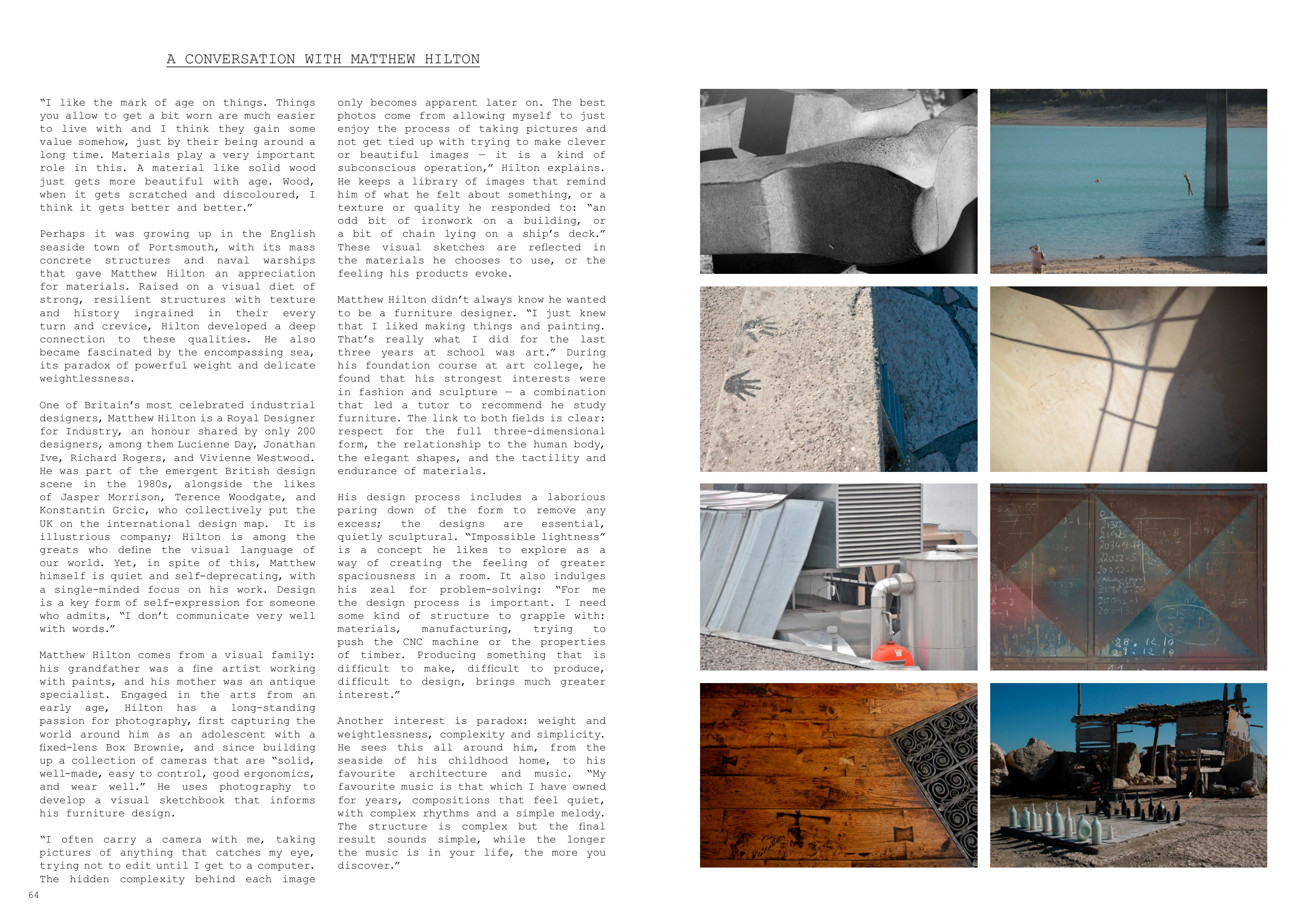
“I often carry a camera with me, taking
pictures of anything that catches my eye,
trying not to edit until I get to a computer.
The hidden complexity behind each image
only becomes apparent later on. The best
photos come from allowing myself to just
enjoy the process of taking pictures and
not get tied up with trying to make clever
or beautiful images — it is a kind of
subconscious operation,” Hilton explains.
He keeps a library of images that remind
him of what he felt about something, or a
texture or quality he responded to: “an
odd bit of ironwork on a building, or
a bit of chain lying on a ship’s deck.”
These visual sketches are reflected in
the materials he chooses to use, or the
feeling his products evoke.
Matthew Hilton didn’t always know he wanted
to be a furniture designer. “I just knew
that I liked making things and painting.
That’s really what I did for the last
three years at school was art.” During
his foundation course at art college, he
found that his strongest interests were
in fashion and sculpture — a combination
that led a tutor to recommend he study
furniture. The link to both fields is clear:
respect for the full three-dimensional
form, the relationship to the human body,
the elegant shapes, and the tactility and
endurance of materials.
His design process includes a laborious
paring down of the form to remove any
excess;
the
designs
are
essential,
quietly sculptural. “Impossible lightness”
is a concept he likes to explore as a
way of creating the feeling of greater
spaciousness in a room. It also indulges
his zeal for problem-solving: “For me
the design process is important. I need
some kind of structure to grapple with:
materials,
manufacturing,
trying
to
push the CNC machine or the properties
of timber. Producing something that is
difficult to make, difficult to produce,
difficult to design, brings much greater
interest.”
Another interest is paradox: weight and
weightlessness, complexity and simplicity.
He sees this all around him, from the
seaside of his childhood home, to his
favourite architecture and music. “My
favourite music is that which I have owned
for years, compositions that feel quiet,
with complex rhythms and a simple melody.
The structure is complex but the final
result sounds simple, while the longer
the music is in your life, the more you
discover.”
A CONVERSATION WITH MATTHEW HILTON