91
The approach may be carefully calculated,
but the result is one that feels absolutely
organic, as if the building and landscape
have always existed in that way. “In the
end, I think good architecture has to move
us and stir emotions.”
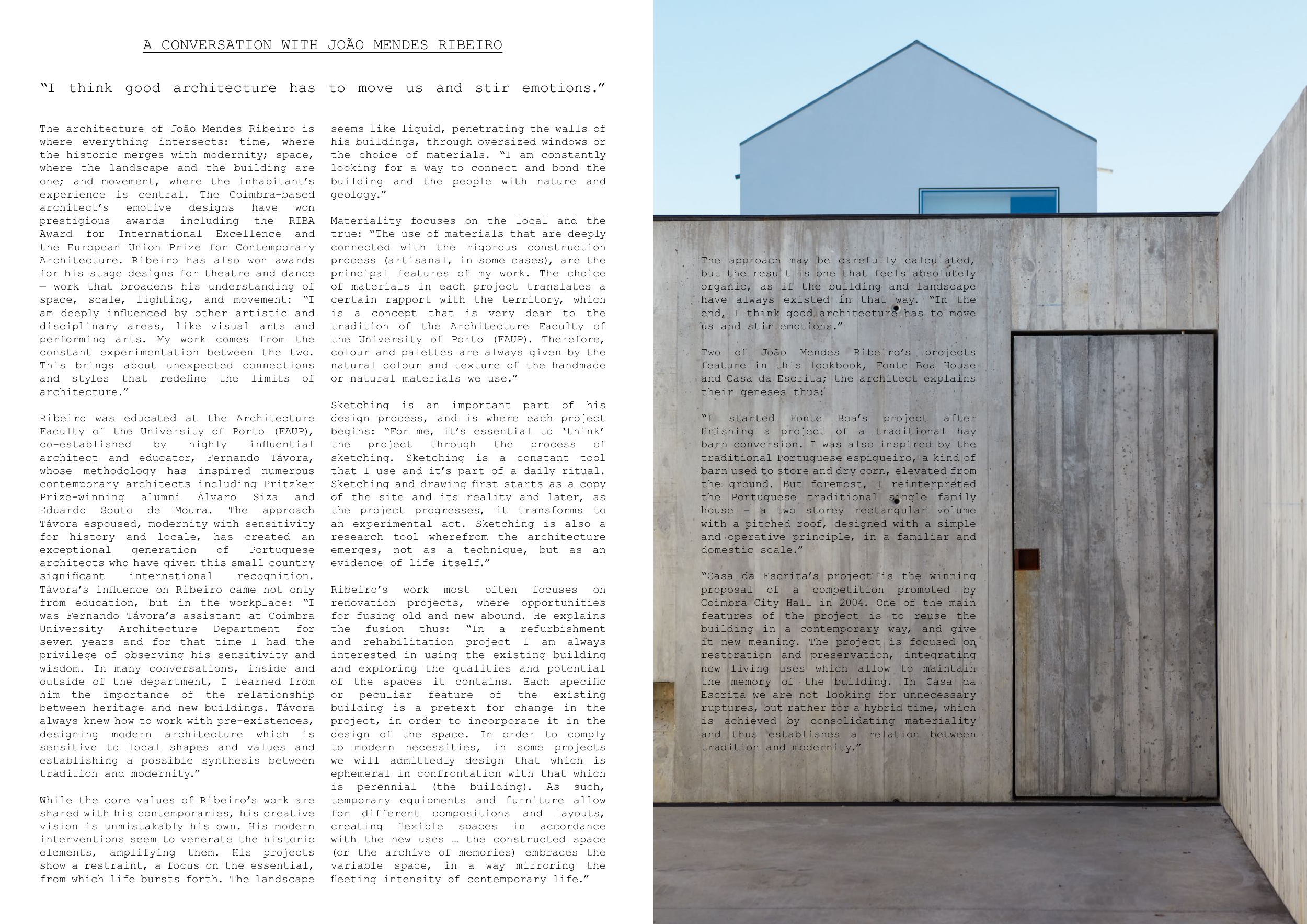
Two of João Mendes Ribeiro’s projects
feature in this lookbook, Fonte Boa House
and Casa da Escrita; the architect explains
their geneses thus:
“I started Fonte Boa’s project after
finishing a project of a traditional hay
barn conversion. I was also inspired by the
traditional Portuguese espigueiro, a kind of
barn used to store and dry corn, elevated from
the ground. But foremost, I reinterpreted
the Portuguese traditional single family
house – a two storey rectangular volume
with a pitched roof, designed with a simple
and operative principle, in a familiar and
domestic scale.”
“Casa da Escrita’s project is the winning
proposal of a competition promoted by
Coimbra City Hall in 2004. One of the main
features of the project is to reuse the
building in a contemporary way, and give
it new meaning. The project is focused on
restoration and preservation, integrating
new living uses which allow to maintain
the memory of the building. In Casa da
Escrita we are not looking for unnecessary
ruptures, but rather for a hybrid time, which
is achieved by consolidating materiality
and thus establishes a relation between
tradition and modernity.”
“I think good architecture has to move us and stir emotions.”
The architecture of João Mendes Ribeiro is
where everything intersects: time, where
the historic merges with modernity; space,
where the landscape and the building are
one; and movement, where the inhabitant’s
experience is central. The Coimbra-based
architect’s
emotive
designs
have
won
prestigious awards including the RIBA
Award for International Excellence and
the European Union Prize for Contemporary
Architecture. Ribeiro has also won awards
for his stage designs for theatre and dance
— work that broadens his understanding of
space, scale, lighting, and movement: “I
am deeply influenced by other artistic and
disciplinary areas, like visual arts and
performing arts. My work comes from the
constant experimentation between the two.
This brings about unexpected connections
and styles that redefine the limits of
architecture.”
Ribeiro was educated at the Architecture
Faculty of the University of Porto (FAUP),
co-established
by
highly
influential
architect and educator, Fernando Távora,
whose methodology has inspired numerous
contemporary architects including Pritzker
Prize-winning
alumni
Álvaro
Siza
and
Eduardo Souto de Moura. The approach
Távora espoused, modernity with sensitivity
for history and locale, has created an
exceptional
generation
of
Portuguese
architects who have given this small country
significant
international
recognition.
Távora’s influence on Ribeiro came not only
from education, but in the workplace: “I
was Fernando Távora’s assistant at Coimbra
University
Architecture
Department
for
seven years and for that time I had the
privilege of observing his sensitivity and
wisdom. In many conversations, inside and
outside of the department, I learned from
him the importance of the relationship
between heritage and new buildings. Távora
always knew how to work with pre-existences,
designing modern architecture which is
sensitive to local shapes and values and
establishing a possible synthesis between
tradition and modernity.”
While the core values of Ribeiro’s work are
shared with his contemporaries, his creative
vision is unmistakably his own. His modern
interventions seem to venerate the historic
elements, amplifying them. His projects
show a restraint, a focus on the essential,
from which life bursts forth. The landscape
seems like liquid, penetrating the walls of
his buildings, through oversized windows or
the choice of materials. “I am constantly
looking for a way to connect and bond the
building and the people with nature and
geology.”
Materiality focuses on the local and the
true: “The use of materials that are deeply
connected with the rigorous construction
process (artisanal, in some cases), are the
principal features of my work. The choice
of materials in each project translates a
certain rapport with the territory, which
is a concept that is very dear to the
tradition of the Architecture Faculty of
the University of Porto (FAUP). Therefore,
colour and palettes are always given by the
natural colour and texture of the handmade
or natural materials we use.”
Sketching is an important part of his
design process, and is where each project
begins: “For me, it’s essential to ‘think’
the
project
through
the
process
of
sketching. Sketching is a constant tool
that I use and it’s part of a daily ritual.
Sketching and drawing first starts as a copy
of the site and its reality and later, as
the project progresses, it transforms to
an experimental act. Sketching is also a
research tool wherefrom the architecture
emerges, not as a technique, but as an
evidence of life itself.”
Ribeiro’s work most often focuses on
renovation projects, where opportunities
for fusing old and new abound. He explains
the fusion thus: “In a refurbishment
and rehabilitation project I am always
interested in using the existing building
and exploring the qualities and potential
of the spaces it contains. Each specific
or
peculiar
feature
of
the
existing
building is a pretext for change in the
project, in order to incorporate it in the
design of the space. In order to comply
to modern necessities, in some projects
we will admittedly design that which is
ephemeral in confrontation with that which
is perennial (the building). As such,
temporary equipments and furniture allow
for different compositions and layouts,
creating flexible spaces in accordance
with the new uses … the constructed space
(or the archive of memories) embraces the
variable space, in a way mirroring the
fleeting intensity of contemporary life.”
A CONVERSATION WITH JOÃO MENDES RIBEIRO