C 07 77
cartography that bombards visitors, but also
captures their attention.
IC: Many people didn’t understand it at
first. They thought we were criticizing the
situation, when it was quite the opposite.
The selection of photographs, aside from
documenting a harsh reality, is filled with
optimisim and highly suggestive visions. The
images call to action, they are innovative
proposals that have managed to discover
revealing actions in these architectures.
CQ: At first we feared that handling so
many works and projects could produce a
complete cacophony with no sense of unity.
The challenge was to convey a sense of unity.
IC: Yes, this was the most complicated
thing. I remember that the first thing we did
was to visit the pavilion in order to establish
a dialogue with the existing and a balance
between the amount of architecture we had
to produce and what was already there. What
people understand after visiting the pavilion
is that it is a very good building, a space
that works as it should, and also, that the
exhibition is carried out with very few means.
CQ: It was surprising to hear someone
comment that this exhibition had managed
to give the building, or the perception of the
building, a dignity that in other exhibitions
had remained hidden. In our view it was the
best container possible for this exhibition.
IC: It is fantastic because it is very ver-
satile. I remember when we decided that we
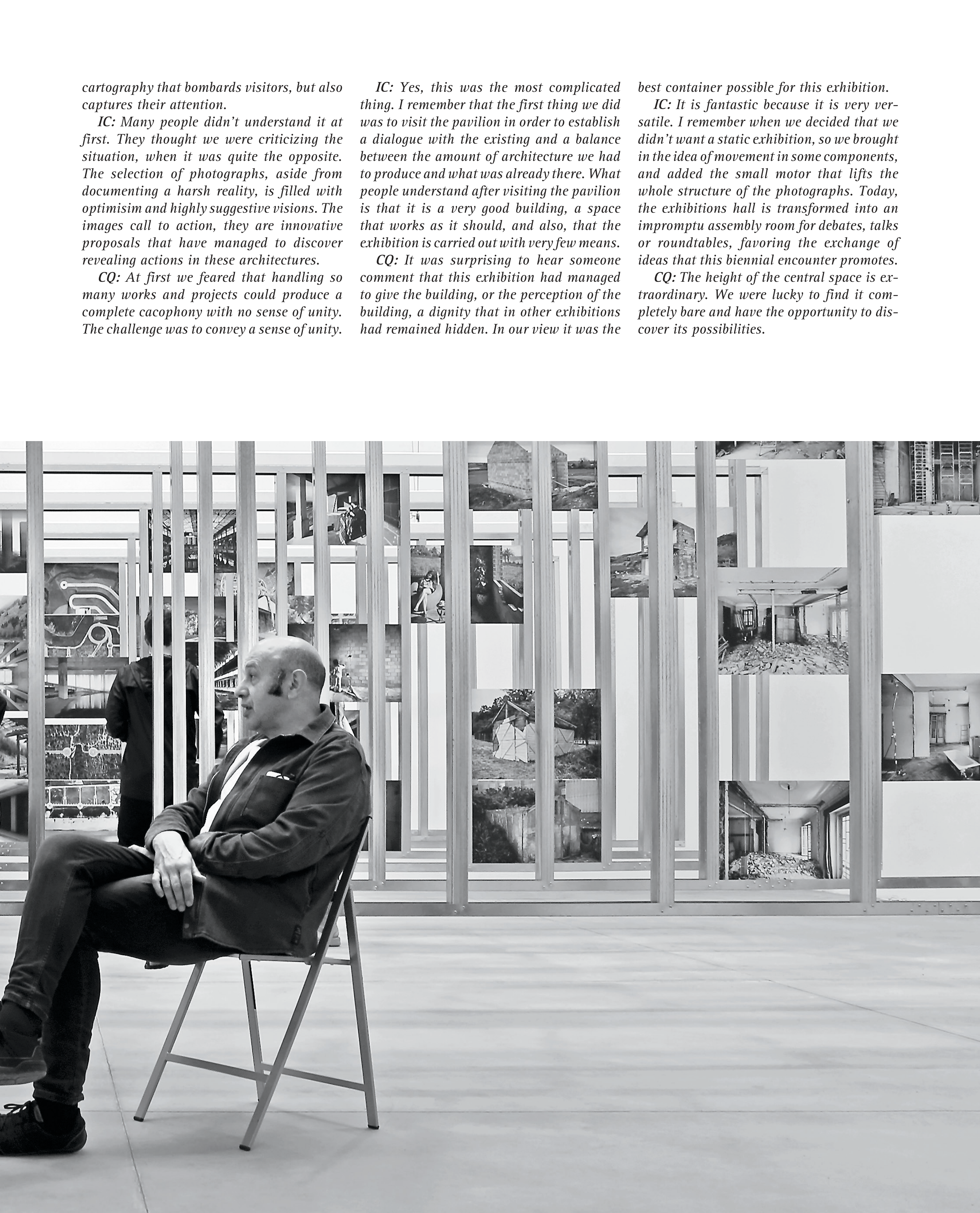
didn’t want a static exhibition, so we brought
in the idea of movement in some components,
and added the small motor that lifts the
whole structure of the photographs. Today,
the exhibitions hall is transformed into an
impromptu assembly room for debates, talks
or roundtables, favoring the exchange of
ideas that this biennial encounter promotes.
CQ: The height of the central space is ex-
traordinary. We were lucky to find it com-
pletely bare and have the opportunity to dis-
cover its possibilities.