C 07 75
The Spanish Pavilion, curated by Iñaqui Car-
nicero (Madrid, 1973) and Carlos Quintáns
(Muxía, 1962), has won the Golden Lion
to the Best National Pavilion at the 15th
International Architecture Exhibition of La
Biennale di Venezia. Its title, ‘Unfinished,’
and its central theme, architecture after the
crisis, seemed to announce another critical,
if not masochistic, analysis of Spanish ar-
chitecture today, but fortunantely it hasn’t
been so. On a shoestring budget Carnicero
and Quintáns have managed to highlight the
general theme of the Biennale directed by
the latest Pritzker Prize laureate Alejandro
Aravena – with his emphasis on modest
projects, his defense of the social role of
architects, and an inevitable focus on Latin
America –, but most importantly, they have
managed to spread a positive message about
Spain, and make it get through: the idea that
beyond the critique of excess, architects have
adapted to the at first glance unrewarding
context of small refurbishments, adapta-
tions, or grafts, without giving up the quality
that once seemed to be exclusive to large
public buildings.
Optimism has in this way made its way
into the Spanish exhibition, a sober and
attractive installation featuring fifty works
carried out with a tight budget and an evolu-
tionary purpose, grouped into nine catego-
ries that take stock of the recent architec-
tural scene in our country. With the pavilion
as backdrop, and still showing undisguised
joy after winning the golden statuette, Car-
nicero and Quintáns talk about the purpose
of their exhibition, and about the challenges
they had to face to convey an at once critical
and hopeful message without falling back
on the clichés associated with the crisis.
Carlos Quintáns (CQ): The truth is that com-
ing to Venice is a beautiful adventure. Of
the three biennials Spain takes part in (the
Spanish one, the Ibero American one and the
Venice Biennale), I think this one is the most
intense and stimulating, because it allows to
convey the message beyond local frontiers.
In this particular edition we were fortunate
to have a general coordinator for the three
biennials, one who has made the effort of
arranging the contents, trying to find the way
of offering an original and complementary
message in each one of them.
Iñaqui Carnicero (IC): Pachi Mangado
has managed to construct a fitting argument
for three very different biennials, and we
must also mention the role of the Biennale’s
director, Alejandro Aravena, who has cho-
sen to share rather than to display his own
work, and has invited us all to do the same.
Thanks to this we have been able to hear
about the problems in each country over the
past years, learning a lot in the process. The
collective has prevailed over the individual
in this exhibition. In all areas.
CQ: The primary focus was to show a
collective project, to transform all those sad
years into a ray of optimism. This is, I think,
what has drawn more attention in our in-
stallation: how it shows the potential of so
many Spanish architects, of so many works.
We wanted the world to discover buildings
that we know well, all works of high qual-
ity, which in Spain we take for granted.
The Venice Biennale had to be a showcase
of this effort.
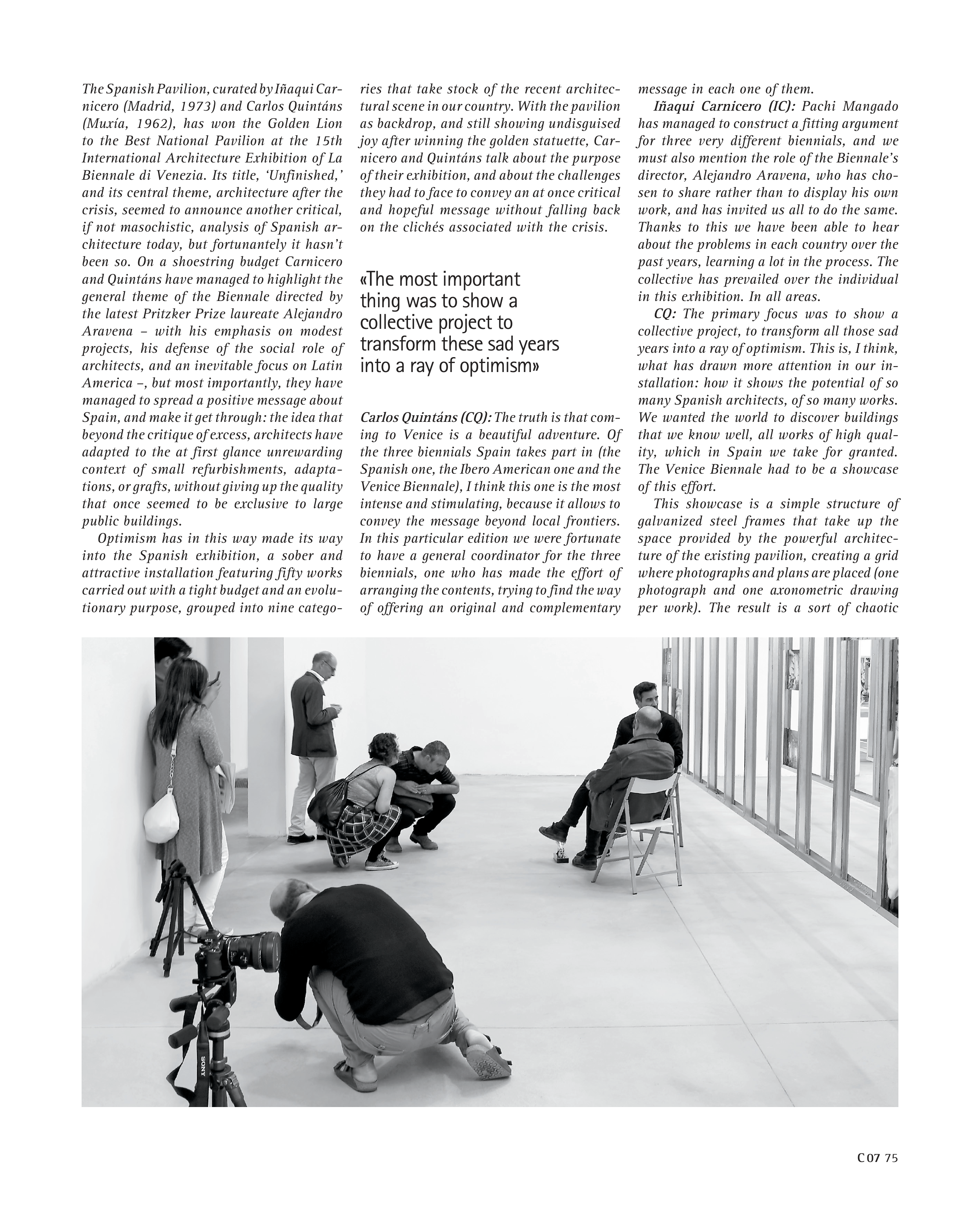
This showcase is a simple structure of
galvanized steel frames that take up the
space provided by the powerful architec-
ture of the existing pavilion, creating a grid
where photographs and plans are placed (one
photograph and one axonometric drawing
per work). The result is a sort of chaotic
«The most important
thing was to show a
collective project to
transform these sad years
into a ray of optimism»