C 06 71
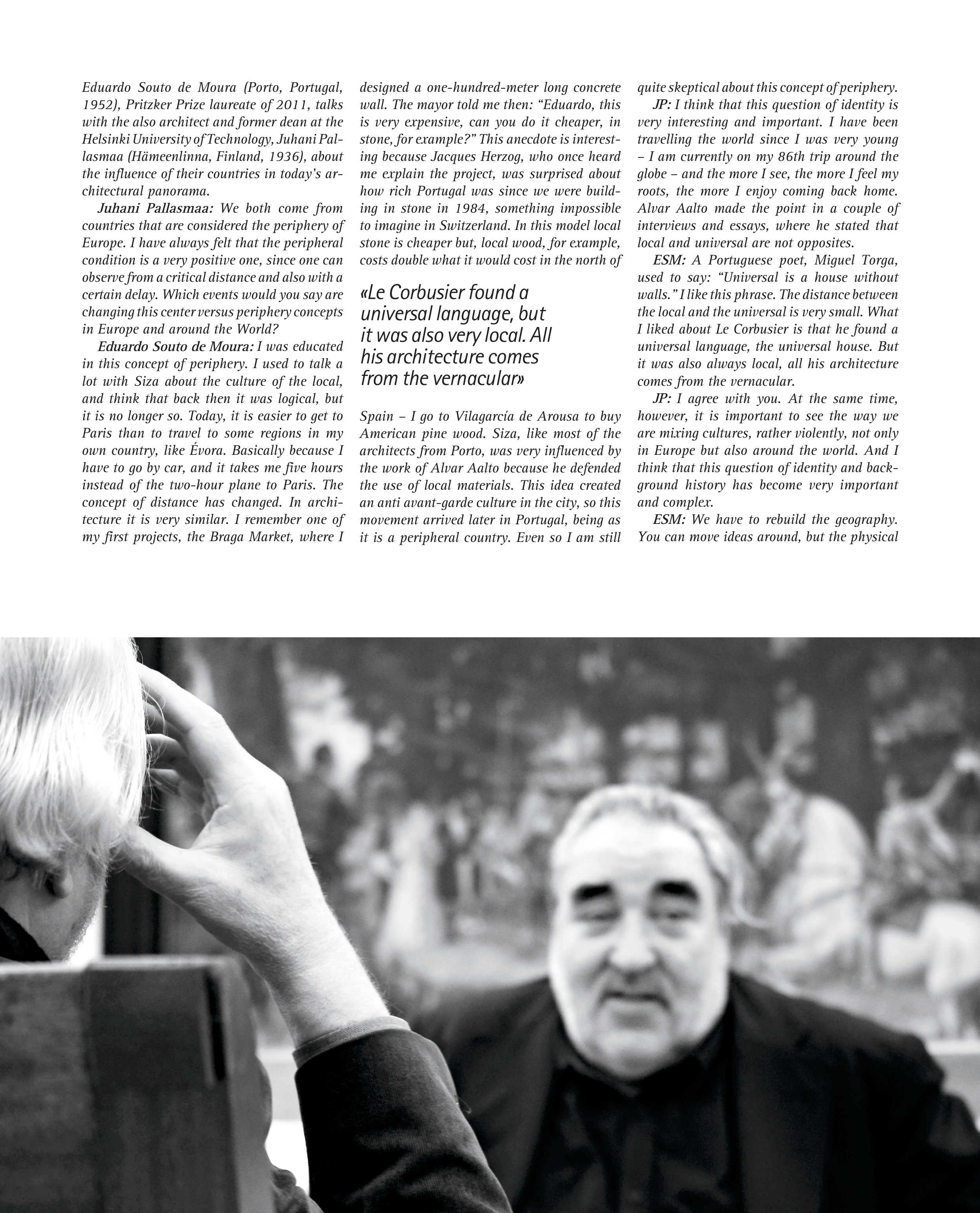
Eduardo Souto de Moura (Porto, Portugal,
1952), Pritzker Prize laureate of 2011, talks
with the also architect and former dean at the
Helsinki University of Technology, Juhani Pal-
lasmaa (Hämeenlinna, Finland, 1936), about
the influence of their countries in today’s ar-
chitectural panorama.
Juhani Pallasmaa: We both come from
countries that are considered the periphery of
Europe. I have always felt that the peripheral
condition is a very positive one, since one can
observe from a critical distance and also with a
certain delay. Which events would you say are
changing this center versus periphery concepts
in Europe and around the World?
Eduardo Souto de Moura: I was educated
in this concept of periphery. I used to talk a
lot with Siza about the culture of the local,
and think that back then it was logical, but
it is no longer so. Today, it is easier to get to
Paris than to travel to some regions in my
own country, like Évora. Basically because I
have to go by car, and it takes me five hours
instead of the two-hour plane to Paris. The
concept of distance has changed. In archi-
tecture it is very similar. I remember one of
my first projects, the Braga Market, where I
designed a one-hundred-meter long concrete
wall. The mayor told me then: “Eduardo, this
is very expensive, can you do it cheaper, in
stone, for example?” This anecdote is interest-
ing because Jacques Herzog, who once heard
me explain the project, was surprised about
how rich Portugal was since we were build-
ing in stone in 1984, something impossible
to imagine in Switzerland. In this model local
stone is cheaper but, local wood, for example,
costs double what it would cost in the north of
quite skeptical about this concept of periphery.
JP: I think that this question of identity is
very interesting and important. I have been
travelling the world since I was very young
– I am currently on my 86th trip around the
globe – and the more I see, the more I feel my
roots, the more I enjoy coming back home.
Alvar Aalto made the point in a couple of
interviews and essays, where he stated that
local and universal are not opposites.
ESM: A Portuguese poet, Miguel Torga,
used to say: “Universal is a house without
walls.” I like this phrase. The distance between
the local and the universal is very small. What
I liked about Le Corbusier is that he found a
universal language, the universal house. But
it was also always local, all his architecture
comes from the vernacular.
JP: I agree with you. At the same time,
however, it is important to see the way we
are mixing cultures, rather violently, not only
in Europe but also around the world. And I
think that this question of identity and back-
ground history has become very important
and complex.
ESM: We have to rebuild the geography.
You can move ideas around, but the physical
Spain – I go to Vilagarcía de Arousa to buy
American pine wood. Siza, like most of the
architects from Porto, was very influenced by
the work of Alvar Aalto because he defended
the use of local materials. This idea created
an anti avant-garde culture in the city, so this
movement arrived later in Portugal, being as
it is a peripheral country. Even so I am still
«Le Corbusier found a
universal language, but
it was also very local. All
his architecture comes
from the vernacular»