C 05 49
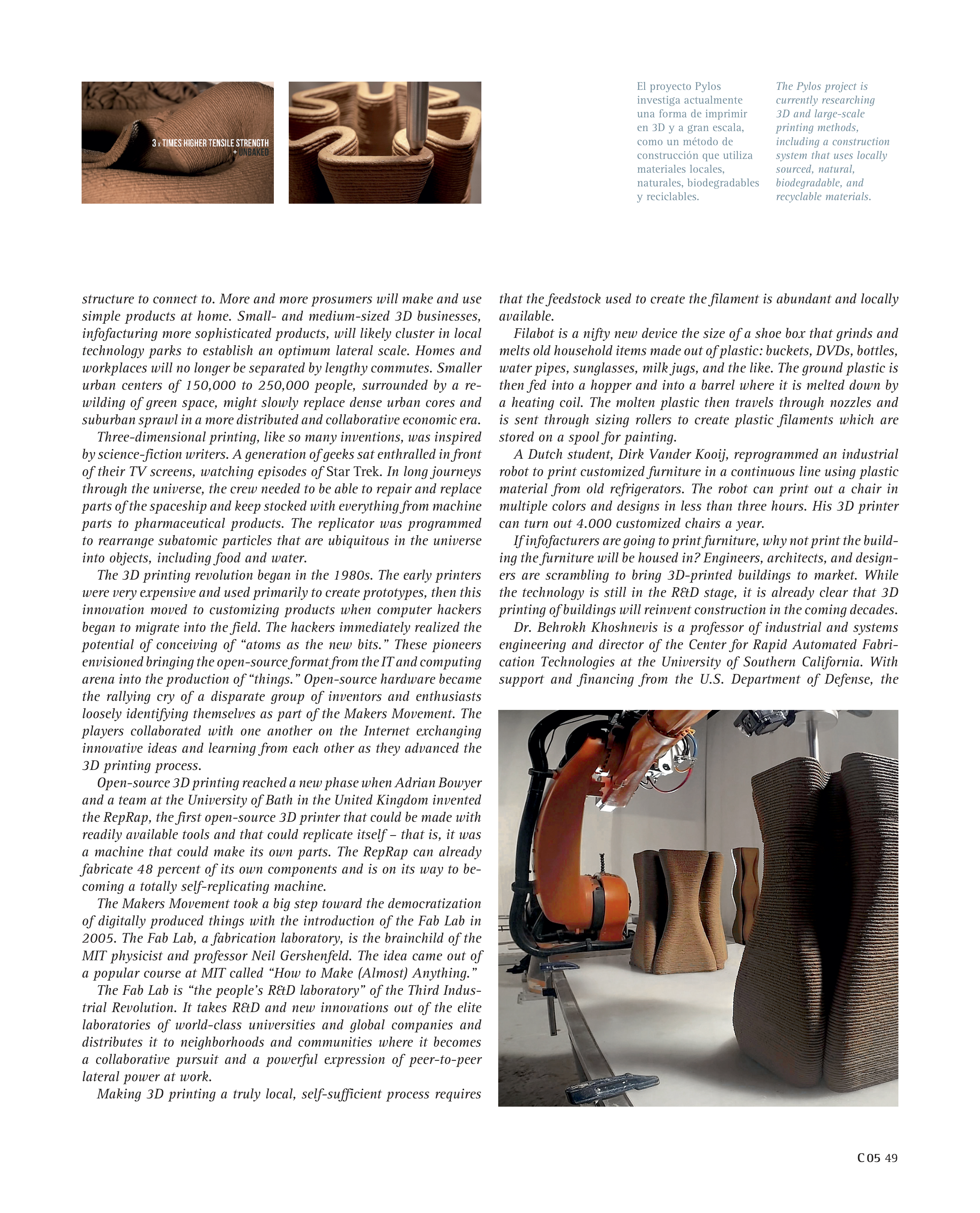
El proyecto Pylos
investiga actualmente
una forma de imprimir
en 3D y a gran escala,
como un método de
construcción que utiliza
materiales locales,
naturales, biodegradables
y reciclables.
The Pylos project is
currently researching
3D and large-scale
printing methods,
including a construction
system that uses locally
sourced, natural,
biodegradable, and
recyclable materials.
structure to connect to. More and more prosumers will make and use
simple products at home. Small- and medium-sized 3D businesses,
infofacturing more sophisticated products, will likely cluster in local
technology parks to establish an optimum lateral scale. Homes and
workplaces will no longer be separated by lengthy commutes. Smaller
urban centers of 150,000 to 250,000 people, surrounded by a re-
wilding of green space, might slowly replace dense urban cores and
suburban sprawl in a more distributed and collaborative economic era.
Three-dimensional printing, like so many inventions, was inspired
by science-fiction writers. A generation of geeks sat enthralled in front
of their TV screens, watching episodes of Star Trek. In long journeys
through the universe, the crew needed to be able to repair and replace
parts of the spaceship and keep stocked with everything from machine
parts to pharmaceutical products. The replicator was programmed
to rearrange subatomic particles that are ubiquitous in the universe
into objects, including food and water.
The 3D printing revolution began in the 1980s. The early printers
were very expensive and used primarily to create prototypes, then this
innovation moved to customizing products when computer hackers
began to migrate into the field. The hackers immediately realized the
potential of conceiving of “atoms as the new bits.” These pioneers
envisioned bringing the open-source format from the IT and computing
arena into the production of “things.” Open-source hardware became
the rallying cry of a disparate group of inventors and enthusiasts
loosely identifying themselves as part of the Makers Movement. The
players collaborated with one another on the Internet exchanging
innovative ideas and learning from each other as they advanced the
3D printing process.
Open-source 3D printing reached a new phase when Adrian Bowyer
and a team at the University of Bath in the United Kingdom invented
the RepRap, the first open-source 3D printer that could be made with
readily available tools and that could replicate itself – that is, it was
a machine that could make its own parts. The RepRap can already
fabricate 48 percent of its own components and is on its way to be-
coming a totally self-replicating machine.
The Makers Movement took a big step toward the democratization
of digitally produced things with the introduction of the Fab Lab in
2005. The Fab Lab, a fabrication laboratory, is the brainchild of the
MIT physicist and professor Neil Gershenfeld. The idea came out of
a popular course at MIT called “How to Make (Almost) Anything.”
The Fab Lab is “the people’s R&D laboratory” of the Third Indus-
trial Revolution. It takes R&D and new innovations out of the elite
laboratories of world-class universities and global companies and
distributes it to neighborhoods and communities where it becomes
a collaborative pursuit and a powerful expression of peer-to-peer
lateral power at work.
Making 3D printing a truly local, self-sufficient process requires
that the feedstock used to create the filament is abundant and locally
available.
Filabot is a nifty new device the size of a shoe box that grinds and
melts old household items made out of plastic: buckets, DVDs, bottles,
water pipes, sunglasses, milk jugs, and the like. The ground plastic is
then fed into a hopper and into a barrel where it is melted down by
a heating coil. The molten plastic then travels through nozzles and
is sent through sizing rollers to create plastic filaments which are
stored on a spool for painting.
A Dutch student, Dirk Vander Kooij, reprogrammed an industrial
robot to print customized furniture in a continuous line using plastic
material from old refrigerators. The robot can print out a chair in
multiple colors and designs in less than three hours. His 3D printer
can turn out 4.000 customized chairs a year.
If infofacturers are going to print furniture, why not print the build-
ing the furniture will be housed in? Engineers, architects, and design-
ers are scrambling to bring 3D-printed buildings to market. While
the technology is still in the R&D stage, it is already clear that 3D
printing of buildings will reinvent construction in the coming decades.
Dr. Behrokh Khoshnevis is a professor of industrial and systems
engineering and director of the Center for Rapid Automated Fabri-
cation Technologies at the University of Southern California. With
support and financing from the U.S. Department of Defense, the