C 05 47
A new Third Industrial Revolution manufacturing model has seized
the public stage and is growing exponentially. Hundreds of companies
are now producing physical products the way software produces infor-
mation in the form of video, audio, and text. It’s called 3D printing.
Printers are already producing products from jewelry and airplane
parts to human prostheses. And cheap printers are being purchased
by hobbyists interested in printing out their own parts and products.
The consumer is beginning to give way to the prosumer as increasing
numbers of people become both the producer and consumer of their
own products. Three-dimensional printing differs from conventional
centralized manufacturing in several important ways.
First, there is little human involvement aside from creating the
software. The software does all the work, which is why it’s more
appropriate to think of the process as “infofacture” rather than
“manufacture.”
Second, the early practitioners of 3D printing have made strides
to ensure that the software used remains open source, allowing pro-
sumers to share new ideas with one another do-it-yourself hobbyist
networks. The open design concept conceives of the production of
goods as a dynamic process in which thousands – even millions – of
players learn from one another by making things together.
Third, the production process is organized completely different
than the traditional manufacturing process. 3D printing is additive
infofacturing, which uses one-tenth of the material of subtractive
manufacturing, giving the 3D printer a substantial leg up in efficiency.
Fourth, 3D printers can print their own spare parts without having
to invest in expensive retooling and the time delays that go with it.
Fifth, the 3D printing movement is deeply committed to sustainable
production and its emphasis is on durability and recyclability and
using nonpolluting materials.
Sixth, 3D printers can set up shop and connect anywhere there is
a Third Industrial Revolution (TIR) infrastructure and enjoy thermo-
dynamic efficiencies far beyond those of centralized factories, with
productivity gains.
Finally, plugging into an IoT infrastructure (internet of things) at
the local level gives the small infofacturers one final, critical advan-
tage over the verticality integrated, centralized of the nineteenth and
twentieth centuries: they can power their vehicles with renewable
energy whose marginal cost is nearly free, significantly reducing their
logistics costs along the supply chain and in the delivery of their
finished products to users.
The ability to produce, market, and distribute physical goods any-
where there is an IoT infrastructure to plug into is going to dramatically
affect the spatial organization of society. Three-dimensional printing
is both local and global; it is also highly mobile, allowing infofacturers
to be anywhere and quickly move to wherever there is an IoT infra-
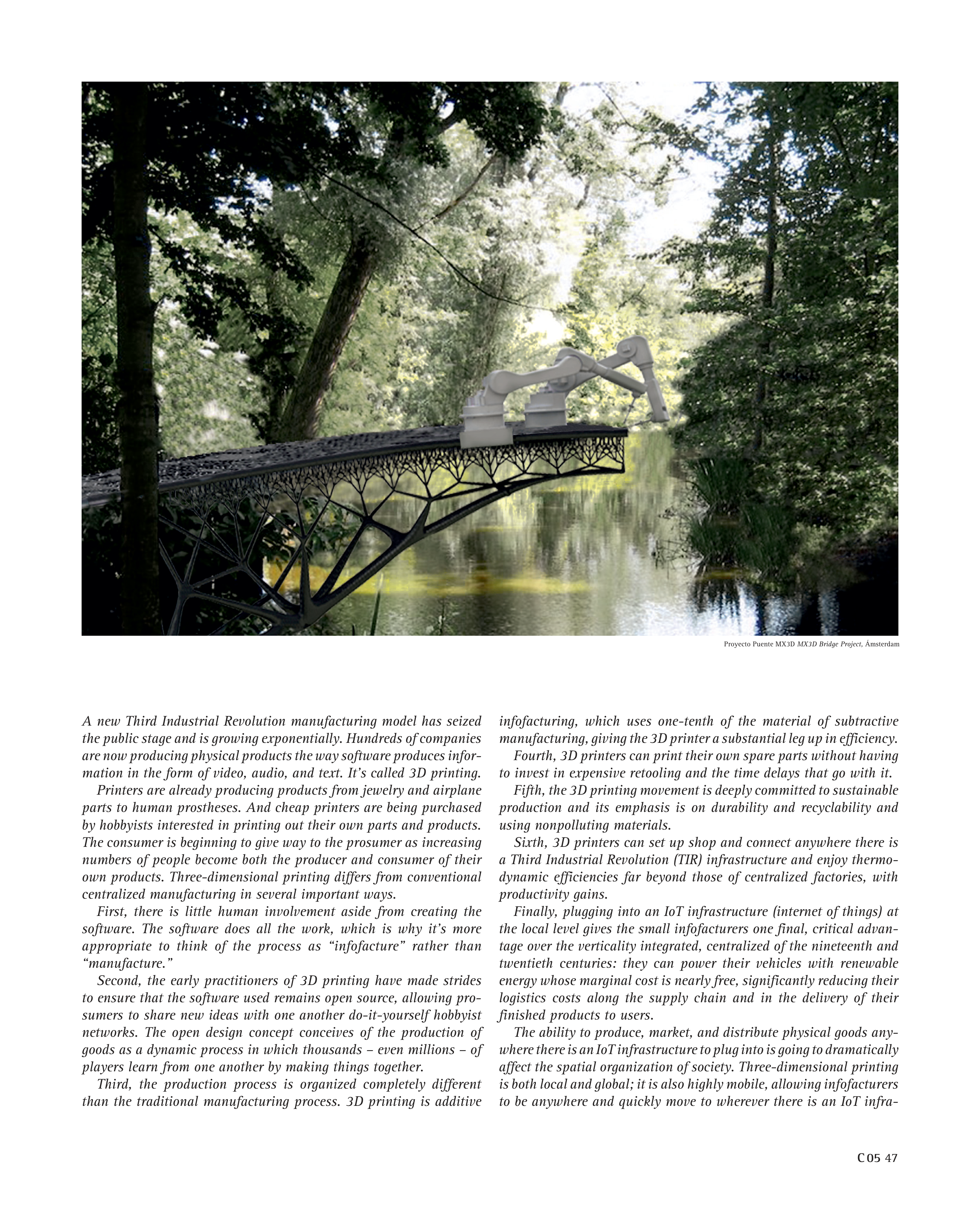
Proyecto Puente MX3D MX3D Bridge Project, Ámsterdam