C 04 75
York Public Library, I decided to revisit the
local library of my past, in an obscure corner
of an industrial suburb of Manchester, and
discovered in the foundation stone that it was
made possible by the same benefactor who
funded the New York Public Library system.
As a youth in Manchester I discovered on
those library shelves books like Towards a
New Architecture, by Le Corbusier. I was
inspired by the juxtaposition of the Caproni
hydroplane and the Acropolis. In that sense
Corbusier is a kindred spirit, not just because
of such beautiful buildings as the chapel at
Ronchamp or his Unité in Marseille, but
also for his fascination with the romance of
flight and machines. The way he would draw
parallels between these flying machines and
architecture fired my imagination as a young
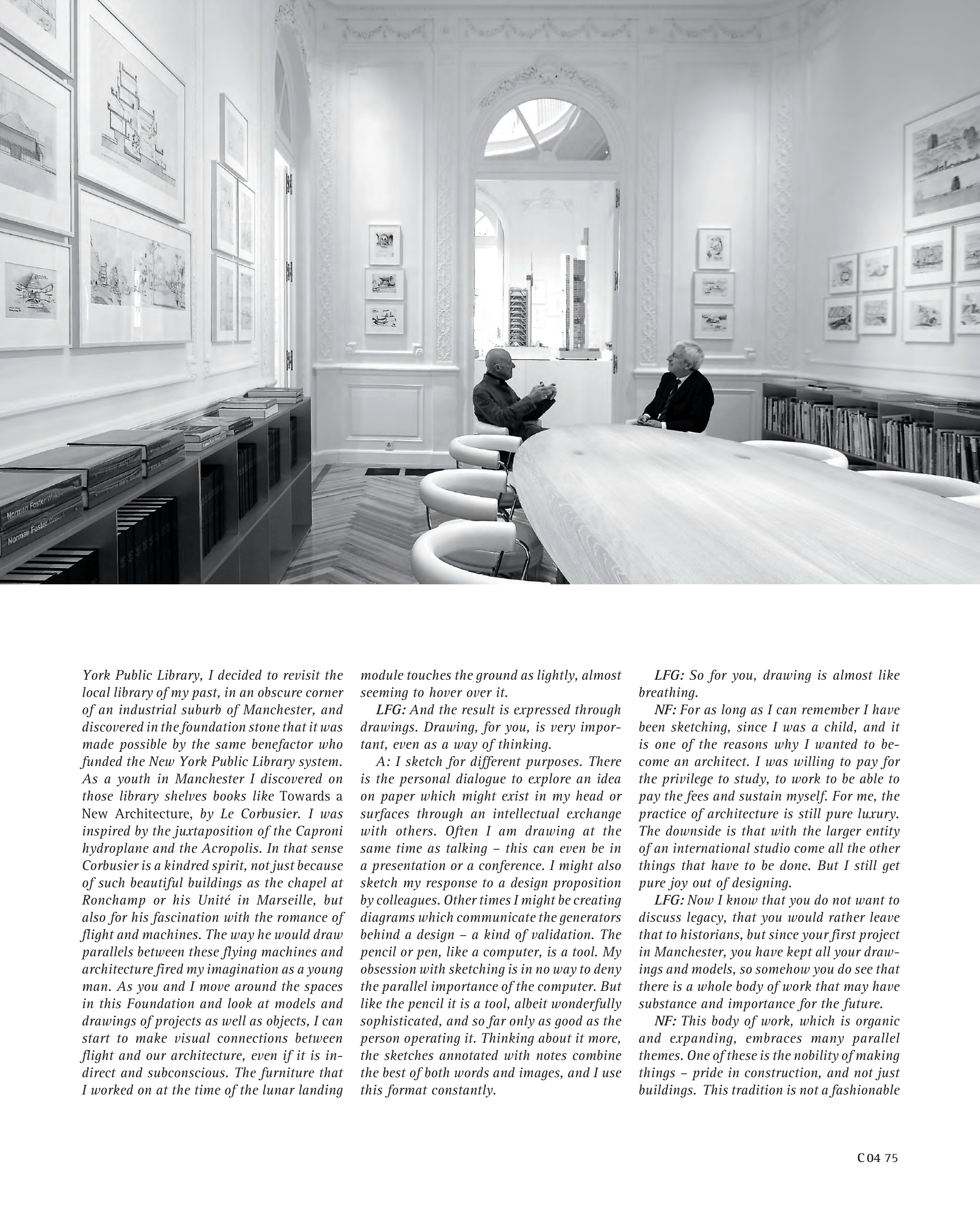
man. As you and I move around the spaces
in this Foundation and look at models and
drawings of projects as well as objects, I can
start to make visual connections between
flight and our architecture, even if it is in-
direct and subconscious. The furniture that
I worked on at the time of the lunar landing
module touches the ground as lightly, almost
seeming to hover over it.
LFG: And the result is expressed through
drawings. Drawing, for you, is very impor-
tant, even as a way of thinking.
A: I sketch for different purposes. There
is the personal dialogue to explore an idea
on paper which might exist in my head or
surfaces through an intellectual exchange
with others. Often I am drawing at the
same time as talking – this can even be in
a presentation or a conference. I might also
sketch my response to a design proposition
by colleagues. Other times I might be creating
diagrams which communicate the generators
behind a design – a kind of validation. The
pencil or pen, like a computer, is a tool. My
obsession with sketching is in no way to deny
the parallel importance of the computer. But
like the pencil it is a tool, albeit wonderfully
sophisticated, and so far only as good as the
person operating it. Thinking about it more,
the sketches annotated with notes combine
the best of both words and images, and I use
this format constantly.
LFG: So for you, drawing is almost like
breathing.
NF: For as long as I can remember I have
been sketching, since I was a child, and it
is one of the reasons why I wanted to be-
come an architect. I was willing to pay for
the privilege to study, to work to be able to
pay the fees and sustain myself. For me, the
practice of architecture is still pure luxury.
The downside is that with the larger entity
of an international studio come all the other
things that have to be done. But I still get
pure joy out of designing.
LFG: Now I know that you do not want to
discuss legacy, that you would rather leave
that to historians, but since your first project
in Manchester, you have kept all your draw-
ings and models, so somehow you do see that
there is a whole body of work that may have
substance and importance for the future.
NF: This body of work, which is organic
and expanding, embraces many parallel
themes. One of these is the nobility of making
things – pride in construction, and not just
buildings. This tradition is not a fashionable