C 03 63
long past—to be replaced instead by th e tech-
nically superior but totally characterless cars
of today. In a similar spirit, a newfound afflu-
ence might lead to wholesale redevelopment
of the very particular and equally exotic mix
of styles that comprises Cuban architecture.
Suddenly the prospect of extinction seemed
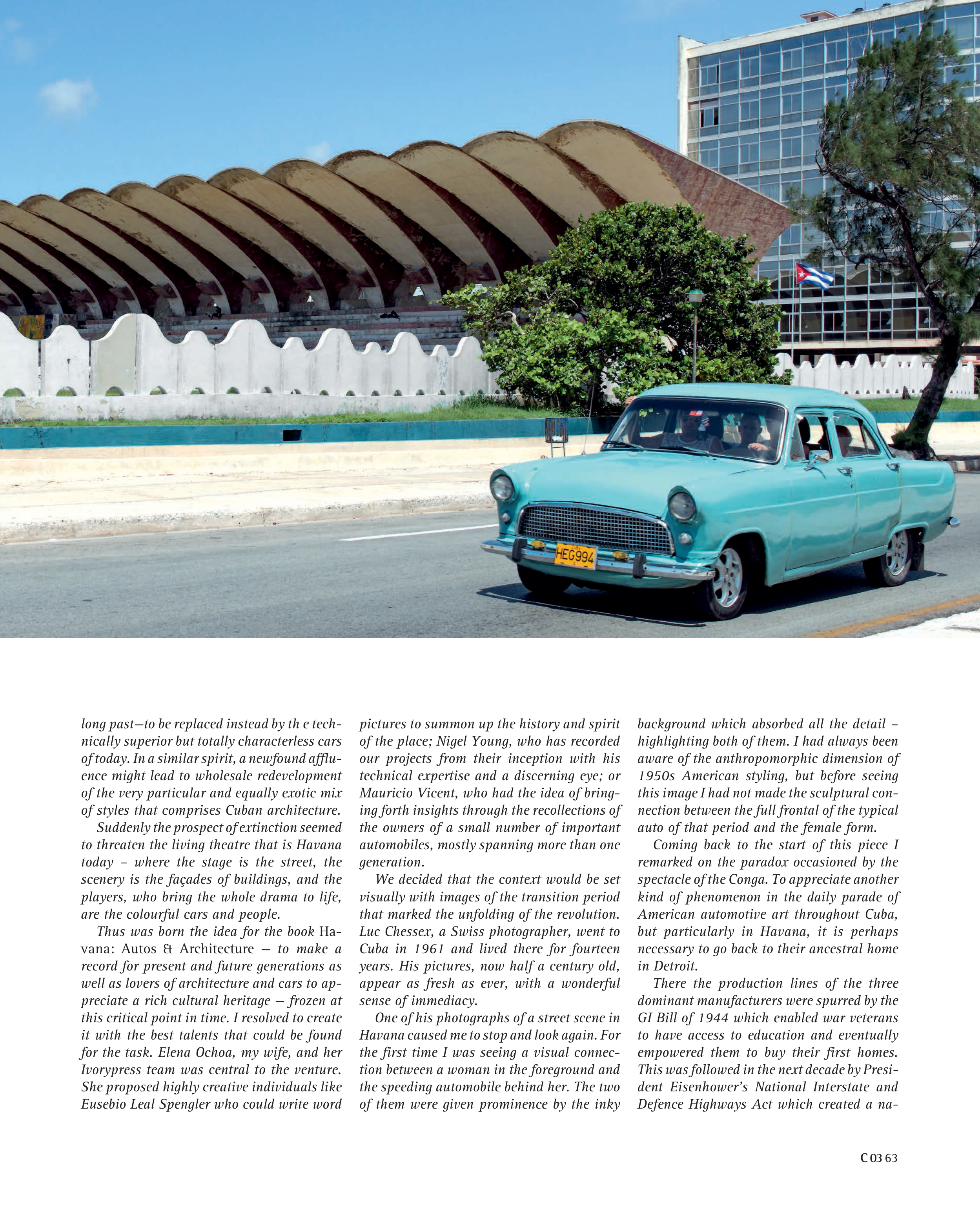
to threaten the living theatre that is Havana
today – where the stage is the street, the
scenery is the façades of buildings, and the
players, who bring the whole drama to life,
are the colourful cars and people.
Thus was born the idea for the book Ha-
vana: Autos & Architecture — to make a
record for present and future generations as
well as lovers of architecture and cars to ap-
preciate a rich cultural heritage — frozen at
this critical point in time. I resolved to create
it with the best talents that could be found
for the task. Elena Ochoa, my wife, and her
Ivorypress team was central to the venture.
She proposed highly creative individuals like
Eusebio Leal Spengler who could write word
pictures to summon up the history and spirit
of the place; Nigel Young, who has recorded
our projects from their inception with his
technical expertise and a discerning eye; or
Mauricio Vicent, who had the idea of bring-
ing forth insights through the recollections of
the owners of a small number of important
automobiles, mostly spanning more than one
generation.
We decided that the context would be set
visually with images of the transition period
that marked the unfolding of the revolution.
Luc Chessex, a Swiss photographer, went to
Cuba in 1961 and lived there for fourteen
years. His pictures, now half a century old,
appear as fresh as ever, with a wonderful
sense of immediacy.
One of his photographs of a street scene in
Havana caused me to stop and look again. For
the first time I was seeing a visual connec-
tion between a woman in the foreground and
the speeding automobile behind her. The two
of them were given prominence by the inky
background which absorbed all the detail –
highlighting both of them. I had always been
aware of the anthropomorphic dimension of
1950s American styling, but before seeing
this image I had not made the sculptural con-
nection between the full frontal of the typical
auto of that period and the female form.
Coming back to the start of this piece I
remarked on the paradox occasioned by the
spectacle of the Conga. To appreciate another
kind of phenomenon in the daily parade of
American automotive art throughout Cuba,
but particularly in Havana, it is perhaps
necessary to go back to their ancestral home
in Detroit.
There the production lines of the three
dominant manufacturers were spurred by the
GI Bill of 1944 which enabled war veterans
to have access to education and eventually
empowered them to buy their first homes.
This was followed in the next decade by Presi-
dent Eisenhower’s National Interstate and
Defence Highways Act which created a na-