C 03 61
The visits that I made to Cuba with my wife
over the last ten years have enabled me to
meet many of the community involved with
the culture of art and architecture. In part
this was due to the overlap between her world
of art and mine of design, but we also have
a shared passion for exploring contemporary
works of sculpture and painting wherever our
travels take us.
On our first visit we met the ‘Historia-
dor’ of Havana, the architect and historian
Eusebio Leal Spengler. An early destination
was the historic centre of the city which had
been lovingly restored under the direction of
Eusebio. More recently we attended the XI
Bienal de Arte which introduced us to many
of the local artists, whose studios we were
able to visit later.
With the celebrated Cuban ballet dancer
Carlos Acosta, a principal in London’s Royal
Ballet, we visited the complex of unfinished
Art Schools designed by Ricardo Porro, Vit-
torio Garatti and Roberto Gottardi in the early
1960s. This stunning group of buildings was
funded and conceived by Fidel Castro in 1961
on the former Country Club in the suburb of
Cubanacán, Havana’s equivalent of Beverly
Hills. The intent was to produce ‘the most
beautiful academy of arts in the whole world’.
We met with the government’s architect Uni-
verso García Lorenzo to explore the feasibility
of creating a ballet school for Carlos Acosta
in one of the abandoned structures.
On our last visit we spent time with two
artist friends, Marco Castillo and Dagoberto
Rodríguez, otherwise known as Los Carpin-
teros. I can recall a dinner with them at
the home of Marco, in a suburb of Havana.
After complimenting him on his 1950s style
furnishing we were led to the garage below to
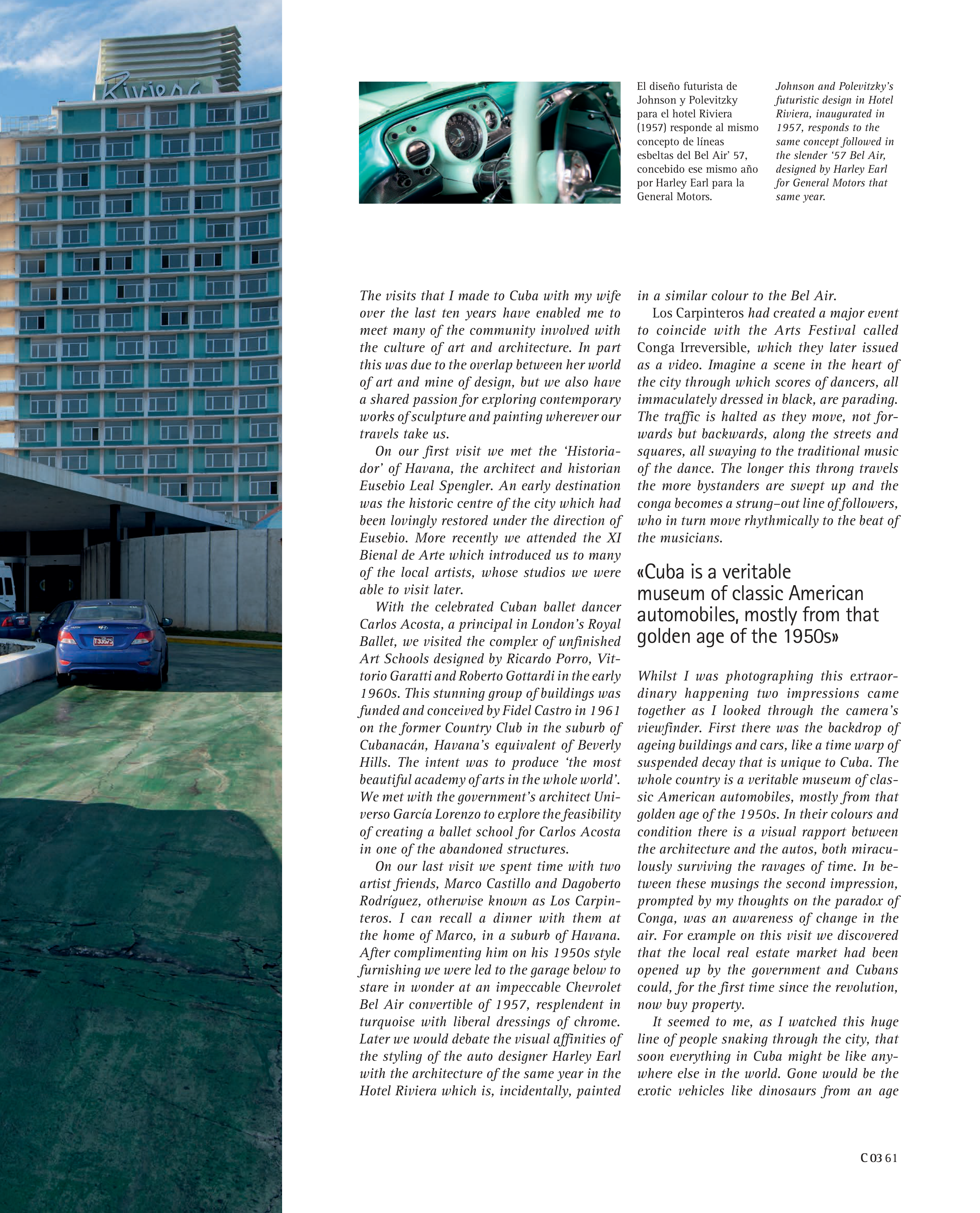
stare in wonder at an impeccable Chevrolet
Bel Air convertible of 1957, resplendent in
turquoise with liberal dressings of chrome.
Later we would debate the visual affinities of
the styling of the auto designer Harley Earl
with the architecture of the same year in the
Hotel Riviera which is, incidentally, painted
in a similar colour to the Bel Air.
Los Carpinteros had created a major event
to coincide with the Arts Festival called
Conga Irreversible, which they later issued
as a video. Imagine a scene in the heart of
the city through which scores of dancers, all
immaculately dressed in black, are parading.
The traffic is halted as they move, not for-
wards but backwards, along the streets and
squares, all swaying to the traditional music
of the dance. The longer this throng travels
the more bystanders are swept up and the
conga becomes a strung–out line of followers,
who in turn move rhythmically to the beat of
the musicians.
Whilst I was photographing this extraor-
dinary happening two impressions came
together as I looked through the camera’s
viewfinder. First there was the backdrop of
ageing buildings and cars, like a time warp of
suspended decay that is unique to Cuba. The
whole country is a veritable museum of clas-
sic American automobiles, mostly from that
golden age of the 1950s. In their colours and
condition there is a visual rapport between
the architecture and the autos, both miracu-
lously surviving the ravages of time. In be-
tween these musings the second impression,
prompted by my thoughts on the paradox of
Conga, was an awareness of change in the
air. For example on this visit we discovered
that the local real estate market had been
opened up by the government and Cubans
could, for the first time since the revolution,
now buy property.
It seemed to me, as I watched this huge
line of people snaking through the city, that
soon everything in Cuba might be like any-
where else in the world. Gone would be the
exotic vehicles like dinosaurs from an age
«Cuba is a veritable
museum of classic American
automobiles, mostly from that
golden age of the 1950s»
El diseño futurista de
Johnson y Polevitzky
para el hotel Riviera
(1957) responde al mismo
concepto de líneas
esbeltas del Bel Air’ 57,
concebido ese mismo año
por Harley Earl para la
General Motors.
Johnson and Polevitzky’s
futuristic design in Hotel
Riviera, inaugurated in
1957, responds to the
same concept followed in
the slender ‘57 Bel Air,
designed by Harley Earl
for General Motors that
same year.