59
C - TOP
Everything that he has done has sprung from his own peripheral
identity, from an innate absence of prejudices and restrictions. “It’s
not a question of being from a certain place,” he explains. "It’s more
a matter of being an outsider. The fact of not being from London gave
me the freedom to do things that many people with links to London
wouldn’t have been able to do. We people on the periphery take more
seriously the things that are done ‘in the center’.”
Ron Arad portrays himself as an imposter who doesn’t belong to any
discipline. But he isn’t and he knows it, just as he intimately knows
the whole global ecosystem of creativity. But the curious history of the
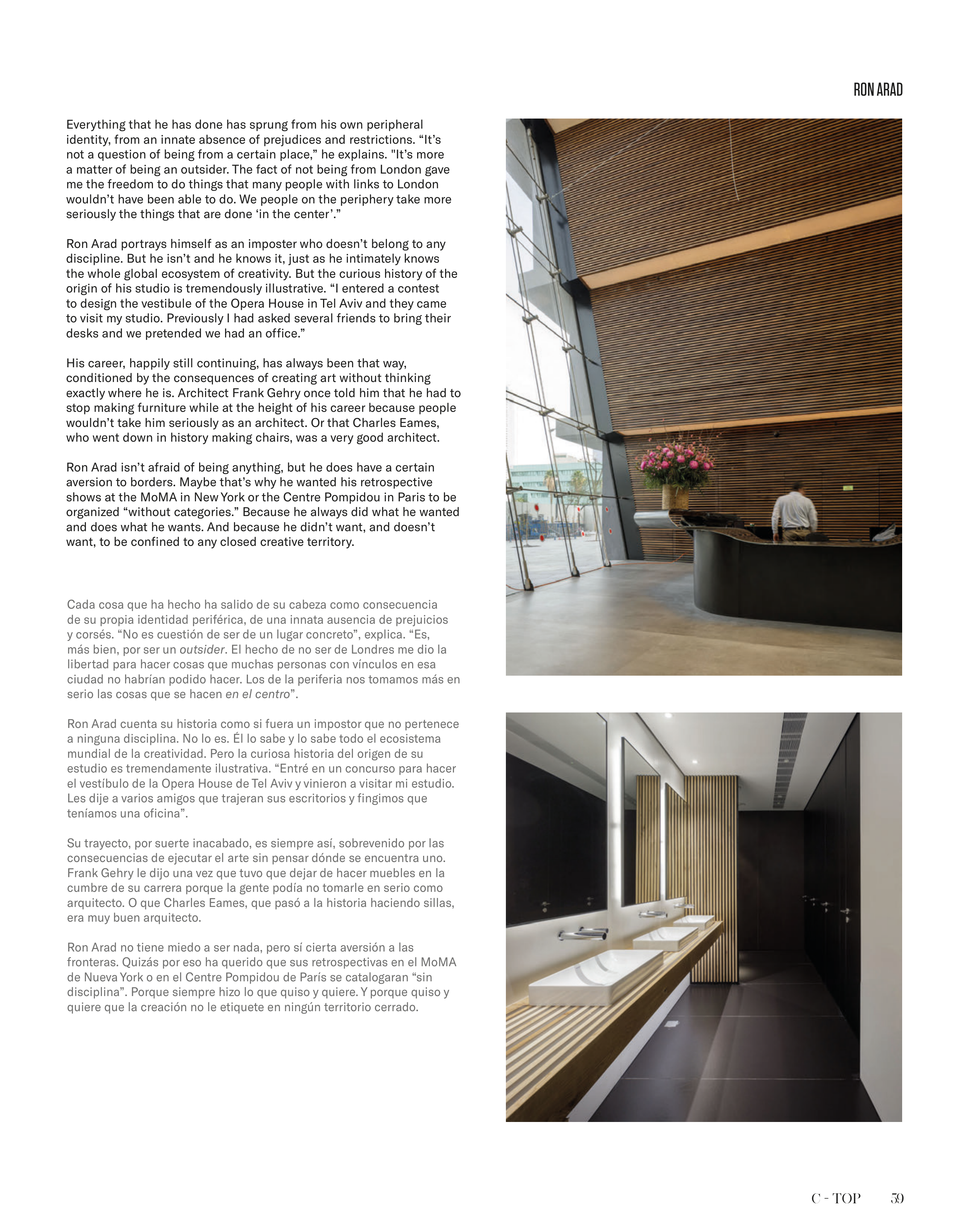
origin of his studio is tremendously illustrative. “I entered a contest
to design the vestibule of the Opera House in Tel Aviv and they came
to visit my studio. Previously I had asked several friends to bring their
desks and we pretended we had an office.”
His career, happily still continuing, has always been that way,
conditioned by the consequences of creating art without thinking
exactly where he is. Architect Frank Gehry once told him that he had to
stop making furniture while at the height of his career because people
wouldn’t take him seriously as an architect. Or that Charles Eames,
who went down in history making chairs, was a very good architect.
Ron Arad isn’t afraid of being anything, but he does have a certain
aversion to borders. Maybe that’s why he wanted his retrospective
shows at the MoMA in New York or the Centre Pompidou in Paris to be
organized “without categories.” Because he always did what he wanted
and does what he wants. And because he didn’t want, and doesn’t
want, to be confined to any closed creative territory.
Cada cosa que ha hecho ha salido de su cabeza como consecuencia
de su propia identidad periférica, de una innata ausencia de prejuicios
y corsés. “No es cuestión de ser de un lugar concreto”, explica. “Es,
más bien, por ser un outsider. El hecho de no ser de Londres me dio la
libertad para hacer cosas que muchas personas con vínculos en esa
ciudad no habrían podido hacer. Los de la periferia nos tomamos más en
serio las cosas que se hacen en el centro”.
Ron Arad cuenta su historia como si fuera un impostor que no pertenece
a ninguna disciplina. No lo es. Él lo sabe y lo sabe todo el ecosistema
mundial de la creatividad. Pero la curiosa historia del origen de su
estudio es tremendamente ilustrativa. “Entré en un concurso para hacer
el vestíbulo de la Opera House de Tel Aviv y vinieron a visitar mi estudio.
Les dije a varios amigos que trajeran sus escritorios y fingimos que
teníamos una oficina”.
Su trayecto, por suerte inacabado, es siempre así, sobrevenido por las
consecuencias de ejecutar el arte sin pensar dónde se encuentra uno.
Frank Gehry le dijo una vez que tuvo que dejar de hacer muebles en la
cumbre de su carrera porque la gente podía no tomarle en serio como
arquitecto. O que Charles Eames, que pasó a la historia haciendo sillas,
era muy buen arquitecto.
Ron Arad no tiene miedo a ser nada, pero sí cierta aversión a las
fronteras. Quizás por eso ha querido que sus retrospectivas en el MoMA
de Nueva York o en el Centre Pompidou de París se catalogaran “sin
disciplina”. Porque siempre hizo lo que quiso y quiere. Y porque quiso y
quiere que la creación no le etiquete en ningún territorio cerrado.
RON ARAD