104
C - TOP
OBSERVE
We don’t know when it happened, but for a long time now the senses
seem to have latched onto orthogonality. Straight lines, 90-degree
angles, and that special ordering of things that the mind has become
accustomed to –dictated, perhaps, by gravity and the perpendicular.
But what is organic forms part of what we are. The curve, the wave
and fluidity are also on nature’s roadmap. That’s why creators like
the Catalan architect Gaudí seem to us to be both familiar and
extraordinary, and why his Modernist architecture is so seductive.
And it’s also why the Brazilian architect Diego Revollo favors some
shapes that, as he puts it, “are more common on the facades of
buildings but little seen in interior design. Bringing those forms inside
was a challenge for the studio.”
No sabemos cuándo ocurrió, pero hace mucho que los sentidos
se aferraron a la ortogonalidad. Llegaron las líneas rectas, los
ángulos de 90 grados y ese especial orden de las cosas al que se
ha acostumbrado el cerebro dictado, quizás, por la gravedad y sus
perpendiculares.
Pero lo orgánico forma parte de lo que somos. La curva, la onda
y el fluido son también el mapa de carreteras de la naturaleza.
Por eso, creadores como Gaudí nos resultan a la vez familiares y
extraordinarios. Por eso, su arquitectura modernista es capaz de
atrapar tantas miradas.
También por eso, el arquitecto brasileño Diego Revollo reivindica
unas formas que, según sus propias palabras, “son más comunes en
fachadas y poco exploradas en diseño de interiores. Traer esas formas
hacia dentro fue un desafío para el estudio”.
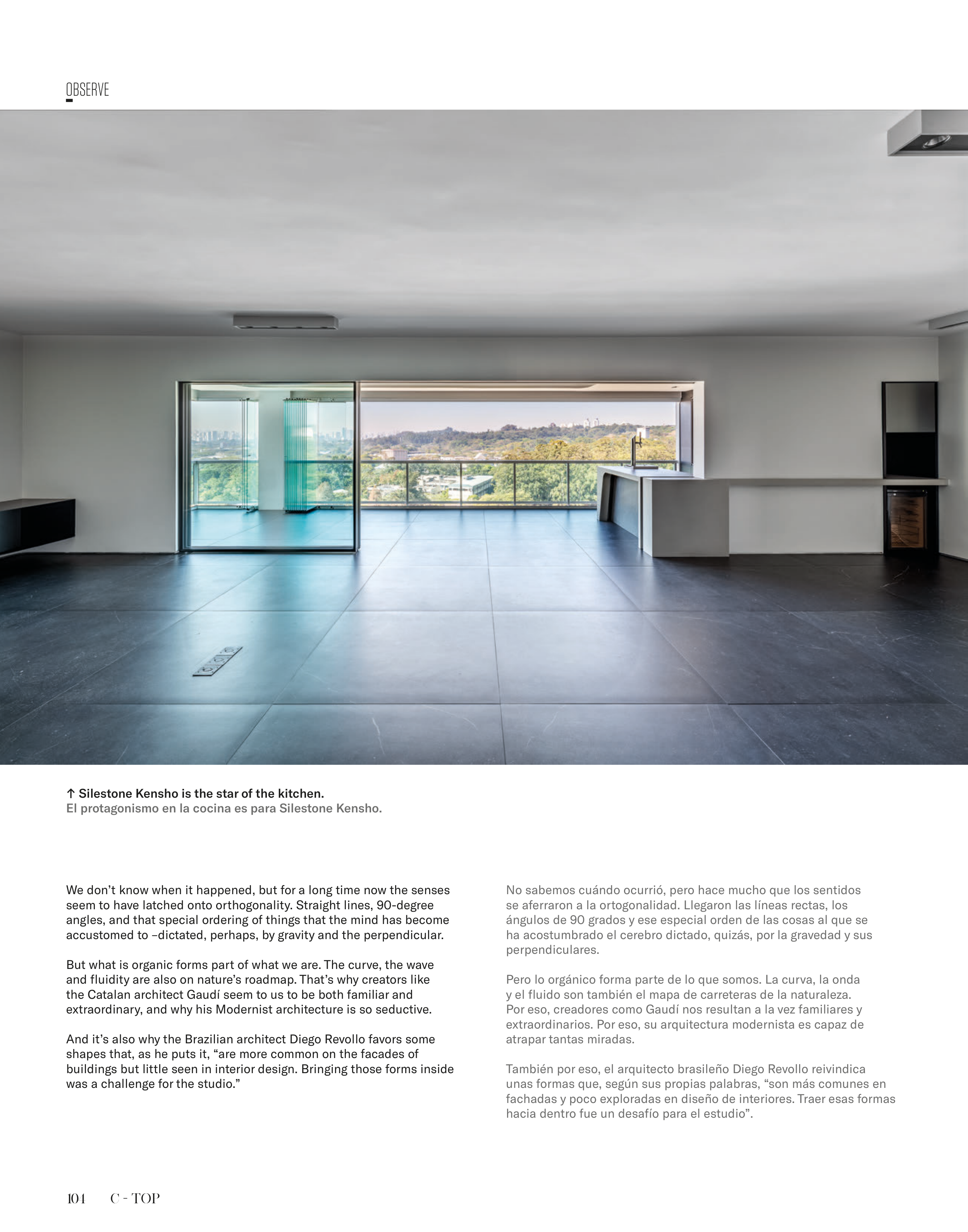
↑ Silestone Kensho is the star of the kitchen.
El protagonismo en la cocina es para Silestone Kensho.