80
C - TOP
LOLITAS, RIBBONS AND FEMINISM
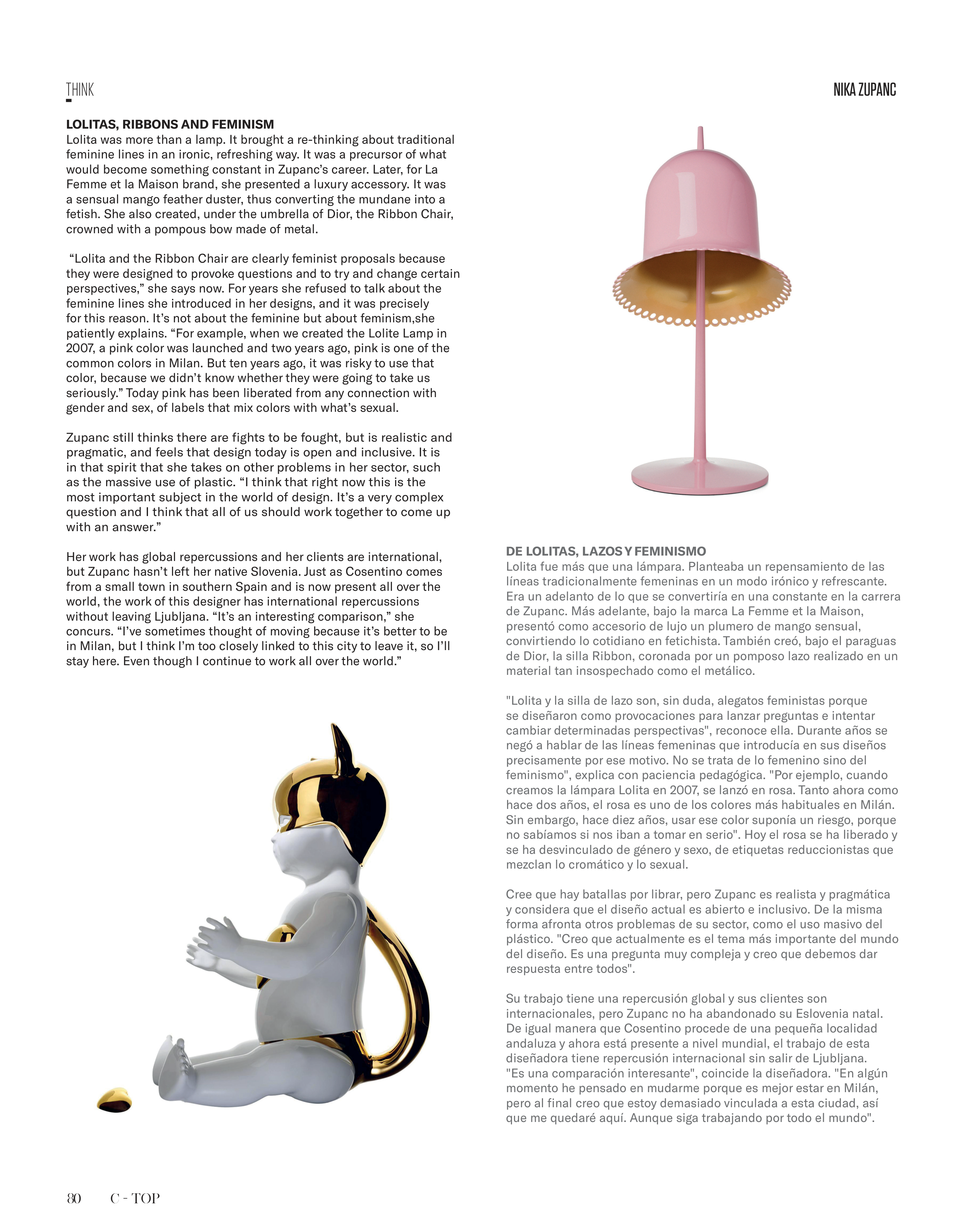
Lolita was more than a lamp. It brought a re-thinking about traditional
feminine lines in an ironic, refreshing way. It was a precursor of what
would become something constant in Zupanc’s career. Later, for La
Femme et la Maison brand, she presented a luxury accessory. It was
a sensual mango feather duster, thus converting the mundane into a
fetish. She also created, under the umbrella of Dior, the Ribbon Chair,
crowned with a pompous bow made of metal.
“Lolita and the Ribbon Chair are clearly feminist proposals because
they were designed to provoke questions and to try and change certain
perspectives,” she says now. For years she refused to talk about the
feminine lines she introduced in her designs, and it was precisely
for this reason. It’s not about the feminine but about feminism,she
patiently explains. “For example, when we created the Lolite Lamp in
2007, a pink color was launched and two years ago, pink is one of the
common colors in Milan. But ten years ago, it was risky to use that
color, because we didn’t know whether they were going to take us
seriously.” Today pink has been liberated from any connection with
gender and sex, of labels that mix colors with what’s sexual.
Zupanc still thinks there are fights to be fought, but is realistic and
pragmatic, and feels that design today is open and inclusive. It is
in that spirit that she takes on other problems in her sector, such
as the massive use of plastic. “I think that right now this is the
most important subject in the world of design. It’s a very complex
question and I think that all of us should work together to come up
with an answer.”
Her work has global repercussions and her clients are international,
but Zupanc hasn’t left her native Slovenia. Just as Cosentino comes
from a small town in southern Spain and is now present all over the
world, the work of this designer has international repercussions
without leaving Ljubljana. “It’s an interesting comparison,” she
concurs. “I’ve sometimes thought of moving because it’s better to be
in Milan, but I think I’m too closely linked to this city to leave it, so I’ll
stay here. Even though I continue to work all over the world.”
DE LOLITAS, LAZOS Y FEMINISMO
Lolita fue más que una lámpara. Planteaba un repensamiento de las
líneas tradicionalmente femeninas en un modo irónico y refrescante.
Era un adelanto de lo que se convertiría en una constante en la carrera
de Zupanc. Más adelante, bajo la marca La Femme et la Maison,
presentó como accesorio de lujo un plumero de mango sensual,
convirtiendo lo cotidiano en fetichista. También creó, bajo el paraguas
de Dior, la silla Ribbon, coronada por un pomposo lazo realizado en un
material tan insospechado como el metálico.
"Lolita y la silla de lazo son, sin duda, alegatos feministas porque
se diseñaron como provocaciones para lanzar preguntas e intentar
cambiar determinadas perspectivas", reconoce ella. Durante años se
negó a hablar de las líneas femeninas que introducía en sus diseños
precisamente por ese motivo. No se trata de lo femenino sino del
feminismo", explica con paciencia pedagógica. "Por ejemplo, cuando
creamos la lámpara Lolita en 2007, se lanzó en rosa. Tanto ahora como
hace dos años, el rosa es uno de los colores más habituales en Milán.
Sin embargo, hace diez años, usar ese color suponía un riesgo, porque
no sabíamos si nos iban a tomar en serio". Hoy el rosa se ha liberado y
se ha desvinculado de género y sexo, de etiquetas reduccionistas que
mezclan lo cromático y lo sexual.
Cree que hay batallas por librar, pero Zupanc es realista y pragmática
y considera que el diseño actual es abierto e inclusivo. De la misma
forma afronta otros problemas de su sector, como el uso masivo del
plástico. "Creo que actualmente es el tema más importante del mundo
del diseño. Es una pregunta muy compleja y creo que debemos dar
respuesta entre todos".
Su trabajo tiene una repercusión global y sus clientes son
internacionales, pero Zupanc no ha abandonado su Eslovenia natal.
De igual manera que Cosentino procede de una pequeña localidad
andaluza y ahora está presente a nivel mundial, el trabajo de esta
diseñadora tiene repercusión internacional sin salir de Ljubljana.
"Es una comparación interesante", coincide la diseñadora. "En algún
momento he pensado en mudarme porque es mejor estar en Milán,
pero al final creo que estoy demasiado vinculada a esta ciudad, así
que me quedaré aquí. Aunque siga trabajando por todo el mundo".
NIKA ZUPANC
THINK