74
C - TOP
THINK
creative story. “What Cosentino is doing is rather advanced and
technological. Reconnecting with nature and the natural world is one
of the important current trends. That’s why it was important to think
first of Dekton and in its relation with water.”
For this creative director, a material like Dekton was used to analyze
the design, the texture, the force and the size of the material so as to
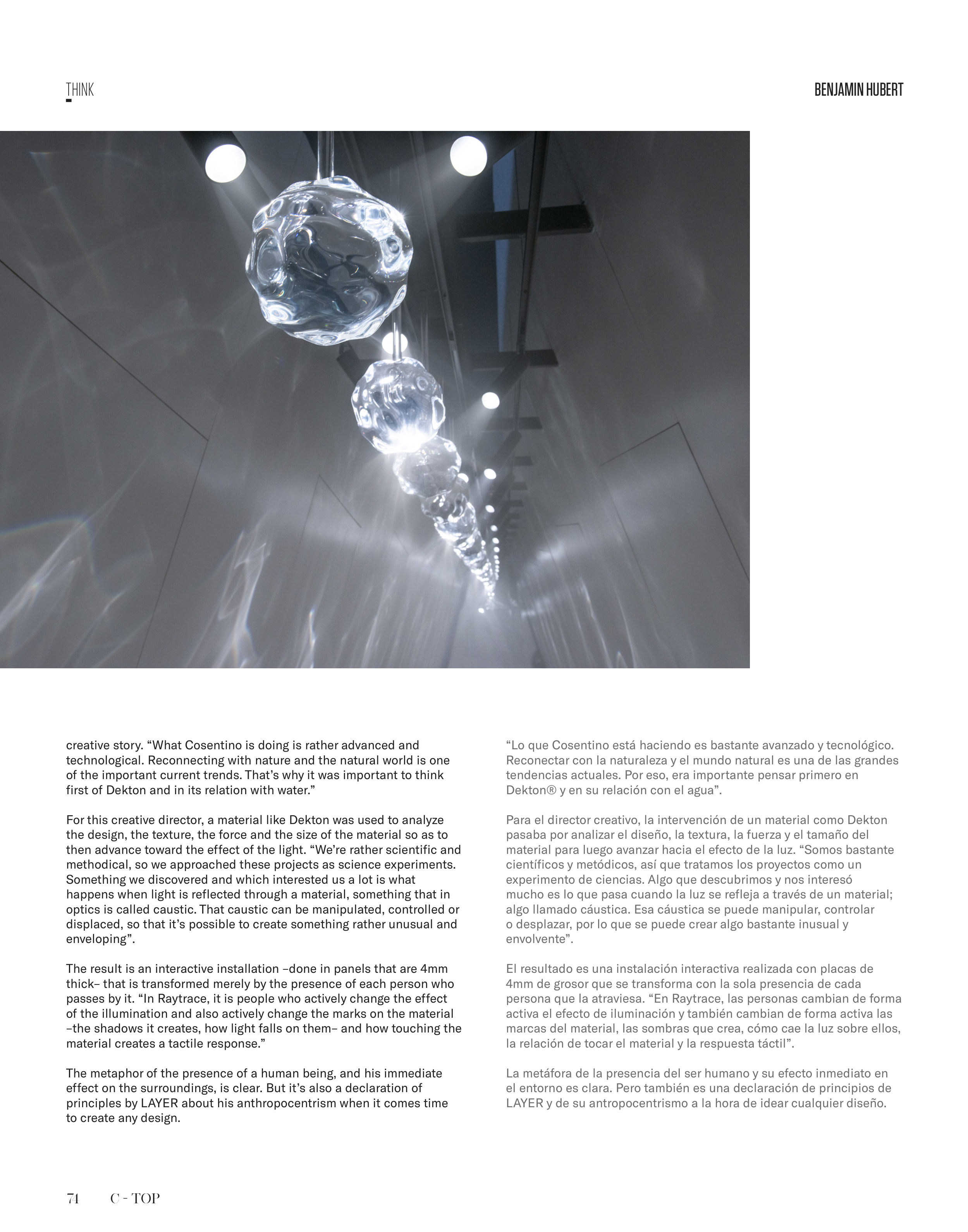
then advance toward the effect of the light. “We’re rather scientific and
methodical, so we approached these projects as science experiments.
Something we discovered and which interested us a lot is what
happens when light is reflected through a material, something that in
optics is called caustic. That caustic can be manipulated, controlled or
displaced, so that it’s possible to create something rather unusual and
enveloping”.
The result is an interactive installation –done in panels that are 4mm
thick– that is transformed merely by the presence of each person who
passes by it. “In Raytrace, it is people who actively change the effect
of the illumination and also actively change the marks on the material
–the shadows it creates, how light falls on them– and how touching the
material creates a tactile response.”
The metaphor of the presence of a human being, and his immediate
effect on the surroundings, is clear. But it’s also a declaration of
principles by LAYER about his anthropocentrism when it comes time
to create any design.
“Lo que Cosentino está haciendo es bastante avanzado y tecnológico.
Reconectar con la naturaleza y el mundo natural es una de las grandes
tendencias actuales. Por eso, era importante pensar primero en
Dekton® y en su relación con el agua”.
Para el director creativo, la intervención de un material como Dekton
pasaba por analizar el diseño, la textura, la fuerza y el tamaño del
material para luego avanzar hacia el efecto de la luz. “Somos bastante
científicos y metódicos, así que tratamos los proyectos como un
experimento de ciencias. Algo que descubrimos y nos interesó
mucho es lo que pasa cuando la luz se refleja a través de un material;
algo llamado cáustica. Esa cáustica se puede manipular, controlar
o desplazar, por lo que se puede crear algo bastante inusual y
envolvente”.
El resultado es una instalación interactiva realizada con placas de
4mm de grosor que se transforma con la sola presencia de cada
persona que la atraviesa. “En Raytrace, las personas cambian de forma
activa el efecto de iluminación y también cambian de forma activa las
marcas del material, las sombras que crea, cómo cae la luz sobre ellos,
la relación de tocar el material y la respuesta táctil”.
La metáfora de la presencia del ser humano y su efecto inmediato en
el entorno es clara. Pero también es una declaración de principios de
LAYER y de su antropocentrismo a la hora de idear cualquier diseño.
BENJAMIN HUBERT