38
C - TOP
mean cutting down dozens of trees: ancient chestnuts and eucalyptus
trees. It meant destroying a place that had made them very happy on
afternoon strolls and picnics, and on nights lying on the ground under
the California stars. So she asked Charles. If the plot of land is so
beautiful, why does the house have to be right in the middle? Why ruin
it? And Charles paid attention, because he respected Ray as an equal
and, of course, because she was right.
They decided to place the house in the upper part of the plot,
respecting most of the trees. They also determined that to do the
least damage to the land, there could be no significant digging, and
the house would not have large cement foundations. It would be put
together like a piece of furniture.
The structure was assembled in just 90 hours, and the rest of the
components took just a few weeks. Multicolored panels for the facade,
steel for the joinery and stairs, wooden dry joints for the partitions and
flooring. It was called Case Study House Nº 8, even though it is known
today as the Eames House. It is a masterpiece of architecture and has
appeared in a lot of magazines and books, but it was never understood
as a manifesto. It was created for living. Which is why, from the first
day, it was gradually colonized by objects: chairs and bureaus and
textiles, mobiles painted by Ray, clay vases and jars bought in street
markets, shrubs and plants, wooden birds, porcelain figures and brass
toys. This wasn’t a museum but a real home.
On September 20, 2006, Eames House was declared a National
Historic Landmark and was included in the National Register of
Historic Places of the United States. Today it houses the Eames
Foundation and is open to the public. If you travel to Los Angeles and
go through Pacific Palisades, you may have the chance to visit the
house that was put together like a piece of furniture and changed the
history of architecture.
la primera versión implicaba talar decenas de árboles: castaños y
eucaliptos centenarios. Implicaba destruir un lugar que les había
hecho felices en paseos y en tardes de pícnic, en noches tumbados
bajo las estrellas de California. Así que le preguntó a Charles: si la
parcela era tan bella, ¿por qué la casa debía estar justo en medio? ¿Por
qué estropearla? Y Charles le hizo caso. Porque respetaba a Ray como
a una igual y, claro, también porque Ray tenía razón. Juntos decidieron
colocarla en la parte alta del solar, respetando la mayoría de los
árboles. Y juntos decidieron que, para hacer el menor daño posible
al terreno, la casa no tendría grandes cimentaciones y aparatosos
movimientos de tierra. Se montaría como un mueble.
La estructura se terminó en 90 horas y el resto de elementos
constructivos se ensambló a en apenas unas semanas. Paneles
multicolores para la fachada, acero para carpinterías y escaleras,
maderas en junta seca para tabiques y pavimentos.
Se la llamó Case Study House Nº 8, aunque es conocida como Eames
House. Es una obra maestra de la arquitectura y ha aparecido en
multitud de revistas y libros, pero nunca se entendió como un manifiesto;
se creó y se utilizó para vivir. Por eso, desde el primer día, la casa fue
paulatinamente colonizada por objetos: sillas y cómodas y telas, móviles
pintados por Ray, macetas de barro y jarrones comprados en mercadillos,
ficus y drácenas, pájaros de madera, figuras de porcelana y juguetes de
latón. No era un museo; era un hogar.
El 20 de septiembre de 2006, la casa Eames recibió la categoría de
Hito Histórico Nacional y fue incluida en el Registro Nacional de
Lugares Históricos de los Estados Unidos de América. A día de hoy
alberga la Eames Foundation y está abierta al público. Si viajan a Los
Ángeles y pasan por Pacific Palisades, tal vez tengan la oportunidad
de visitar la casa que se montó como un mueble y cambió la historia
de la arquitectura.
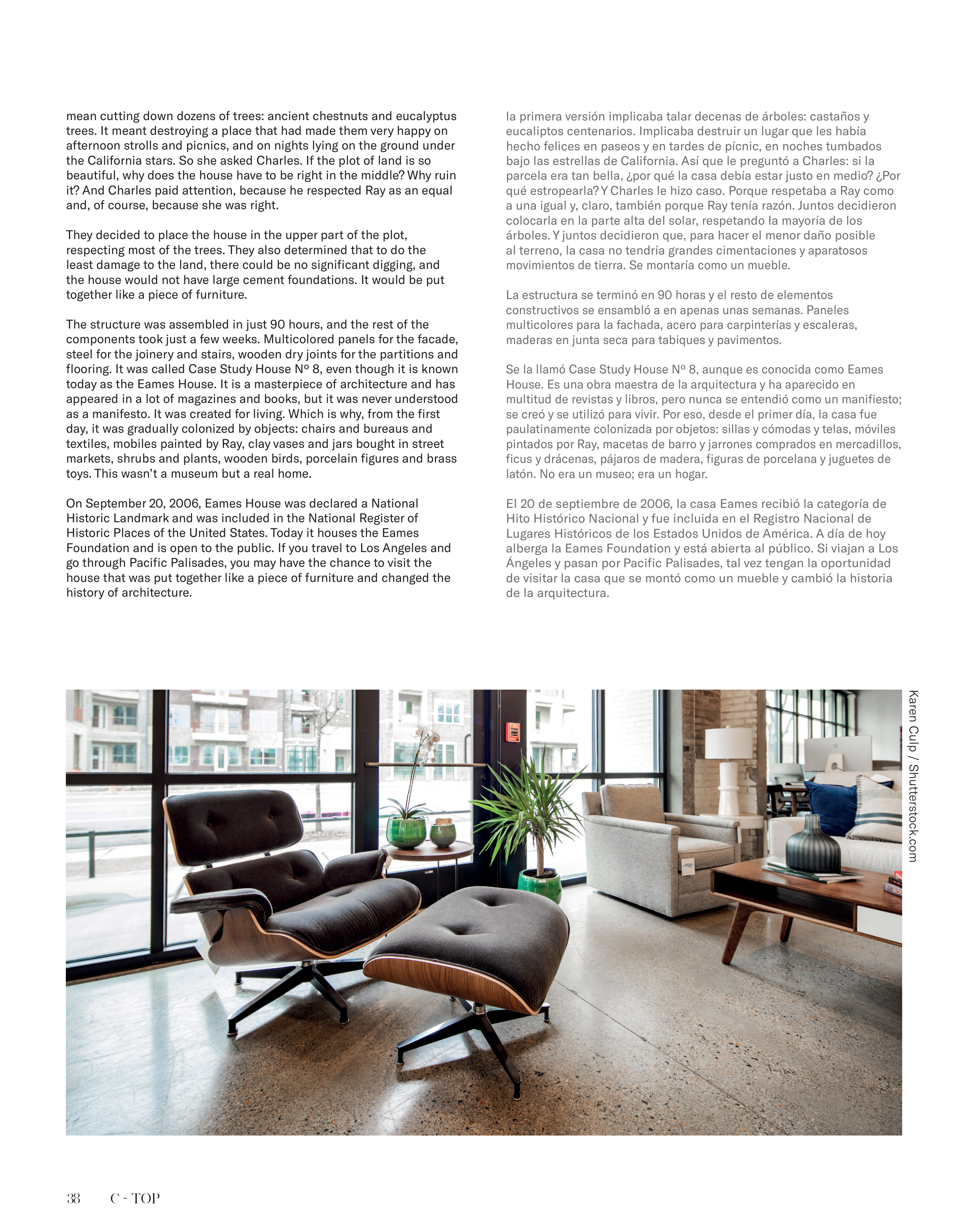
Karen Culp / Shutterstock.com