109
C - TOP
RUTH OBERMAYERS
Astrophysicist Carl Sagan used to say that to bake an apple pie “the
first thing you have to do is create the universe". It’s the same thing
in the kitchen of a luthier.The 50 centimeters between the chin rest
and the scroll of a violin contain so many variables –atoms, waves,
densities, curvatures, vibrations– that the instrument can only be
successfully created if the builder first knows how to harmoniously
manage all its elements.
Because it's more than an object, more than an instrument, the violin
is an organism that must be pampered, corrected and adjusted to
each different musician. It’s not only a case of finding the perfect
ergonomics but of also giving shape to the exact sound that the
musician has in his head. A precise, precious task that brings together
consistency, love of work well done, and a knowledge of tradition.
For Ruth Obermayer, born in Munich 41 years ago, each one of her
constructions is a voyage to the essence of the luthier’s craft. Her
atelier in Huétor Vega (Granada, Spain) is full of brushes, saws, chisels,
gouges, files and blades. She arrived there in 2014, attracted by its its
peace and the mix of mountain and sea. She uses hardly any machines
because she is in no hurry. “I like to work at a slower pace and be more
conscious of tradition,” says this German luthier, whose methods are
in the tradition of the 17th and 18th centuries, the Amati, Stradivari and
Guarneri who achieved perfection 300 years ago.
Decía el astrofísico Carl Sagan que para hacer una tarta de manzana
partiendo desde cero, “lo primero que tienes que hacer es crear el
universo”. En los fogones de un luthier ocurre lo mismo. Los 50 cm
que van de la barbada a la voluta de un violín concentran tal cantidad
de variables –átomos, ondas, densidades, curvaturas, vibraciones–
que su construcción solo resulta exitosa si uno sabe primero manejar
armónicamente todos los elementos que lo componen.
Porque, más que un objeto, más que un instrumento, el violín es
un organismo al que hay que mimar, corregir y ajustar a la firma
inequívoca del artista. No solo se trata de encontrar la ergonomía
perfecta, sino también de dar forma al sonido exacto que el músico
tiene en la cabeza. Una tarea precisa y preciosa en la que se conjugan
constancia, amor al trabajo y conocimiento de la tradición.
Para Ruth Obermayer (Múnich, 1978), cada una de sus construcciones
es un viaje a la esencia del oficio de luthier. Cepillos, sierras,
formones, gubias, limas y cuchillas componen el paisaje de su
atelier de Huétor Vega (Granada), localidad en la que se instaló en
2004 seducida por su tranquilidad y la mezcla de montaña y mar.
Apenas usa máquinas porque no tiene prisa por acabar. “Me gusta
trabajar en un ritmo más lento, más concienciada de la tradición”,
explica la luthier alemana, cuya metodología se alinea con la de los
constructores del XVII y el XVIII, los Amati, Stradivari y Guarneri que
alcanzaron el summum de la perfección hace 300 años.
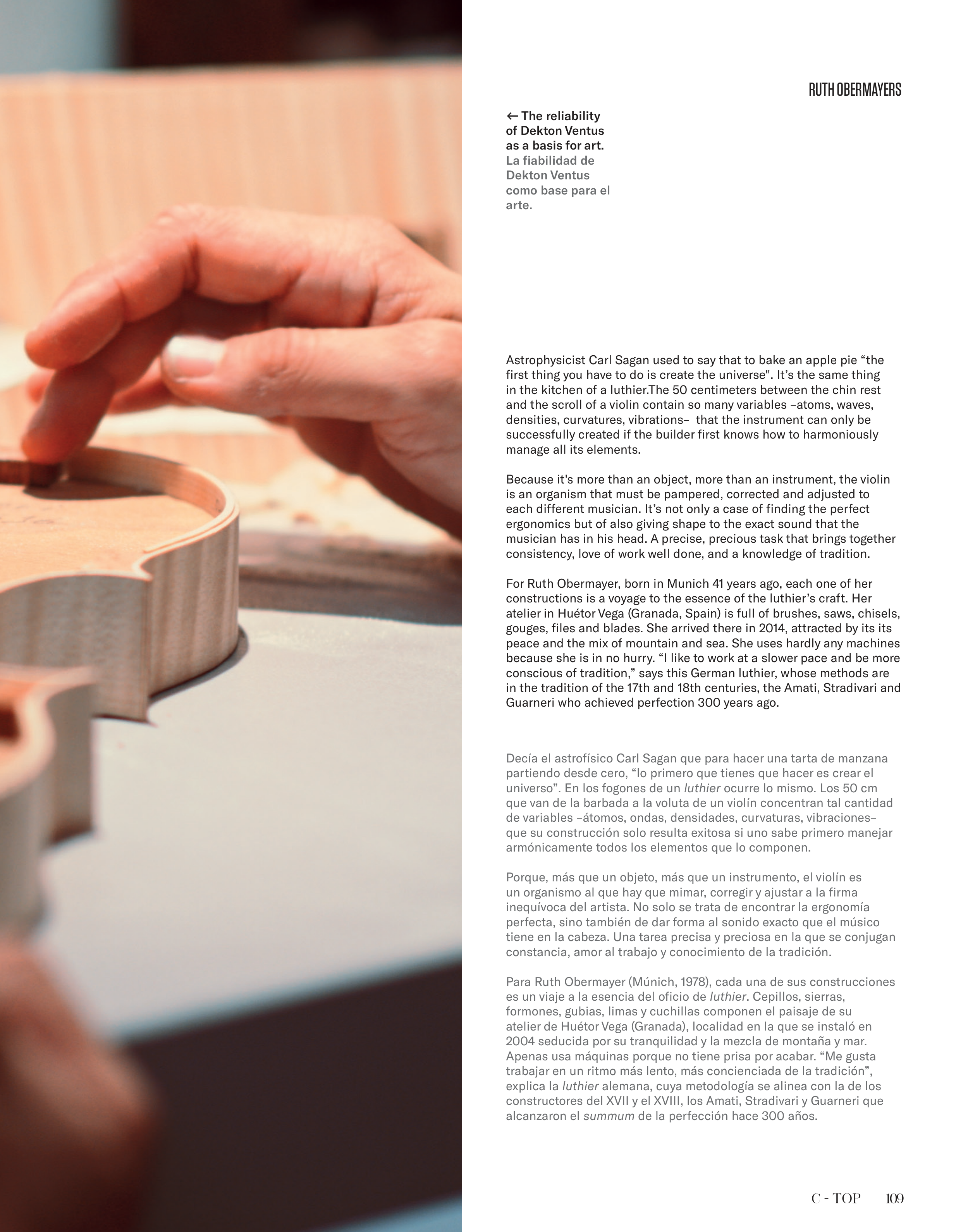
← The reliability
of Dekton Ventus
as a basis for art.
La fiabilidad de
Dekton Ventus
como base para el
arte.