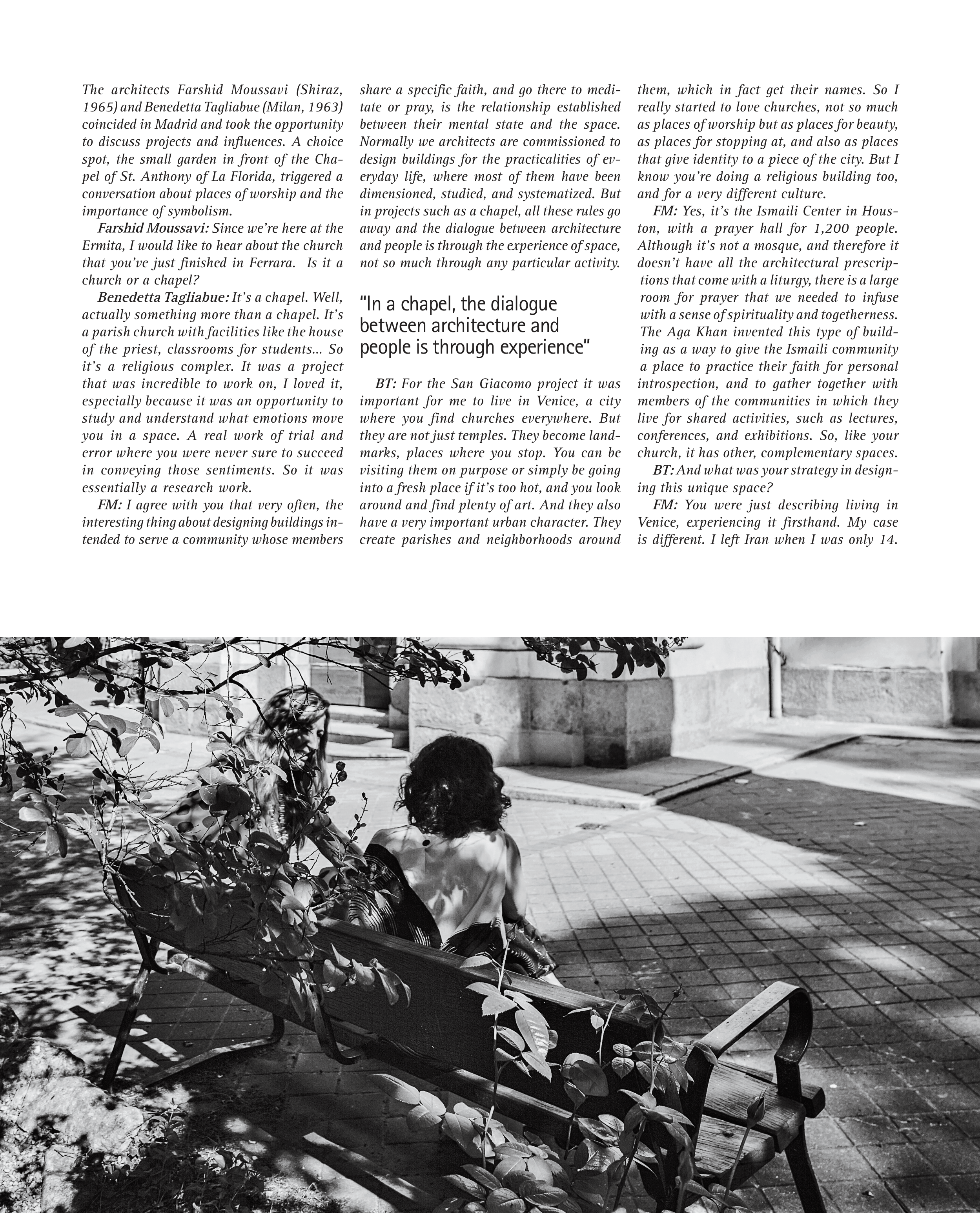
The architects Farshid Moussavi (Shiraz,
1965) and Benedetta Tagliabue (Milan, 1963)
coincided in Madrid and took the opportunity
to discuss projects and influences. A choice
spot, the small garden in front of the Cha-
pel of St. Anthony of La Florida, triggered a
conversation about places of worship and the
importance of symbolism.
Farshid Moussavi: Since we’re here at the
Ermita, I would like to hear about the church
that you’ve just finished in Ferrara. Is it a
church or a chapel?
Benedetta Tagliabue: It’s a chapel. Well,
actually something more than a chapel. It’s
a parish church with facilities like the house
of the priest, classrooms for students… So
it’s a religious complex. It was a project
that was incredible to work on, I loved it,
especially because it was an opportunity to
study and understand what emotions move
you in a space. A real work of trial and
error where you were never sure to succeed
in conveying those sentiments. So it was
essentially a research work.
FM: I agree with you that very often, the
interesting thing about designing buildings in-
tended to serve a community whose members
share a specific faith, and go there to medi-
tate or pray, is the relationship established
between their mental state and the space.
Normally we architects are commissioned to
design buildings for the practicalities of ev-
eryday life, where most of them have been
dimensioned, studied, and systematized. But
in projects such as a chapel, all these rules go
away and the dialogue between architecture
and people is through the experience of space,
not so much through any particular activity.
BT: For the San Giacomo project it was
important for me to live in Venice, a city
where you find churches everywhere. But
they are not just temples. They become land-
marks, places where you stop. You can be
visiting them on purpose or simply be going
into a fresh place if it’s too hot, and you look
around and find plenty of art. And they also
have a very important urban character. They
create parishes and neighborhoods around
them, which in fact get their names. So I
really started to love churches, not so much
as places of worship but as places for beauty,
as places for stopping at, and also as places
that give identity to a piece of the city. But I
know you’re doing a religious building too,
and for a very different culture.
FM: Yes, it’s the Ismaili Center in Hous-
ton, with a prayer hall for 1,200 people.
Although it’s not a mosque, and therefore it
doesn’t have all the architectural prescrip-
tions that come with a liturgy, there is a large
room for prayer that we needed to infuse
with a sense of spirituality and togetherness.
The Aga Khan invented this type of build-
ing as a way to give the Ismaili community
a place to practice their faith for personal
introspection, and to gather together with
members of the communities in which they
live for shared activities, such as lectures,
conferences, and exhibitions. So, like your
church, it has other, complementary spaces.
BT: And what was your strategy in design-
ing this unique space?
FM: You were just describing living in
Venice, experiencing it firsthand. My case
is different. I left Iran when I was only 14.
“In a chapel, the dialogue
between architecture and
people is through experience”