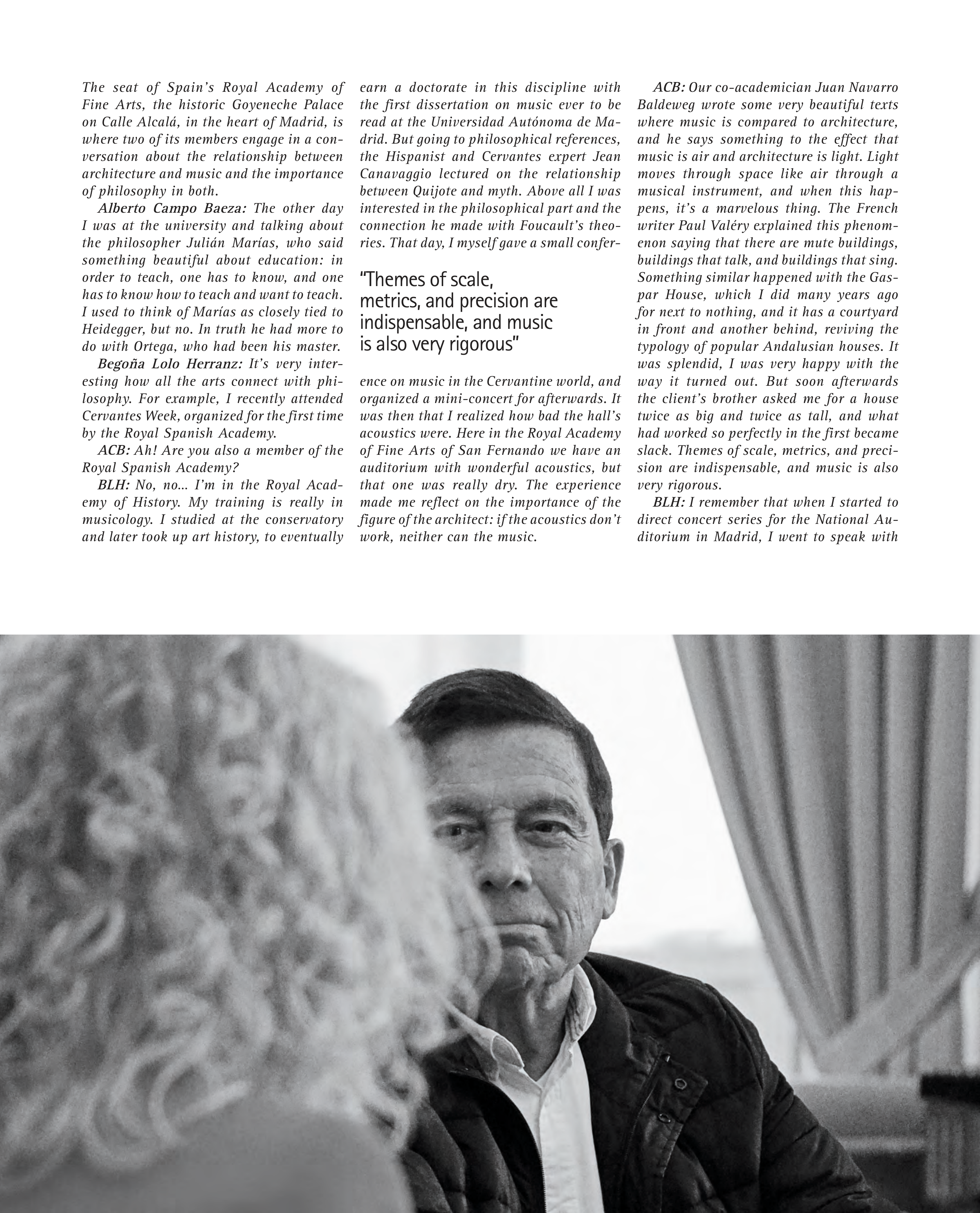
The seat of Spain’s Royal Academy of
Fine Arts, the historic Goyeneche Palace
on Calle Alcalá, in the heart of Madrid, is
where two of its members engage in a con-
versation about the relationship between
architecture and music and the importance
of philosophy in both.
Alberto Campo Baeza: The other day
I was at the university and talking about
the philosopher Julián Marías, who said
something beautiful about education: in
order to teach, one has to know, and one
has to know how to teach and want to teach.
I used to think of Marías as closely tied to
Heidegger, but no. In truth he had more to
do with Ortega, who had been his master.
Begoña Lolo Herranz: It’s very inter-
esting how all the arts connect with phi-
losophy. For example, I recently attended
Cervantes Week, organized for the first time
by the Royal Spanish Academy.
ACB: Ah! Are you also a member of the
Royal Spanish Academy?
BLH: No, no… I’m in the Royal Acad-
emy of History. My training is really in
musicology. I studied at the conservatory
and later took up art history, to eventually
earn a doctorate in this discipline with
the first dissertation on music ever to be
read at the Universidad Autónoma de Ma-
drid. But going to philosophical references,
the Hispanist and Cervantes expert Jean
Canavaggio lectured on the relationship
between Quijote and myth. Above all I was
interested in the philosophical part and the
connection he made with Foucault’s theo-
ries. That day, I myself gave a small confer-
ence on music in the Cervantine world, and
organized a mini-concert for afterwards. It
was then that I realized how bad the hall’s
acoustics were. Here in the Royal Academy
of Fine Arts of San Fernando we have an
auditorium with wonderful acoustics, but
that one was really dry. The experience
made me reflect on the importance of the
figure of the architect: if the acoustics don’t
work, neither can the music.
ACB: Our co-academician Juan Navarro
Baldeweg wrote some very beautiful texts
where music is compared to architecture,
and he says something to the effect that
music is air and architecture is light. Light
moves through space like air through a
musical instrument, and when this hap-
pens, it’s a marvelous thing. The French
writer Paul Valéry explained this phenom-
enon saying that there are mute buildings,
buildings that talk, and buildings that sing.
Something similar happened with the Gas-
par House, which I did many years ago
for next to nothing, and it has a courtyard
in front and another behind, reviving the
typology of popular Andalusian houses. It
was splendid, I was very happy with the
way it turned out. But soon afterwards
the client’s brother asked me for a house
twice as big and twice as tall, and what
had worked so perfectly in the first became
slack. Themes of scale, metrics, and preci-
sion are indispensable, and music is also
very rigorous.
BLH: I remember that when I started to
direct concert series for the National Au-
ditorium in Madrid, I went to speak with
“Themes of scale,
metrics, and precision are
indispensable, and music
is also very rigorous”