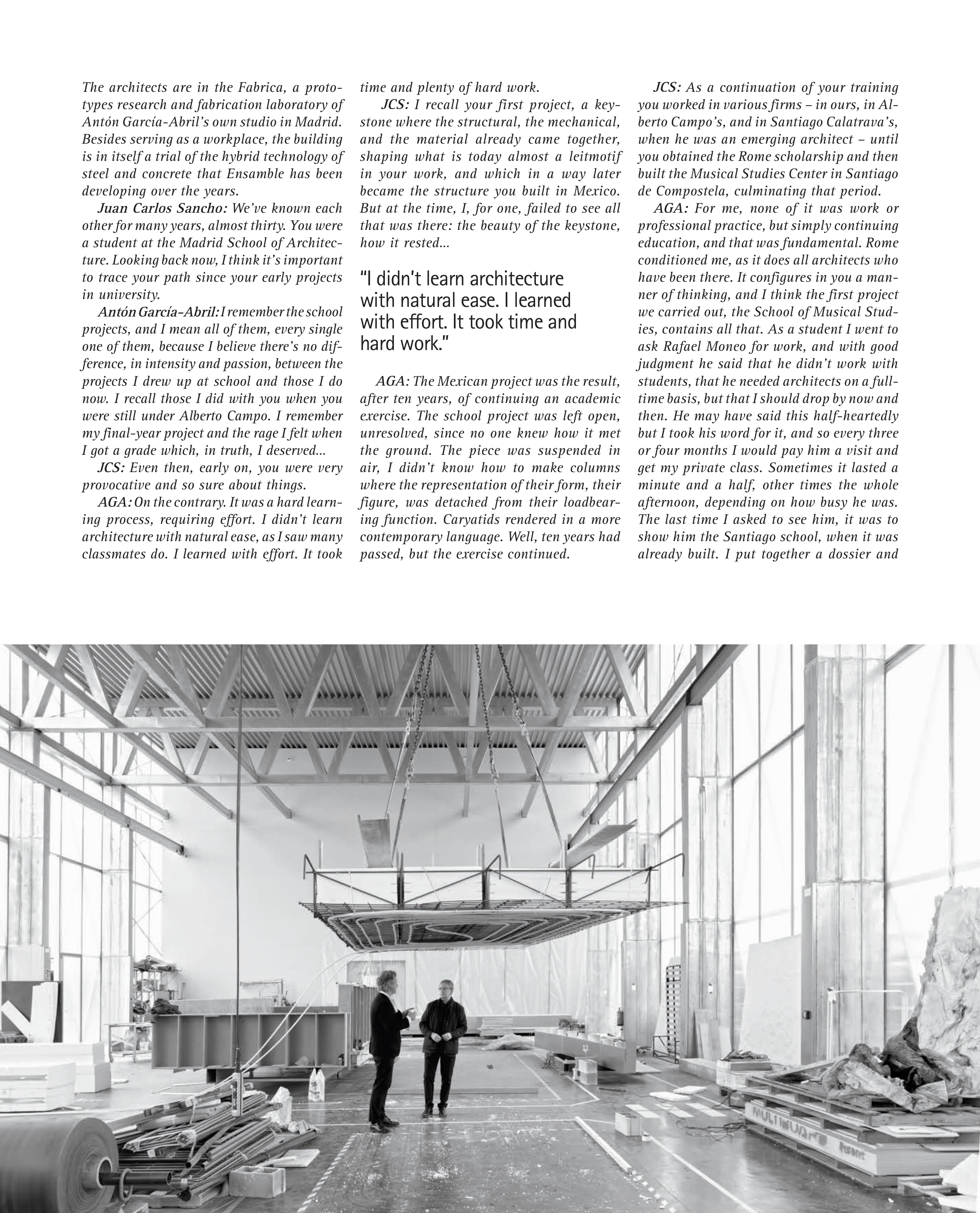
The architects are in the Fabrica, a proto-
types research and fabrication laboratory of
Antón García-Abril’s own studio in Madrid.
Besides serving as a workplace, the building
is in itself a trial of the hybrid technology of
steel and concrete that Ensamble has been
developing over the years.
Juan Carlos Sancho: We’ve known each
other for many years, almost thirty. You were
a student at the Madrid School of Architec-
ture. Looking back now, I think it’s important
to trace your path since your early projects
in university.
Antón García-Abril: I remember the school
projects, and I mean all of them, every single
one of them, because I believe there’s no dif-
ference, in intensity and passion, between the
projects I drew up at school and those I do
now. I recall those I did with you when you
were still under Alberto Campo. I remember
my final-year project and the rage I felt when
I got a grade which, in truth, I deserved…
JCS: Even then, early on, you were very
provocative and so sure about things.
AGA: On the contrary. It was a hard learn-
ing process, requiring effort. I didn’t learn
architecture with natural ease, as I saw many
classmates do. I learned with effort. It took
time and plenty of hard work.
JCS: I recall your first project, a key-
stone where the structural, the mechanical,
and the material already came together,
shaping what is today almost a leitmotif
in your work, and which in a way later
became the structure you built in Mexico.
But at the time, I, for one, failed to see all
that was there: the beauty of the keystone,
how it rested…
AGA: The Mexican project was the result,
after ten years, of continuing an academic
exercise. The school project was left open,
unresolved, since no one knew how it met
the ground. The piece was suspended in
air, I didn’t know how to make columns
where the representation of their form, their
figure, was detached from their loadbear-
ing function. Caryatids rendered in a more
contemporary language. Well, ten years had
passed, but the exercise continued.
JCS: As a continuation of your training
you worked in various firms – in ours, in Al-
berto Campo’s, and in Santiago Calatrava’s,
when he was an emerging architect – until
you obtained the Rome scholarship and then
built the Musical Studies Center in Santiago
de Compostela, culminating that period.
AGA: For me, none of it was work or
professional practice, but simply continuing
education, and that was fundamental. Rome
conditioned me, as it does all architects who
have been there. It configures in you a man-
ner of thinking, and I think the first project
we carried out, the School of Musical Stud-
ies, contains all that. As a student I went to
ask Rafael Moneo for work, and with good
judgment he said that he didn’t work with
students, that he needed architects on a full-
time basis, but that I should drop by now and
then. He may have said this half-heartedly
but I took his word for it, and so every three
or four months I would pay him a visit and
get my private class. Sometimes it lasted a
minute and a half, other times the whole
afternoon, depending on how busy he was.
The last time I asked to see him, it was to
show him the Santiago school, when it was
already built. I put together a dossier and
“I didn’t learn architecture
with natural ease. I learned
with effort. It took time and
hard work.”