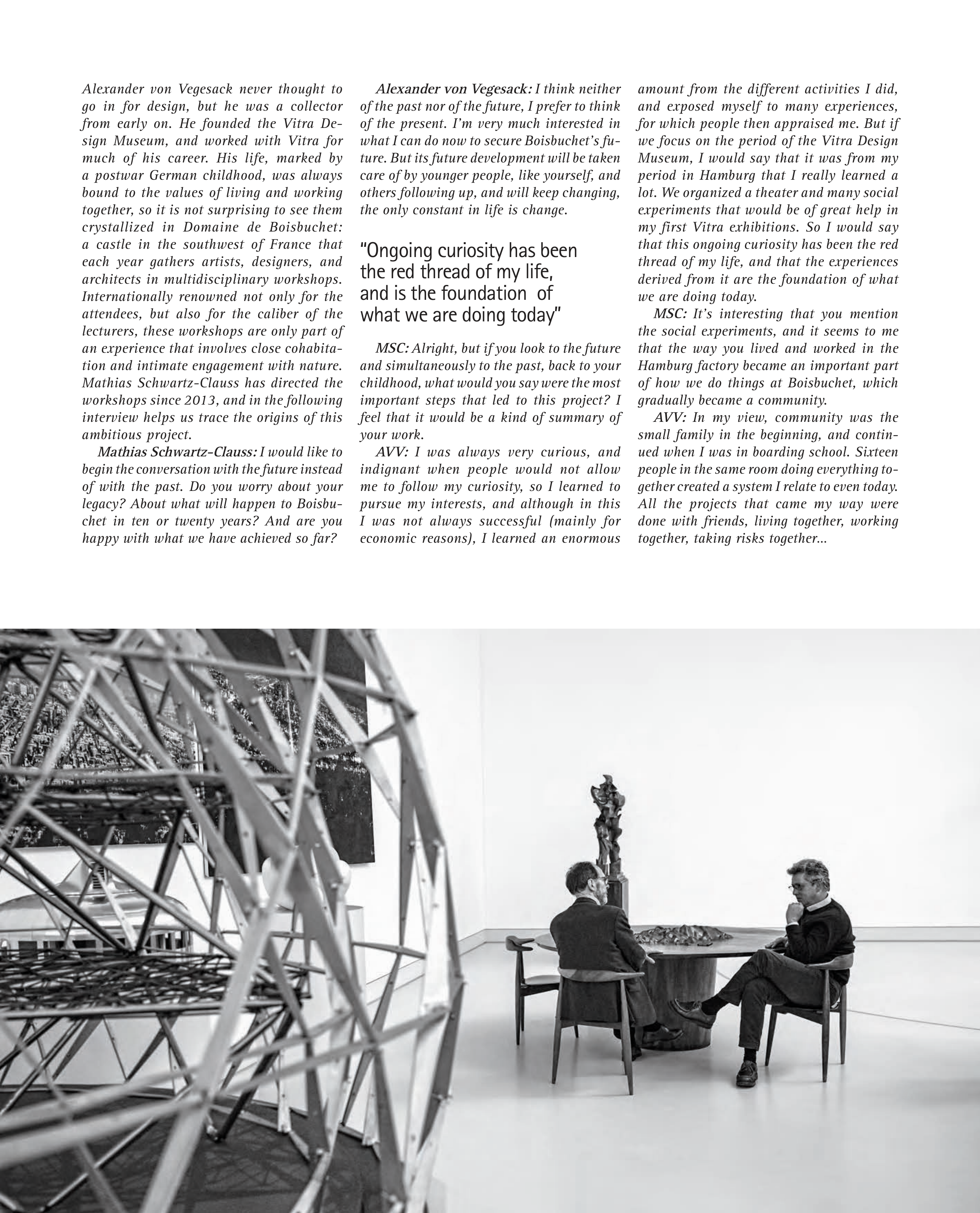
Alexander von Vegesack never thought to
go in for design, but he was a collector
from early on. He founded the Vitra De-
sign Museum, and worked with Vitra for
much of his career. His life, marked by
a postwar German childhood, was always
bound to the values of living and working
together, so it is not surprising to see them
crystallized in Domaine de Boisbuchet:
a castle in the southwest of France that
each year gathers artists, designers, and
architects in multidisciplinary workshops.
Internationally renowned not only for the
attendees, but also for the caliber of the
lecturers, these workshops are only part of
an experience that involves close cohabita-
tion and intimate engagement with nature.
Mathias Schwartz-Clauss has directed the
workshops since 2013, and in the following
interview helps us trace the origins of this
ambitious project.
Mathias Schwartz-Clauss: I would like to
begin the conversation with the future instead
of with the past. Do you worry about your
legacy? About what will happen to Boisbu-
chet in ten or twenty years? And are you
happy with what we have achieved so far?
Alexander von Vegesack: I think neither
of the past nor of the future, I prefer to think
of the present. I’m very much interested in
what I can do now to secure Boisbuchet’s fu-
ture. But its future development will be taken
care of by younger people, like yourself, and
others following up, and will keep changing,
the only constant in life is change.
MSC: Alright, but if you look to the future
and simultaneously to the past, back to your
childhood, what would you say were the most
important steps that led to this project? I
feel that it would be a kind of summary of
your work.
AVV: I was always very curious, and
indignant when people would not allow
me to follow my curiosity, so I learned to
pursue my interests, and although in this
I was not always successful (mainly for
economic reasons), I learned an enormous
amount from the different activities I did,
and exposed myself to many experiences,
for which people then appraised me. But if
we focus on the period of the Vitra Design
Museum, I would say that it was from my
period in Hamburg that I really learned a
lot. We organized a theater and many social
experiments that would be of great help in
my first Vitra exhibitions. So I would say
that this ongoing curiosity has been the red
thread of my life, and that the experiences
derived from it are the foundation of what
we are doing today.
MSC: It’s interesting that you mention
the social experiments, and it seems to me
that the way you lived and worked in the
Hamburg factory became an important part
of how we do things at Boisbuchet, which
gradually became a community.
AVV: In my view, community was the
small family in the beginning, and contin-
ued when I was in boarding school. Sixteen
people in the same room doing everything to-
gether created a system I relate to even today.
All the projects that came my way were
done with friends, living together, working
together, taking risks together…
“Ongoing curiosity has been
the red thread of my life,
and is the foundation of
what we are doing today”