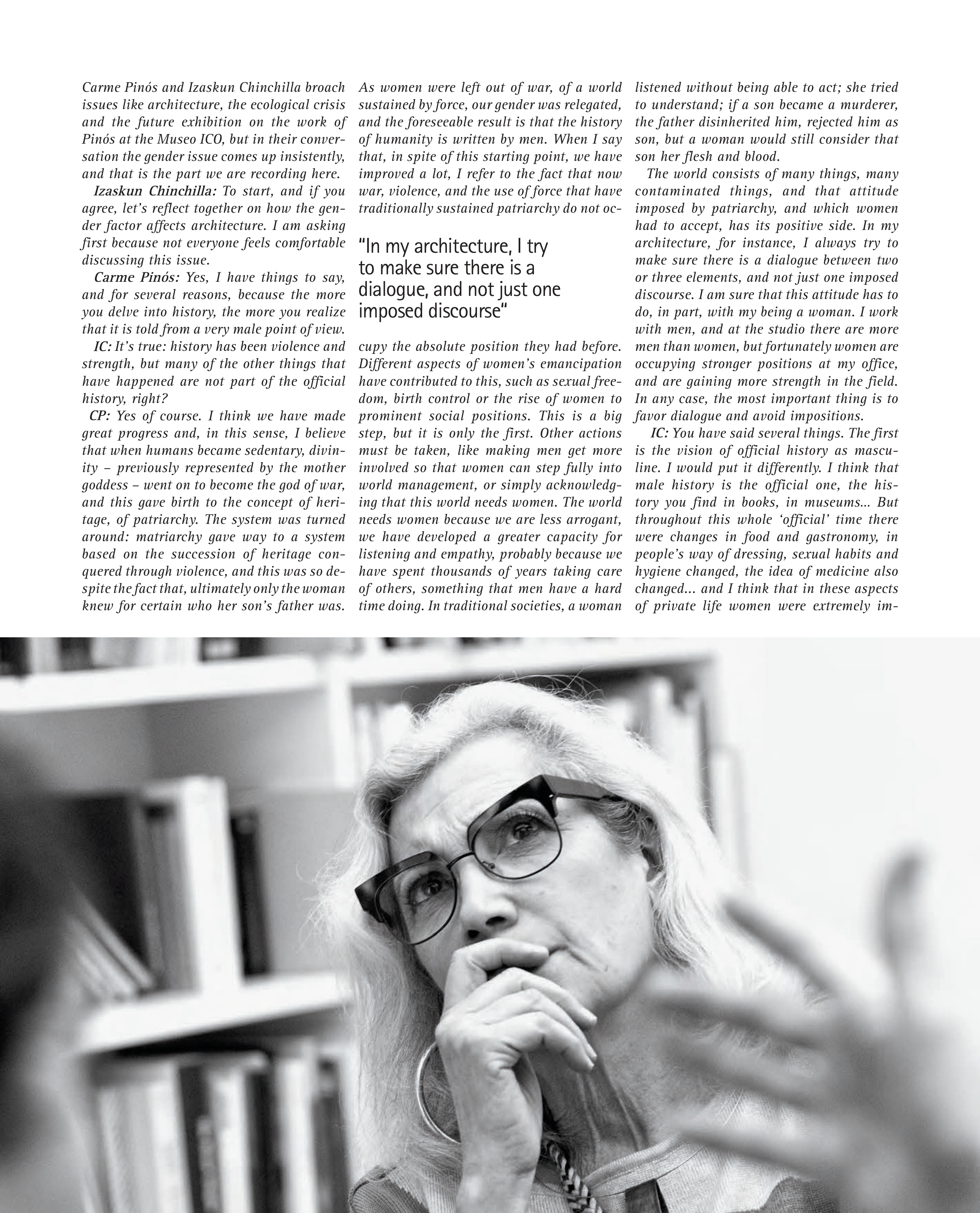
Carme Pinós and Izaskun Chinchilla broach
issues like architecture, the ecological crisis
and the future exhibition on the work of
Pinós at the Museo ICO, but in their conver-
sation the gender issue comes up insistently,
and that is the part we are recording here.
Izaskun Chinchilla: To start, and if you
agree, let’s reflect together on how the gen-
der factor affects architecture. I am asking
first because not everyone feels comfortable
discussing this issue.
Carme Pinós: Yes, I have things to say,
and for several reasons, because the more
you delve into history, the more you realize
that it is told from a very male point of view.
IC: It’s true: history has been violence and
strength, but many of the other things that
have happened are not part of the official
history, right?
CP: Yes of course. I think we have made
great progress and, in this sense, I believe
that when humans became sedentary, divin-
ity – previously represented by the mother
goddess – went on to become the god of war,
and this gave birth to the concept of heri-
tage, of patriarchy. The system was turned
around: matriarchy gave way to a system
based on the succession of heritage con-
quered through violence, and this was so de-
spite the fact that, ultimately only the woman
knew for certain who her son’s father was.
As women were left out of war, of a world
sustained by force, our gender was relegated,
and the foreseeable result is that the history
of humanity is written by men. When I say
that, in spite of this starting point, we have
improved a lot, I refer to the fact that now
war, violence, and the use of force that have
traditionally sustained patriarchy do not oc-
cupy the absolute position they had before.
Different aspects of women’s emancipation
have contributed to this, such as sexual free-
dom, birth control or the rise of women to
prominent social positions. This is a big
step, but it is only the first. Other actions
must be taken, like making men get more
involved so that women can step fully into
world management, or simply acknowledg-
ing that this world needs women. The world
needs women because we are less arrogant,
we have developed a greater capacity for
listening and empathy, probably because we
have spent thousands of years taking care
of others, something that men have a hard
time doing. In traditional societies, a woman
listened without being able to act; she tried
to understand; if a son became a murderer,
the father disinherited him, rejected him as
son, but a woman would still consider that
son her flesh and blood.
The world consists of many things, many
contaminated things, and that attitude
imposed by patriarchy, and which women
had to accept, has its positive side. In my
architecture, for instance, I always try to
make sure there is a dialogue between two
or three elements, and not just one imposed
discourse. I am sure that this attitude has to
do, in part, with my being a woman. I work
with men, and at the studio there are more
men than women, but fortunately women are
occupying stronger positions at my office,
and are gaining more strength in the field.
In any case, the most important thing is to
favor dialogue and avoid impositions.
IC: You have said several things. The first
is the vision of official history as mascu-
line. I would put it differently. I think that
male history is the official one, the his-
tory you find in books, in museums… But
throughout this whole ‘official’ time there
were changes in food and gastronomy, in
people’s way of dressing, sexual habits and
hygiene changed, the idea of medicine also
changed... and I think that in these aspects
of private life women were extremely im-
“In my architecture, I try
to make sure there is a
dialogue, and not just one
imposed discourse“