70 C 15
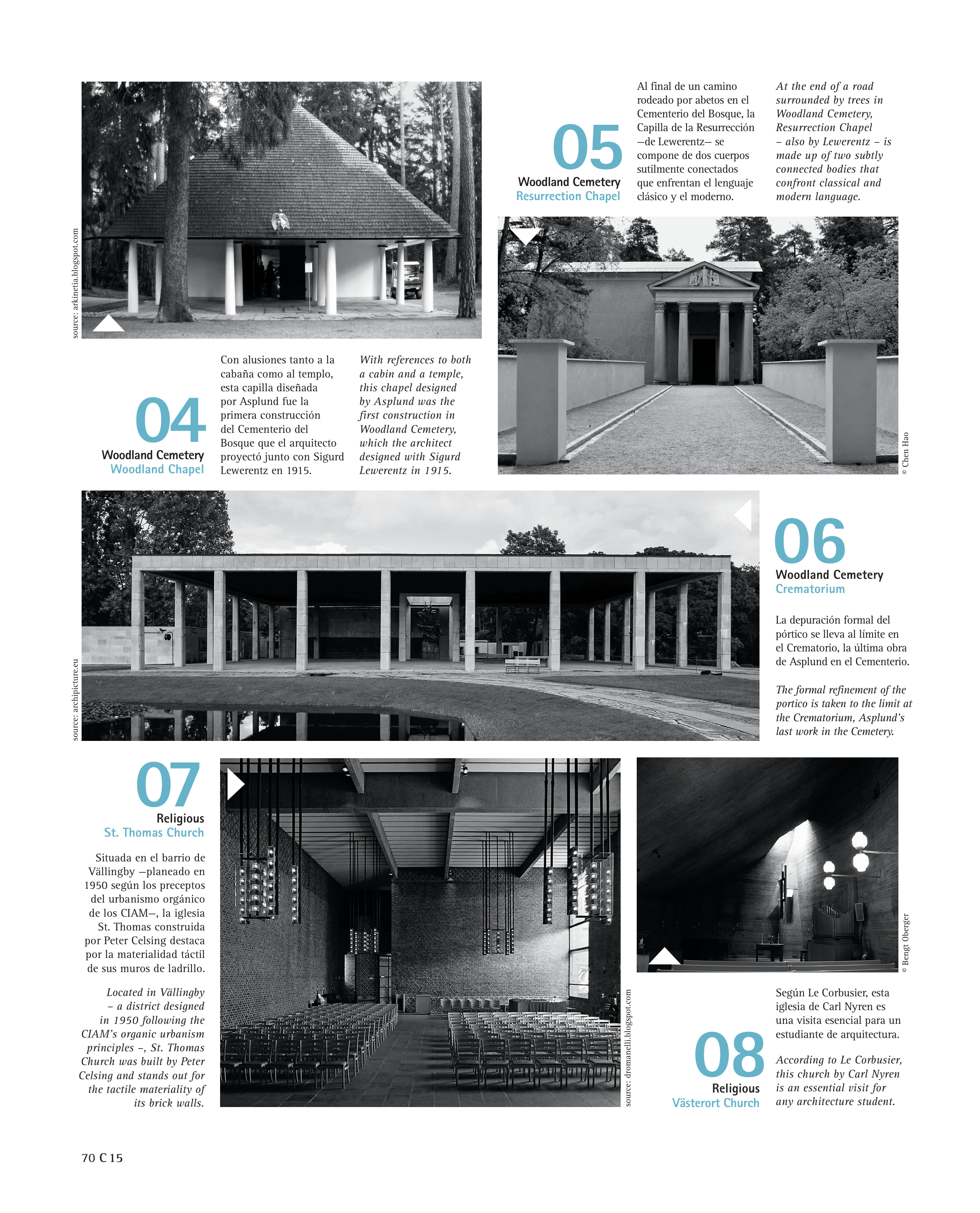
Located in Vällingby
– a district designed
in 1950 following the
CIAM’s organic urbanism
principles –, St. Thomas
Church was built by Peter
Celsing and stands out for
the tactile materiality of
its brick walls.
Situada en el barrio de
Vällingby —planeado en
1950 según los preceptos
del urbanismo orgánico
de los CIAM—, la iglesia
St. Thomas construida
por Peter Celsing destaca
por la materialidad táctil
de sus muros de ladrillo.
Religious
St. Thomas Church
07
08
Religious
Västerort Church
05
Woodland Cemetery
Resurrection Chapel
Al final de un camino
rodeado por abetos en el
Cementerio del Bosque, la
Capilla de la Resurrección
—de Lewerentz— se
compone de dos cuerpos
sutilmente conectados
que enfrentan el lenguaje
clásico y el moderno.
At the end of a road
surrounded by trees in
Woodland Cemetery,
Resurrection Chapel
– also by Lewerentz – is
made up of two subtly
connected bodies that
confront classical and
modern language.
04
Woodland Cemetery
Woodland Chapel
Con alusiones tanto a la
cabaña como al templo,
esta capilla diseñada
por Asplund fue la
primera construcción
del Cementerio del
Bosque que el arquitecto
proyectó junto con Sigurd
Lewerentz en 1915.
With references to both
a cabin and a temple,
this chapel designed
by Asplund was the
first construction in
Woodland Cemetery,
which the architect
designed with Sigurd
Lewerentz in 1915.
According to Le Corbusier,
this church by Carl Nyren
is an essential visit for
any architecture student.
The formal refinement of the
portico is taken to the limit at
the Crematorium, Asplund’s
last work in the Cemetery.
Según Le Corbusier, esta
iglesia de Carl Nyren es
una visita esencial para un
estudiante de arquitectura.
La depuración formal del
pórtico se lleva al límite en
el Crematorio, la última obra
de Asplund en el Cementerio.
Woodland Cemetery
Crematorium
06
source: arkinetia.blogspot.com
© Chen Hao
source: archipicture.eu
source: dromanelli.blogspot.com
© Bengt Oberger