Architect of tenacious theoretical interests,
Peter Eisenman was born into a family of
European origin, completed his intellec-
tual training in Europe and had as men-
tors, successively, the British critic Colin
Rowe, the Italian historian Manfredo Ta-
furi, and the French philosopher Jacques
Derrida. Bridging the young architecture
of the East Coast of the United States and
the new currents of the Old Continent, his
cultural activism through magazines, en-
counters, and research groups like the In-
stitute for Architecture and Urban Studies
turned him into a representative of a new
professional attitude, expressed also in a
series of highly influential domestic proj-
ects. After taking part in several European
competitions where he explored the dialogue
between geometric abstraction and urban
topography, he completed his first important
works in the the state of Ohio – the Wexner,
the Aronoff, and the Columbus Convention
centers –, all expressions of the disjointed
volumes of the deconstructivist aesthetic.
However, his most ambitious and prominent
projects would be completed at the turn of
the century, and both are in Europe: the
Jewish Memorial in Berlin, a tragic and lyri-
cal field of concrete stellae that recalls the
Holocaust in the heart of Germany; and the
City of Culture of Galicia, a colossal complex
of topographically modelled buildings that
hasn’t been completed yet.
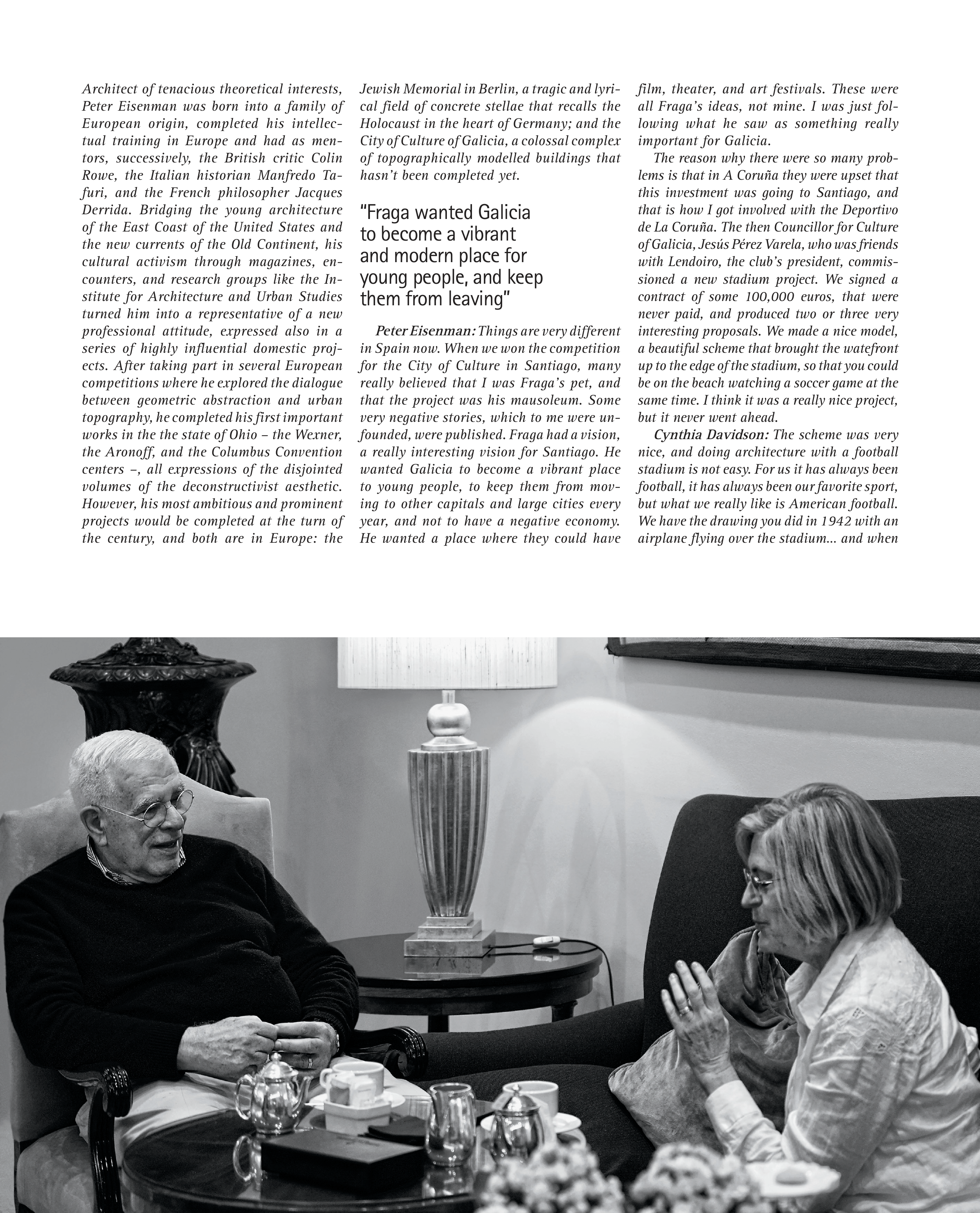
Peter Eisenman: Things are very different
in Spain now. When we won the competition
for the City of Culture in Santiago, many
really believed that I was Fraga’s pet, and
that the project was his mausoleum. Some
very negative stories, which to me were un-
founded, were published. Fraga had a vision,
a really interesting vision for Santiago. He
wanted Galicia to become a vibrant place
to young people, to keep them from mov-
ing to other capitals and large cities every
year, and not to have a negative economy.
He wanted a place where they could have
film, theater, and art festivals. These were
all Fraga’s ideas, not mine. I was just fol-
lowing what he saw as something really
important for Galicia.
The reason why there were so many prob-
lems is that in A Coruña they were upset that
this investment was going to Santiago, and
that is how I got involved with the Deportivo
de La Coruña. The then Councillor for Culture
of Galicia, Jesús Pérez Varela, who was friends
with Lendoiro, the club’s president, commis-
sioned a new stadium project. We signed a
contract of some 100,000 euros, that were
never paid, and produced two or three very
interesting proposals. We made a nice model,
a beautiful scheme that brought the watefront
up to the edge of the stadium, so that you could
be on the beach watching a soccer game at the
same time. I think it was a really nice project,
but it never went ahead.
Cynthia Davidson: The scheme was very
nice, and doing architecture with a football
stadium is not easy. For us it has always been
football, it has always been our favorite sport,
but what we really like is American football.
We have the drawing you did in 1942 with an
airplane flying over the stadium… and when
“Fraga wanted Galicia
to become a vibrant
and modern place for
young people, and keep
them from leaving”