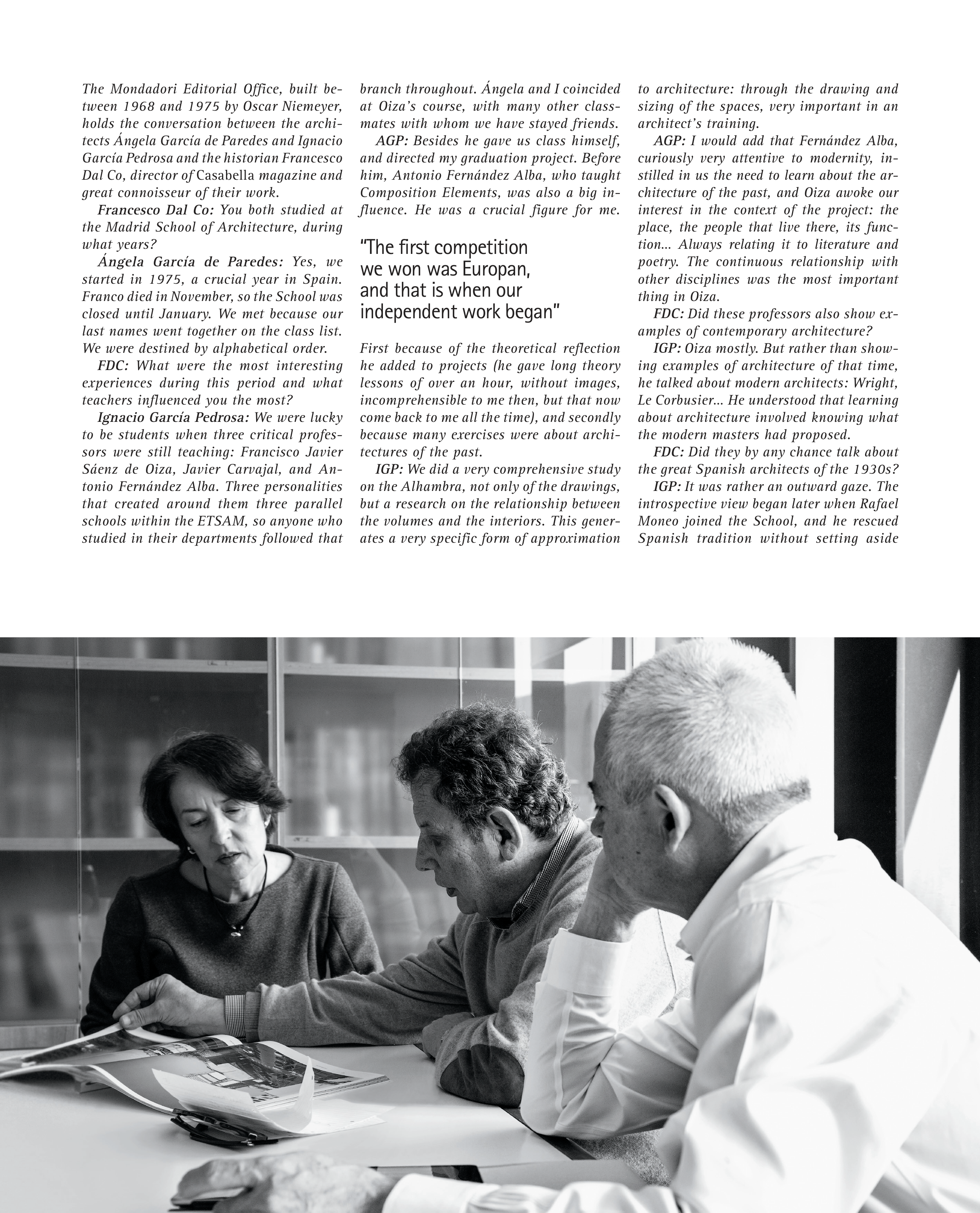
The Mondadori Editorial Office, built be-
tween 1968 and 1975 by Oscar Niemeyer,
holds the conversation between the archi-
tects Ángela García de Paredes and Ignacio
García Pedrosa and the historian Francesco
Dal Co, director of Casabella magazine and
great connoisseur of their work.
Francesco Dal Co: You both studied at
the Madrid School of Architecture, during
what years?
Ángela García de Paredes: Yes, we
started in 1975, a crucial year in Spain.
Franco died in November, so the School was
closed until January. We met because our
last names went together on the class list.
We were destined by alphabetical order.
FDC: What were the most interesting
experiences during this period and what
teachers influenced you the most?
Ignacio García Pedrosa: We were lucky
to be students when three critical profes-
sors were still teaching: Francisco Javier
Sáenz de Oiza, Javier Carvajal, and An-
tonio Fernández Alba. Three personalities
that created around them three parallel
schools within the ETSAM, so anyone who
studied in their departments followed that
branch throughout. Ángela and I coincided
at Oiza’s course, with many other class-
mates with whom we have stayed friends.
AGP: Besides he gave us class himself,
and directed my graduation project. Before
him, Antonio Fernández Alba, who taught
Composition Elements, was also a big in-
fluence. He was a crucial figure for me.
First because of the theoretical reflection
he added to projects (he gave long theory
lessons of over an hour, without images,
incomprehensible to me then, but that now
come back to me all the time), and secondly
because many exercises were about archi-
tectures of the past.
IGP: We did a very comprehensive study
on the Alhambra, not only of the drawings,
but a research on the relationship between
the volumes and the interiors. This gener-
ates a very specific form of approximation
to architecture: through the drawing and
sizing of the spaces, very important in an
architect’s training.
AGP: I would add that Fernández Alba,
curiously very attentive to modernity, in-
stilled in us the need to learn about the ar-
chitecture of the past, and Oiza awoke our
interest in the context of the project: the
place, the people that live there, its func-
tion… Always relating it to literature and
poetry. The continuous relationship with
other disciplines was the most important
thing in Oiza.
FDC: Did these professors also show ex-
amples of contemporary architecture?
IGP: Oiza mostly. But rather than show-
ing examples of architecture of that time,
he talked about modern architects: Wright,
Le Corbusier… He understood that learning
about architecture involved knowing what
the modern masters had proposed.
FDC: Did they by any chance talk about
the great Spanish architects of the 1930s?
IGP: It was rather an outward gaze. The
introspective view began later when Rafael
Moneo joined the School, and he rescued
Spanish tradition without setting aside
“The first competition
we won was Europan,
and that is when our
independent work began”