C 11 43
You’re not running around with flags. I’m
interested in individuals. Yes, when you grow
up, you grow up in a place, a language, and
a culture, which helps, but you have to claim
freedom from it.
Let’s talk about materials. Your experi-
ence in materials is wide, versatile, and
very innovative. Often the material itself
becomes the concept. What comes first, the
concept or the material?
It’s a two-way thing. Sometimes you see ma-
terials and processes and you think: “What
can I do with it? This is so amazing. What
shall we do with it.” Even this morning, dur-
ing my visit to the amazing city you have here
that is all about materials and processes,
my mind went: “What can I do, what can
we do…” Sometimes you have an idea and
you think: “What will be the best material
to use? What will be the best process? Who
will be the best fabricator?” Which in a way
is why we’re here. We designed the part that
we’re going to use before I knew the word
‘Dekton.’ You designed it before I knew of
your existence. And with a little research,
we found ourselves here. And now we’re here
and seeing what we can do, and it will mean
that we can do other stuff that we haven’t
done yet, that we don’t know about. So it’s
a two-way thing.
You built the seventh floor of Hotel
Puerta América in Madrid and you were
exhibited in Ivorypress as well. What is
your relationship with Spain?
I also had a really nice exhibition on the
Ramblas, in Barcelona, because I had won an
award. But Spain is also my favorite place
for holidays. I’m a neighbor here, I go to
Formentera. It was introduced to me by Javier
Mariscal many years ago. We did an exhibi-
tion to celebrate the tenth anniversary of the
Pompidou Center. They chose ten designers
to represent all the different directions of
design. I represented ruinism because I was
playing with concrete that I broke, don’t ask
me why. Mariscal and I were the youngest.
There were all sorts of Mendinis… We had no
choice, we became very good friends because
we were the little boys. And then Mariscal
started charming us and pulling us to Bar-
celona, Formentera… He did a very good job.
Do you compare your work with your
contemporaries?
I believe so. Everything you do, if it is vis-
ible enough, or visible at all, and if it offers
something new, is part of a dialogue. When I
go to an exhibition or I go to see something,
and I’m not jealous, it’s not good. If I go to
an exhibition and there’s no jealousy, I think:
“Why am I wasting my time here?” At the
same time, when I have an idea, I think: “Is
it good or not?” If I saw these glasses in a
gallery or, since this is not art, in an opti-
cian’s shop, would I be jealous? If the answer
is yes, then I go ahead and do it. But if the
answer is no…
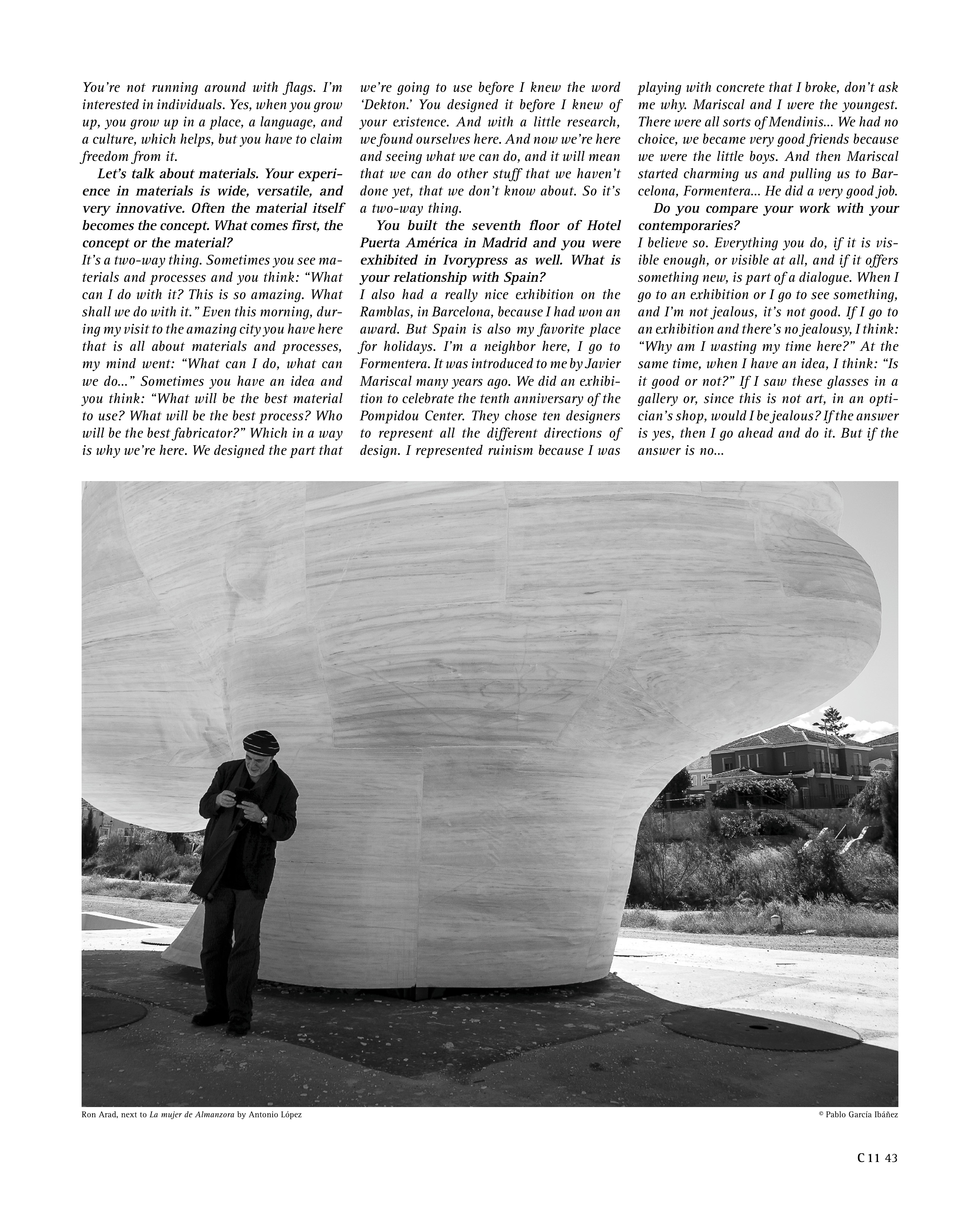
Ron Arad, next to La mujer de Almanzora by Antonio López
© Pablo García Ibáñez