C 11 41
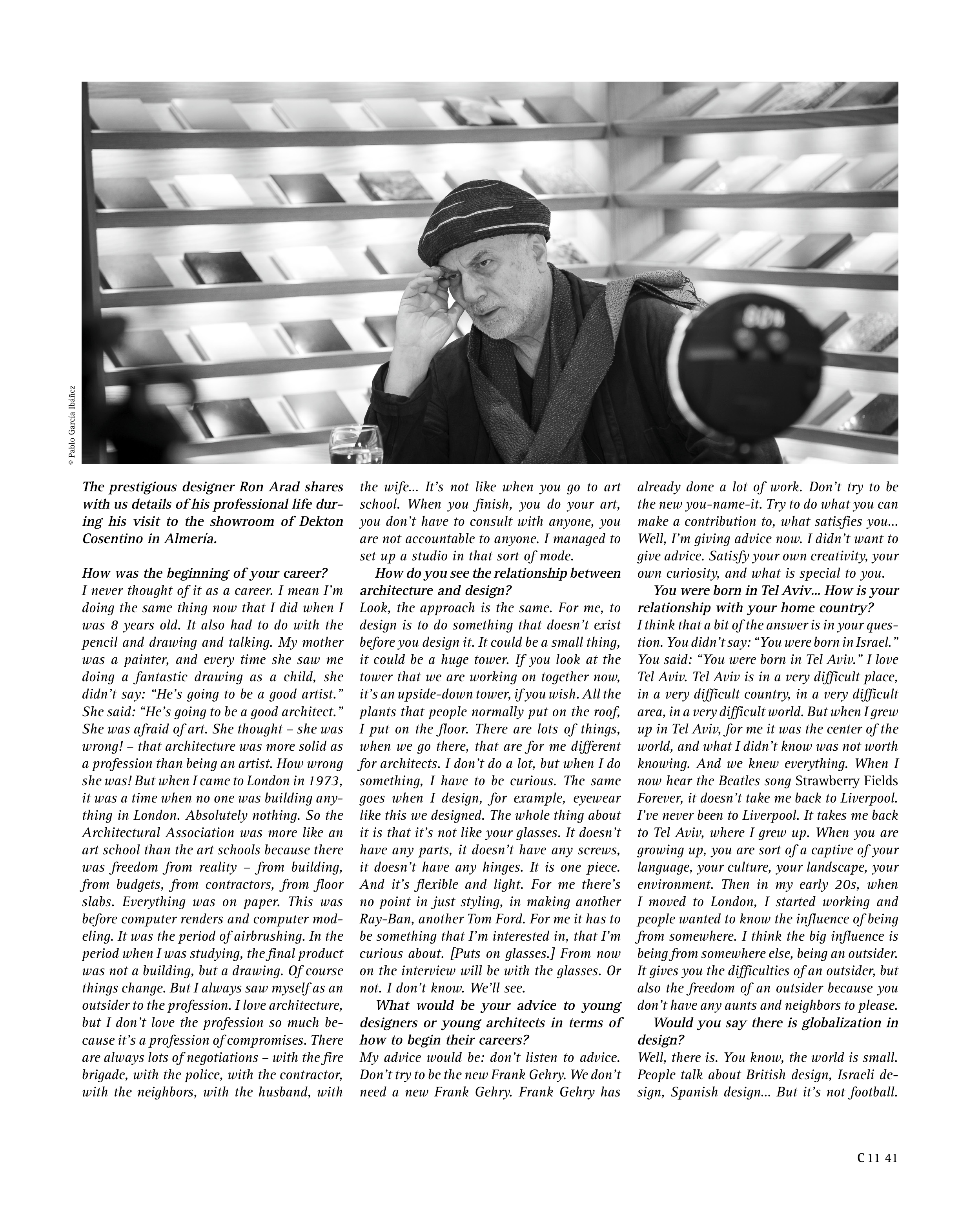
© Pablo García Ibáñez
The prestigious designer Ron Arad shares
with us details of his professional life dur-
ing his visit to the showroom of Dekton
Cosentino in Almería.
How was the beginning of your career?
I never thought of it as a career. I mean I’m
doing the same thing now that I did when I
was 8 years old. It also had to do with the
pencil and drawing and talking. My mother
was a painter, and every time she saw me
doing a fantastic drawing as a child, she
didn’t say: “He’s going to be a good artist.”
She said: “He’s going to be a good architect.”
She was afraid of art. She thought – she was
wrong! – that architecture was more solid as
a profession than being an artist. How wrong
she was! But when I came to London in 1973,
it was a time when no one was building any-
thing in London. Absolutely nothing. So the
Architectural Association was more like an
art school than the art schools because there
was freedom from reality – from building,
from budgets, from contractors, from floor
slabs. Everything was on paper. This was
before computer renders and computer mod-
eling. It was the period of airbrushing. In the
period when I was studying, the final product
was not a building, but a drawing. Of course
things change. But I always saw myself as an
outsider to the profession. I love architecture,
but I don’t love the profession so much be-
cause it’s a profession of compromises. There
are always lots of negotiations – with the fire
brigade, with the police, with the contractor,
with the neighbors, with the husband, with
the wife… It’s not like when you go to art
school. When you finish, you do your art,
you don’t have to consult with anyone, you
are not accountable to anyone. I managed to
set up a studio in that sort of mode.
How do you see the relationship between
architecture and design?
Look, the approach is the same. For me, to
design is to do something that doesn’t exist
before you design it. It could be a small thing,
it could be a huge tower. If you look at the
tower that we are working on together now,
it’s an upside-down tower, if you wish. All the
plants that people normally put on the roof,
I put on the floor. There are lots of things,
when we go there, that are for me different
for architects. I don’t do a lot, but when I do
something, I have to be curious. The same
goes when I design, for example, eyewear
like this we designed. The whole thing about
it is that it’s not like your glasses. It doesn’t
have any parts, it doesn’t have any screws,
it doesn’t have any hinges. It is one piece.
And it’s flexible and light. For me there’s
no point in just styling, in making another
Ray-Ban, another Tom Ford. For me it has to
be something that I’m interested in, that I’m
curious about. [Puts on glasses.] From now
on the interview will be with the glasses. Or
not. I don’t know. We’ll see.
What would be your advice to young
designers or young architects in terms of
how to begin their careers?
My advice would be: don’t listen to advice.
Don’t try to be the new Frank Gehry. We don’t
need a new Frank Gehry. Frank Gehry has
already done a lot of work. Don’t try to be
the new you-name-it. Try to do what you can
make a contribution to, what satisfies you…
Well, I’m giving advice now. I didn’t want to
give advice. Satisfy your own creativity, your
own curiosity, and what is special to you.
You were born in Tel Aviv… How is your
relationship with your home country?
I think that a bit of the answer is in your ques-
tion. You didn’t say: “You were born in Israel.”
You said: “You were born in Tel Aviv.” I love
Tel Aviv. Tel Aviv is in a very difficult place,
in a very difficult country, in a very difficult
area, in a very difficult world. But when I grew
up in Tel Aviv, for me it was the center of the
world, and what I didn’t know was not worth
knowing. And we knew everything. When I
now hear the Beatles song Strawberry Fields
Forever, it doesn’t take me back to Liverpool.
I’ve never been to Liverpool. It takes me back
to Tel Aviv, where I grew up. When you are
growing up, you are sort of a captive of your
language, your culture, your landscape, your
environment. Then in my early 20s, when
I moved to London, I started working and
people wanted to know the influence of being
from somewhere. I think the big influence is
being from somewhere else, being an outsider.
It gives you the difficulties of an outsider, but
also the freedom of an outsider because you
don’t have any aunts and neighbors to please.
Would you say there is globalization in
design?
Well, there is. You know, the world is small.
People talk about British design, Israeli de-
sign, Spanish design… But it’s not football.