C 06 49
inflatable form from the outside, as in the Domecrete system by
Israeli architects Haim and Raphael Heifetz (Heifetz System) or the
spectacular domes spanning up to 36 meters by the Italian archi-
tect Dante Bini (Binishell System). And others, like the American
Monolithic Dome System, were built by spraying from the interior
to ensure that the inflatable membrane makes the concrete’s exterior
waterproof. The most widely known system is the patented Concrete
Canvas. In this case the inflated membrane is a three-dimensional
fiber matrix whose interior contains a mixture of dry concrete that
hardens when hydrated with water from the exterior, and once cast
the fibers reinforce the concrete.
Membranes of Inflated Elements
Unlike the previous examples, in these systems pressure goes into
the the enclosing elements and not the contained space, making it
easier to design more complex forms. In this case the precinct does
not need to be watertight, so there is a free-flowing relationship
between interior and exterior, with no need for doors.
This formal freedom and absence of doors can be seen in projects
like the Tuballoon by Snøhetta (2006), the Air Forest by Mass Studies
(2008) and the Golden Dome by AmidCero9 (2011). The Tubaloon
is 40 meters long and 20 meters tall, and covers jazz concert stages,
with a suggestive shape the evokes wind instruments or the geom-
etries of the inner ear. Further formal evocations can be found in
the design by Mass Studies for City Park in Denver, a spectacular
forest made of nylon fabric with gradients of silver dots that move,
like leaves, with the wind and pressure changes, making visitors feel
as if they were inside a living animal. And the more daring Golden
Dome is a helium-filled form, a prototype of which was displayed
at Tokyo’s Museum of Contemporary Art.
However, the most important developments have been achieved
with the repetition of inflated forms that are then sown together.
Lenticular forms or cushions, these elements can often be combined
and held by auxiliary metallic structures or cylinders that, folded
or arched, take on all the loadbearing responsiblity.
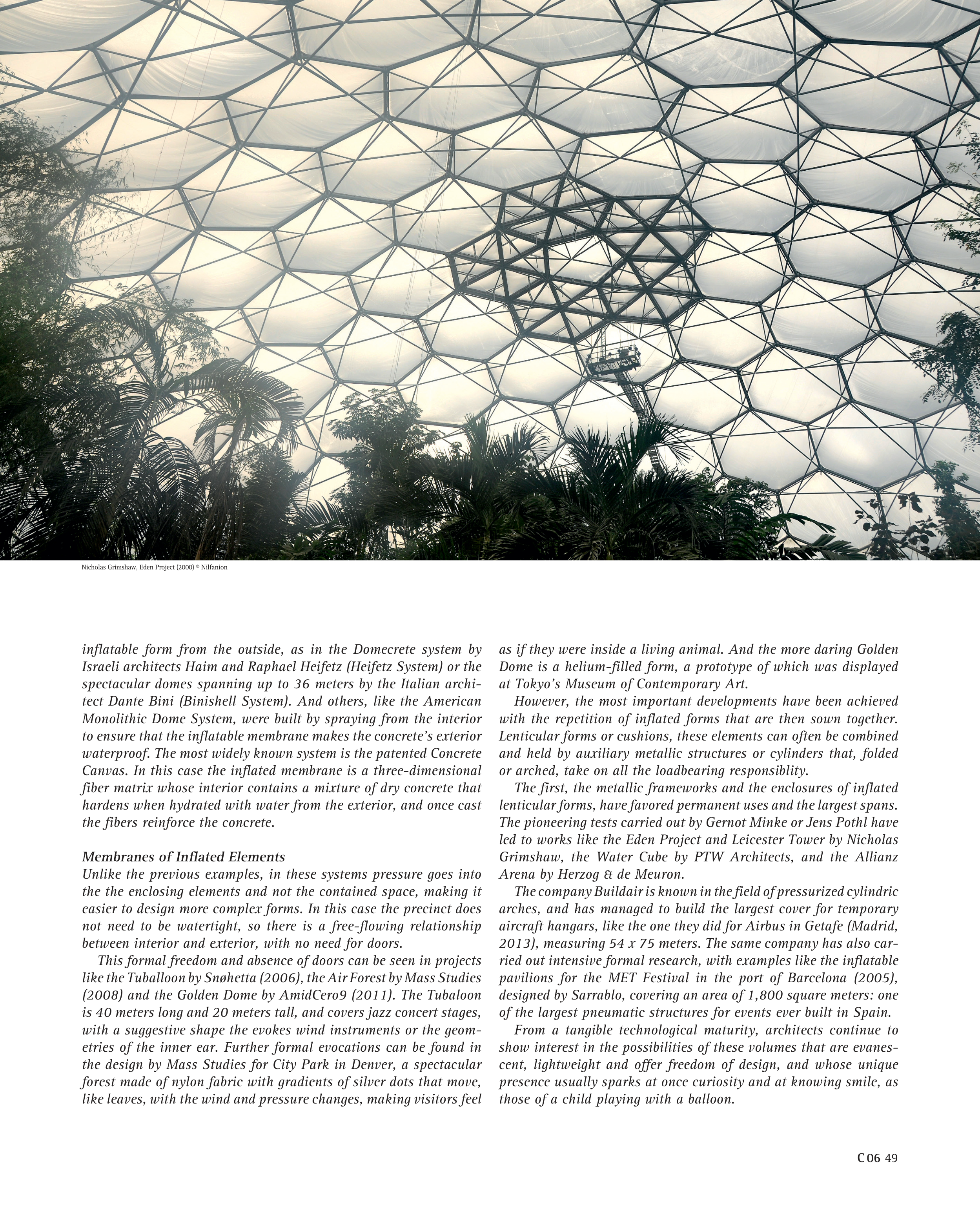
The first, the metallic frameworks and the enclosures of inflated
lenticular forms, have favored permanent uses and the largest spans.
The pioneering tests carried out by Gernot Minke or Jens Pothl have
led to works like the Eden Project and Leicester Tower by Nicholas
Grimshaw, the Water Cube by PTW Architects, and the Allianz
Arena by Herzog & de Meuron.
The company Buildair is known in the field of pressurized cylindric
arches, and has managed to build the largest cover for temporary
aircraft hangars, like the one they did for Airbus in Getafe (Madrid,
2013), measuring 54 x 75 meters. The same company has also car-
ried out intensive formal research, with examples like the inflatable
pavilions for the MET Festival in the port of Barcelona (2005),
designed by Sarrablo, covering an area of 1,800 square meters: one
of the largest pneumatic structures for events ever built in Spain.
From a tangible technological maturity, architects continue to
show interest in the possibilities of these volumes that are evanes-
cent, lightweight and offer freedom of design, and whose unique
presence usually sparks at once curiosity and at knowing smile, as
those of a child playing with a balloon.
Nicholas Grimshaw, Eden Project (2000) © Nilfanion