C 06 45
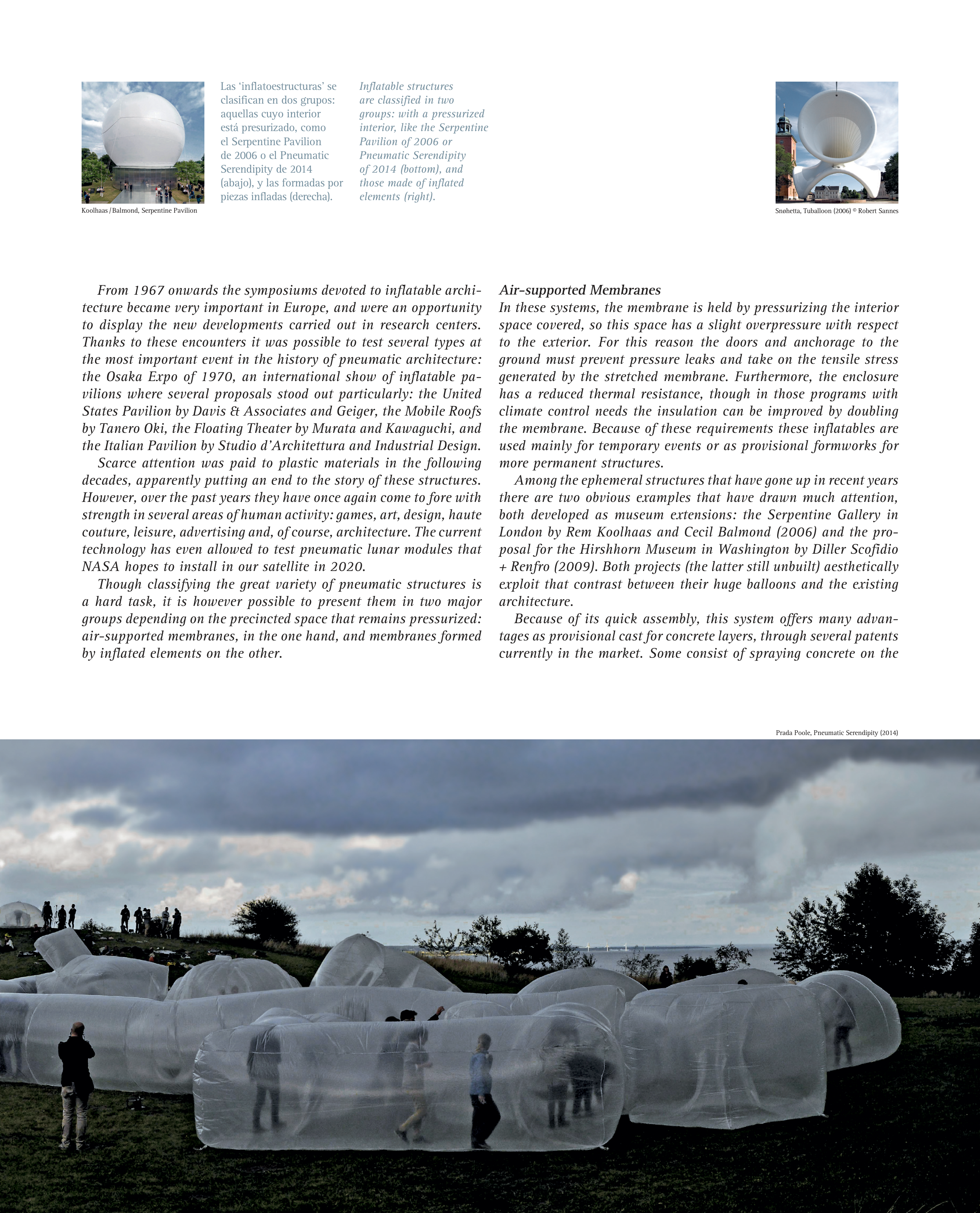
Las ‘inflatoestructuras’ se
clasifican en dos grupos:
aquellas cuyo interior
está presurizado, como
el Serpentine Pavilion
de 2006 o el Pneumatic
Serendipity de 2014
(abajo), y las formadas por
piezas infladas (derecha).
Inflatable structures
are classified in two
groups: with a pressurized
interior, like the Serpentine
Pavilion of 2006 or
Pneumatic Serendipity
of 2014 (bottom), and
those made of inflated
elements (right).
From 1967 onwards the symposiums devoted to inflatable archi-
tecture became very important in Europe, and were an opportunity
to display the new developments carried out in research centers.
Thanks to these encounters it was possible to test several types at
the most important event in the history of pneumatic architecture:
the Osaka Expo of 1970, an international show of inflatable pa-
vilions where several proposals stood out particularly: the United
States Pavilion by Davis & Associates and Geiger, the Mobile Roofs
by Tanero Oki, the Floating Theater by Murata and Kawaguchi, and
the Italian Pavilion by Studio d’Architettura and Industrial Design.
Scarce attention was paid to plastic materials in the following
decades, apparently putting an end to the story of these structures.
However, over the past years they have once again come to fore with
strength in several areas of human activity: games, art, design, haute
couture, leisure, advertising and, of course, architecture. The current
technology has even allowed to test pneumatic lunar modules that
NASA hopes to install in our satellite in 2020.
Though classifying the great variety of pneumatic structures is
a hard task, it is however possible to present them in two major
groups depending on the precincted space that remains pressurized:
air-supported membranes, in the one hand, and membranes formed
by inflated elements on the other.
Air-supported Membranes
In these systems, the membrane is held by pressurizing the interior
space covered, so this space has a slight overpressure with respect
to the exterior. For this reason the doors and anchorage to the
ground must prevent pressure leaks and take on the tensile stress
generated by the stretched membrane. Furthermore, the enclosure
has a reduced thermal resistance, though in those programs with
climate control needs the insulation can be improved by doubling
the membrane. Because of these requirements these inflatables are
used mainly for temporary events or as provisional formworks for
more permanent structures.
Among the ephemeral structures that have gone up in recent years
there are two obvious examples that have drawn much attention,
both developed as museum extensions: the Serpentine Gallery in
London by Rem Koolhaas and Cecil Balmond (2006) and the pro-
posal for the Hirshhorn Museum in Washington by Diller Scofidio
+ Renfro (2009). Both projects (the latter still unbuilt) aesthetically
exploit that contrast between their huge balloons and the existing
architecture.
Because of its quick assembly, this system offers many advan-
tages as provisional cast for concrete layers, through several patents
currently in the market. Some consist of spraying concrete on the
Prada Poole, Pneumatic Serendipity (2014)
Snøhetta, Tuballoon (2006) © Robert Sannes
Koolhaas / Balmond, Serpentine Pavilion