C 05 71
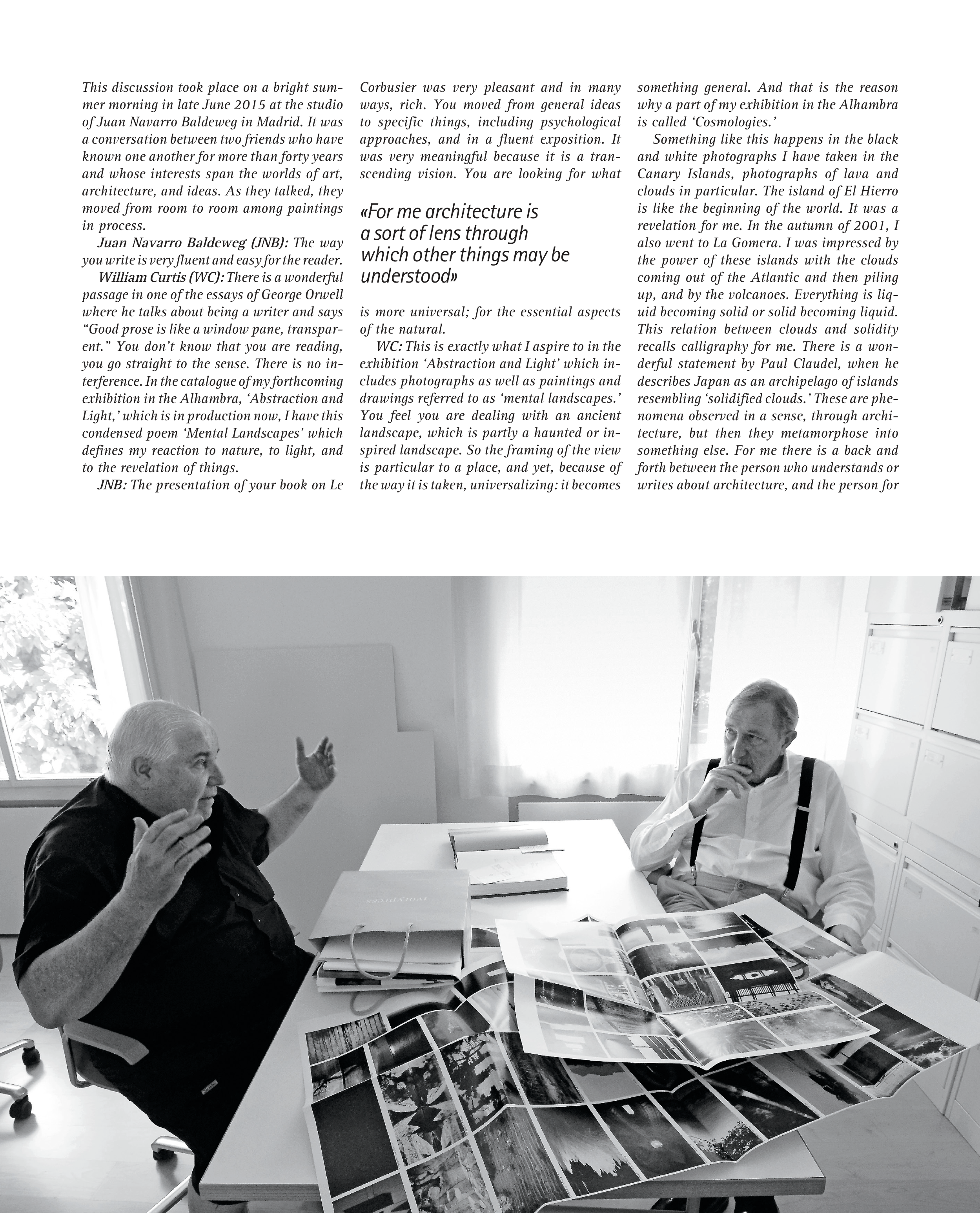
This discussion took place on a bright sum-
mer morning in late June 2015 at the studio
of Juan Navarro Baldeweg in Madrid. It was
a conversation between two friends who have
known one another for more than forty years
and whose interests span the worlds of art,
architecture, and ideas. As they talked, they
moved from room to room among paintings
in process.
Juan Navarro Baldeweg (JNB): The way
you write is very fluent and easy for the reader.
William Curtis (WC): There is a wonderful
passage in one of the essays of George Orwell
where he talks about being a writer and says
“Good prose is like a window pane, transpar-
ent.” You don’t know that you are reading,
you go straight to the sense. There is no in-
terference. In the catalogue of my forthcoming
exhibition in the Alhambra, ‘Abstraction and
Light,’ which is in production now, I have this
condensed poem ‘Mental Landscapes’ which
defines my reaction to nature, to light, and
to the revelation of things.
JNB: The presentation of your book on Le
Corbusier was very pleasant and in many
ways, rich. You moved from general ideas
to specific things, including psychological
approaches, and in a fluent exposition. It
was very meaningful because it is a tran-
scending vision. You are looking for what
something general. And that is the reason
why a part of my exhibition in the Alhambra
is called ‘Cosmologies.’
Something like this happens in the black
and white photographs I have taken in the
Canary Islands, photographs of lava and
clouds in particular. The island of El Hierro
is like the beginning of the world. It was a
revelation for me. In the autumn of 2001, I
also went to La Gomera. I was impressed by
the power of these islands with the clouds
coming out of the Atlantic and then piling
up, and by the volcanoes. Everything is liq-
uid becoming solid or solid becoming liquid.
This relation between clouds and solidity
recalls calligraphy for me. There is a won-
derful statement by Paul Claudel, when he
describes Japan as an archipelago of islands
resembling ‘solidified clouds.’ These are phe-
nomena observed in a sense, through archi-
tecture, but then they metamorphose into
something else. For me there is a back and
forth between the person who understands or
writes about architecture, and the person for
is more universal; for the essential aspects
of the natural.
WC: This is exactly what I aspire to in the
exhibition ‘Abstraction and Light’ which in-
cludes photographs as well as paintings and
drawings referred to as ‘mental landscapes.’
You feel you are dealing with an ancient
landscape, which is partly a haunted or in-
spired landscape. So the framing of the view
is particular to a place, and yet, because of
the way it is taken, universalizing: it becomes
«For me architecture is
a sort of lens through
which other things may be
understood»