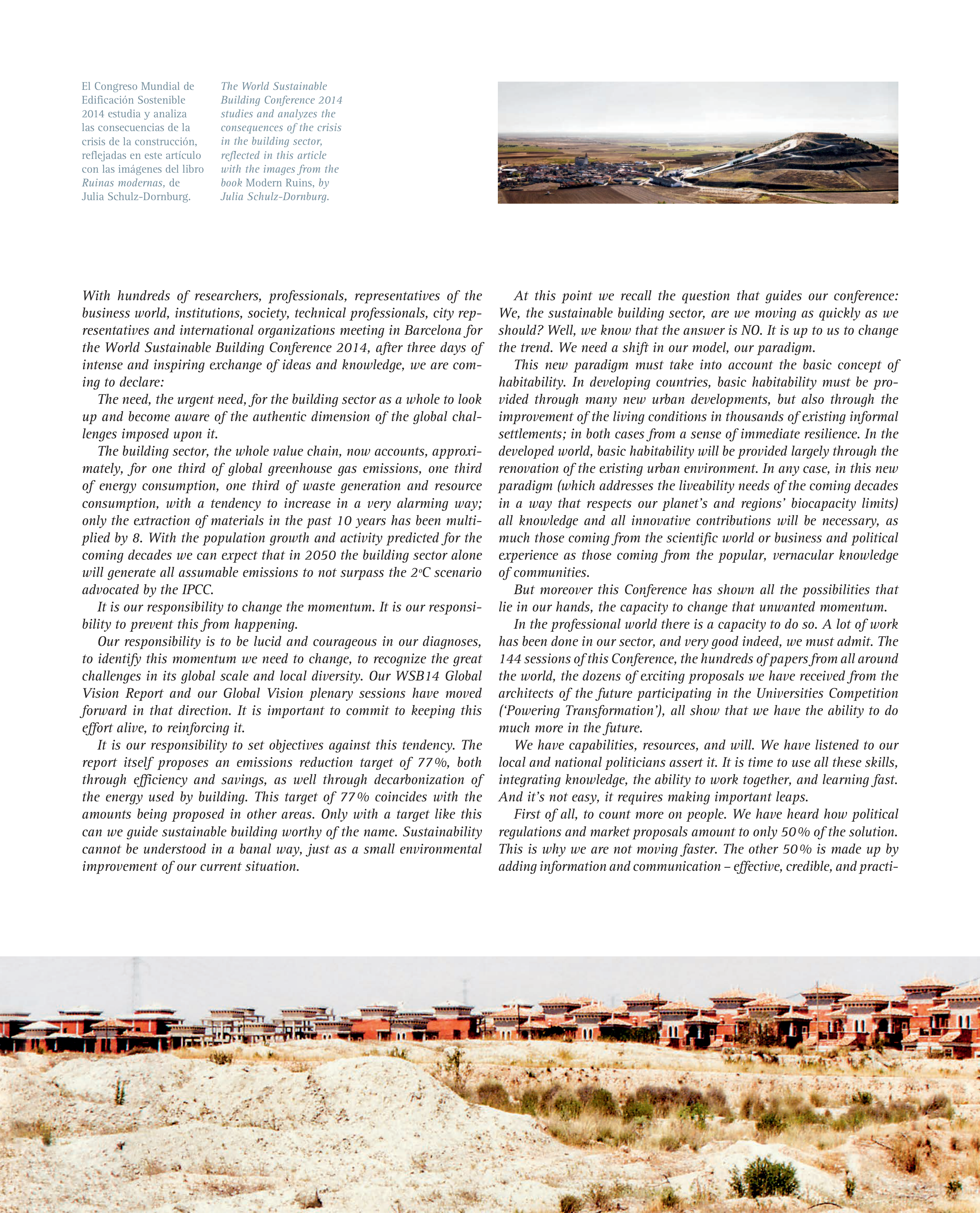
El Congreso Mundial de
Edificación Sostenible
2014 estudia y analiza
las consecuencias de la
crisis de la construcción,
reflejadas en este artículo
con las imágenes del libro
Ruinas modernas, de
Julia Schulz-Dornburg.
The World Sustainable
Building Conference 2014
studies and analyzes the
consequences of the crisis
in the building sector,
reflected in this article
with the images from the
book Modern Ruins, by
Julia Schulz-Dornburg.
With hundreds of researchers, professionals, representatives of the
business world, institutions, society, technical professionals, city rep-
resentatives and international organizations meeting in Barcelona for
the World Sustainable Building Conference 2014, after three days of
intense and inspiring exchange of ideas and knowledge, we are com-
ing to declare:
The need, the urgent need, for the building sector as a whole to look
up and become aware of the authentic dimension of the global chal-
lenges imposed upon it.
The building sector, the whole value chain, now accounts, approxi-
mately, for one third of global greenhouse gas emissions, one third
of energy consumption, one third of waste generation and resource
consumption, with a tendency to increase in a very alarming way;
only the extraction of materials in the past 10 years has been multi-
plied by 8. With the population growth and activity predicted for the
coming decades we can expect that in 2050 the building sector alone
will generate all assumable emissions to not surpass the 2ºC scenario
advocated by the IPCC.
It is our responsibility to change the momentum. It is our responsi-
bility to prevent this from happening.
Our responsibility is to be lucid and courageous in our diagnoses,
to identify this momentum we need to change, to recognize the great
challenges in its global scale and local diversity. Our WSB14 Global
Vision Report and our Global Vision plenary sessions have moved
forward in that direction. It is important to commit to keeping this
effort alive, to reinforcing it.
It is our responsibility to set objectives against this tendency. The
report itself proposes an emissions reduction target of 77%, both
through efficiency and savings, as well through decarbonization of
the energy used by building. This target of 77% coincides with the
amounts being proposed in other areas. Only with a target like this
can we guide sustainable building worthy of the name. Sustainability
cannot be understood in a banal way, just as a small environmental
improvement of our current situation.
At this point we recall the question that guides our conference:
We, the sustainable building sector, are we moving as quickly as we
should? Well, we know that the answer is NO. It is up to us to change
the trend. We need a shift in our model, our paradigm.
This new paradigm must take into account the basic concept of
habitability. In developing countries, basic habitability must be pro-
vided through many new urban developments, but also through the
improvement of the living conditions in thousands of existing informal
settlements; in both cases from a sense of immediate resilience. In the
developed world, basic habitability will be provided largely through the
renovation of the existing urban environment. In any case, in this new
paradigm (which addresses the liveability needs of the coming decades
in a way that respects our planet’s and regions’ biocapacity limits)
all knowledge and all innovative contributions will be necessary, as
much those coming from the scientific world or business and political
experience as those coming from the popular, vernacular knowledge
of communities.
But moreover this Conference has shown all the possibilities that
lie in our hands, the capacity to change that unwanted momentum.
In the professional world there is a capacity to do so. A lot of work
has been done in our sector, and very good indeed, we must admit. The
144 sessions of this Conference, the hundreds of papers from all around
the world, the dozens of exciting proposals we have received from the
architects of the future participating in the Universities Competition
(‘Powering Transformation’), all show that we have the ability to do
much more in the future.
We have capabilities, resources, and will. We have listened to our
local and national politicians assert it. It is time to use all these skills,
integrating knowledge, the ability to work together, and learning fast.
And it’s not easy, it requires making important leaps.
First of all, to count more on people. We have heard how political
regulations and market proposals amount to only 50% of the solution.
This is why we are not moving faster. The other 50% is made up by
adding information and communication – effective, credible, and practi-