C 02 65
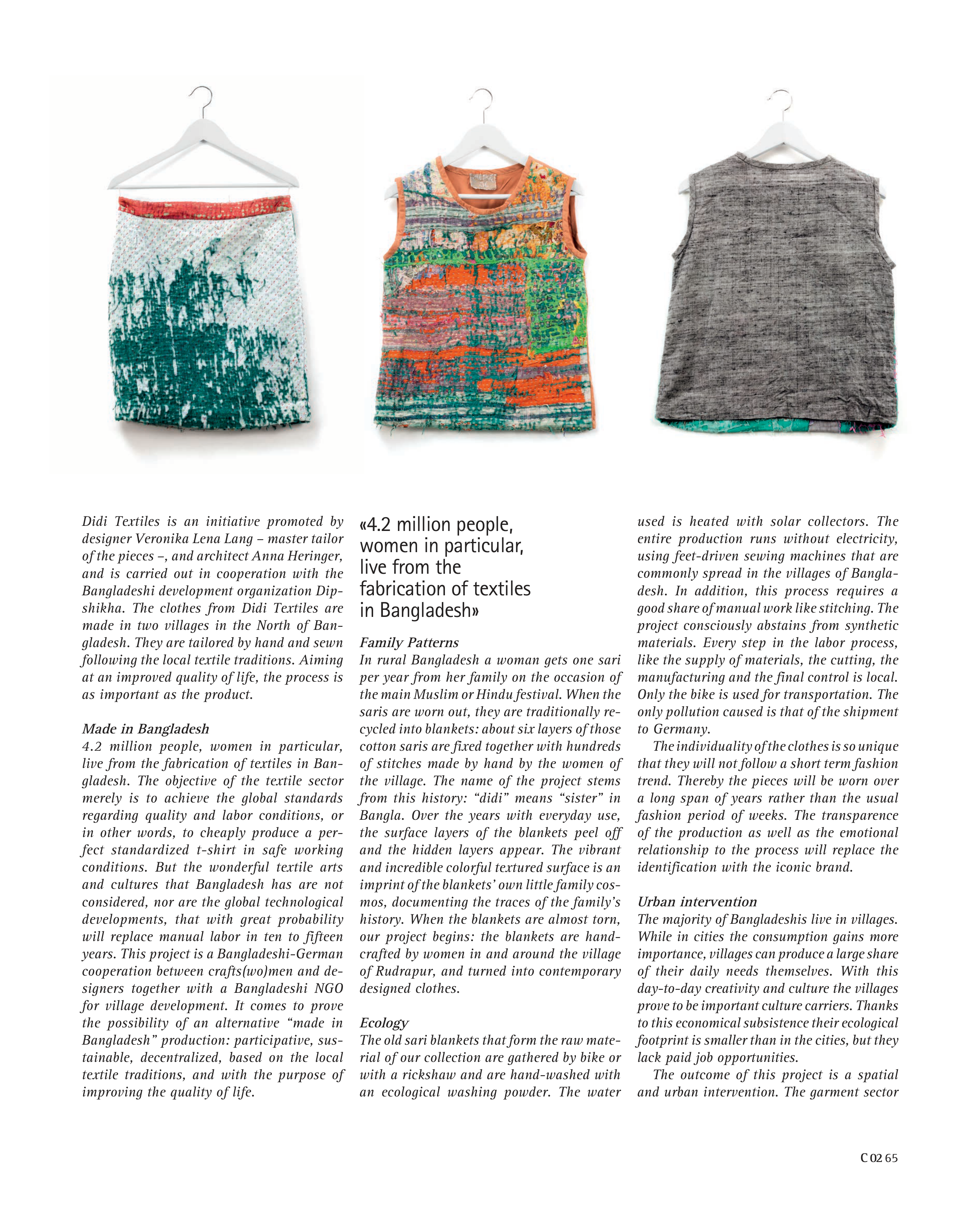
Didi Textiles is an initiative promoted by
designer Veronika Lena Lang – master tailor
of the pieces –, and architect Anna Heringer,
and is carried out in cooperation with the
Bangladeshi development organization Dip-
shikha. The clothes from Didi Textiles are
made in two villages in the North of Ban-
gladesh. They are tailored by hand and sewn
following the local textile traditions. Aiming
at an improved quality of life, the process is
as important as the product.
Made in Bangladesh
4.2 million people, women in particular,
live from the fabrication of textiles in Ban-
gladesh. The objective of the textile sector
merely is to achieve the global standards
regarding quality and labor conditions, or
in other words, to cheaply produce a per-
fect standardized t-shirt in safe working
conditions. But the wonderful textile arts
and cultures that Bangladesh has are not
considered, nor are the global technological
developments, that with great probability
will replace manual labor in ten to fifteen
years. This project is a Bangladeshi-German
cooperation between crafts(wo)men and de-
signers together with a Bangladeshi NGO
for village development. It comes to prove
the possibility of an alternative “made in
Bangladesh” production: participative, sus-
tainable, decentralized, based on the local
textile traditions, and with the purpose of
improving the quality of life.
Family Patterns
In rural Bangladesh a woman gets one sari
per year from her family on the occasion of
the main Muslim or Hindu festival. When the
saris are worn out, they are traditionally re-
cycled into blankets: about six layers of those
cotton saris are fixed together with hundreds
of stitches made by hand by the women of
the village. The name of the project stems
from this history: “didi” means “sister” in
Bangla. Over the years with everyday use,
the surface layers of the blankets peel off
and the hidden layers appear. The vibrant
and incredible colorful textured surface is an
imprint of the blankets’ own little family cos-
mos, documenting the traces of the family’s
history. When the blankets are almost torn,
our project begins: the blankets are hand-
crafted by women in and around the village
of Rudrapur, and turned into contemporary
designed clothes.
Ecology
The old sari blankets that form the raw mate-
rial of our collection are gathered by bike or
with a rickshaw and are hand-washed with
an ecological washing powder. The water
used is heated with solar collectors. The
entire production runs without electricity,
using feet-driven sewing machines that are
commonly spread in the villages of Bangla-
desh. In addition, this process requires a
good share of manual work like stitching. The
project consciously abstains from synthetic
materials. Every step in the labor process,
like the supply of materials, the cutting, the
manufacturing and the final control is local.
Only the bike is used for transportation. The
only pollution caused is that of the shipment
to Germany.
The individuality of the clothes is so unique
that they will not follow a short term fashion
trend. Thereby the pieces will be worn over
a long span of years rather than the usual
fashion period of weeks. The transparence
of the production as well as the emotional
relationship to the process will replace the
identification with the iconic brand.
Urban intervention
The majority of Bangladeshis live in villages.
While in cities the consumption gains more
importance, villages can produce a large share
of their daily needs themselves. With this
day-to-day creativity and culture the villages
prove to be important culture carriers. Thanks
to this economical subsistence their ecological
footprint is smaller than in the cities, but they
lack paid job opportunities.
The outcome of this project is a spatial
and urban intervention. The garment sector
«4.2 million people,
women in particular,
live from the
fabrication of textiles
in Bangladesh»