Kohler Architecture and Digital Fabrication on additive robotic
fabrication of complex timber structures, where the craft of timber
construction design and the craft of computer programming are
directly linked. This involves researching strategically at 1:1 scale,
understanding the digital not only as a metaphor of an architectural
world of unlimited (virtual) possibilities resolved by complex simula-
tions, but as information of matter where constructive and material
characteristics offer unforeseen ventures in conceiving architectural
designs. Such a synthesis develops its full potential in combination
with a manufacturing machine capable of physically carrying out
different materialization processes. An industrial robot meets this
requirement on an architectural building scale. It is a generic tool
and not specialized for one specific activity. It enables to reach into
the conception of new material processes and puts the traditional
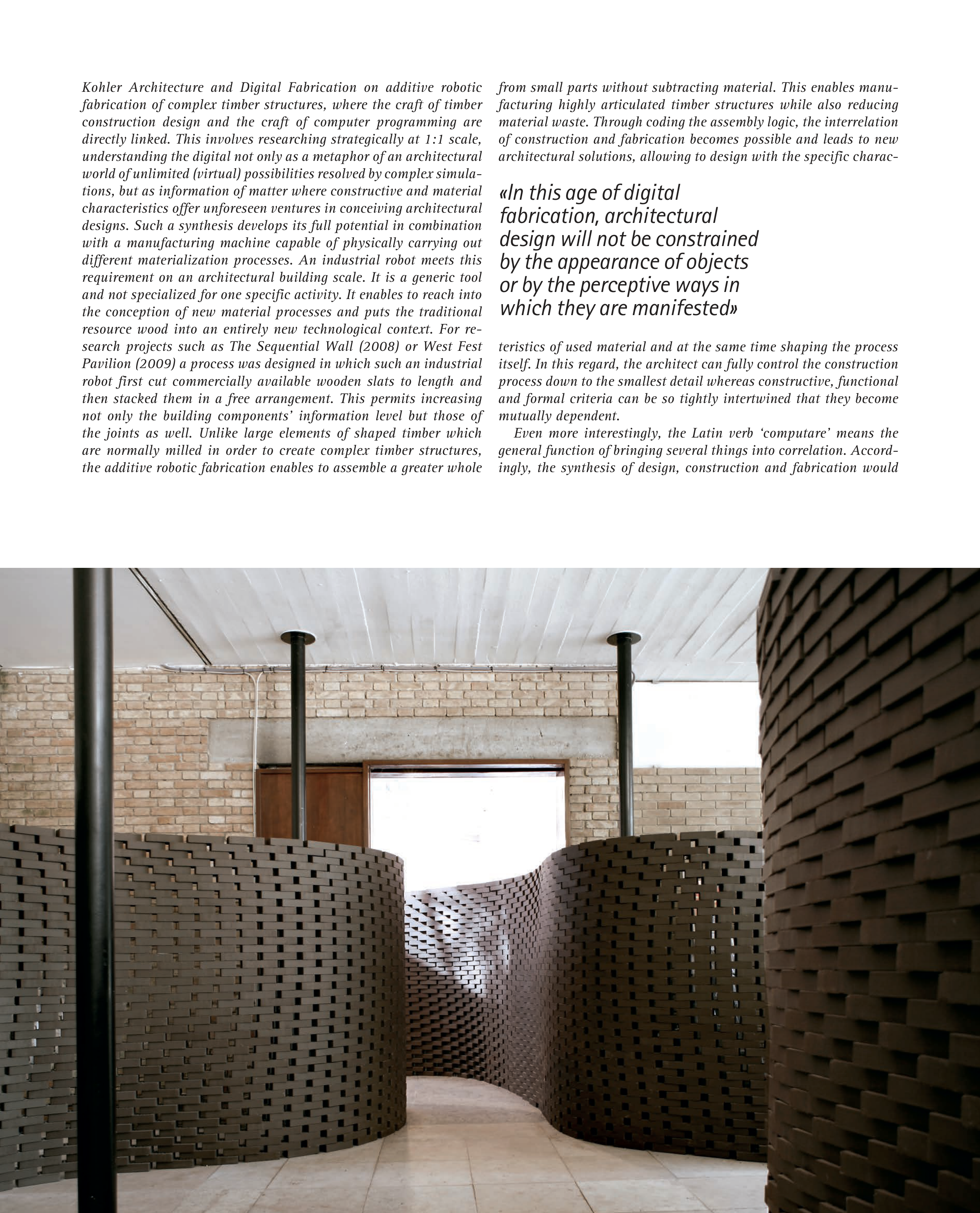
resource wood into an entirely new technological context. For re-
search projects such as The Sequential Wall (2008) or West Fest
Pavilion (2009) a process was designed in which such an industrial
robot first cut commercially available wooden slats to length and
then stacked them in a free arrangement. This permits increasing
not only the building components’ information level but those of
the joints as well. Unlike large elements of shaped timber which
are normally milled in order to create complex timber structures,
the additive robotic fabrication enables to assemble a greater whole
from small parts without subtracting material. This enables manu-
facturing highly articulated timber structures while also reducing
material waste. Through coding the assembly logic, the interrelation
of construction and fabrication becomes possible and leads to new
architectural solutions, allowing to design with the specific charac-
«In this age of digital
fabrication, architectural
design will not be constrained
by the appearance of objects
or by the perceptive ways in
which they are manifested»
teristics of used material and at the same time shaping the process
itself. In this regard, the architect can fully control the construction
process down to the smallest detail whereas constructive, functional
and formal criteria can be so tightly intertwined that they become
mutually dependent.
Even more interestingly, the Latin verb ‘computare’ means the
general function of bringing several things into correlation. Accord-
ingly, the synthesis of design, construction and fabrication would