22 C 01
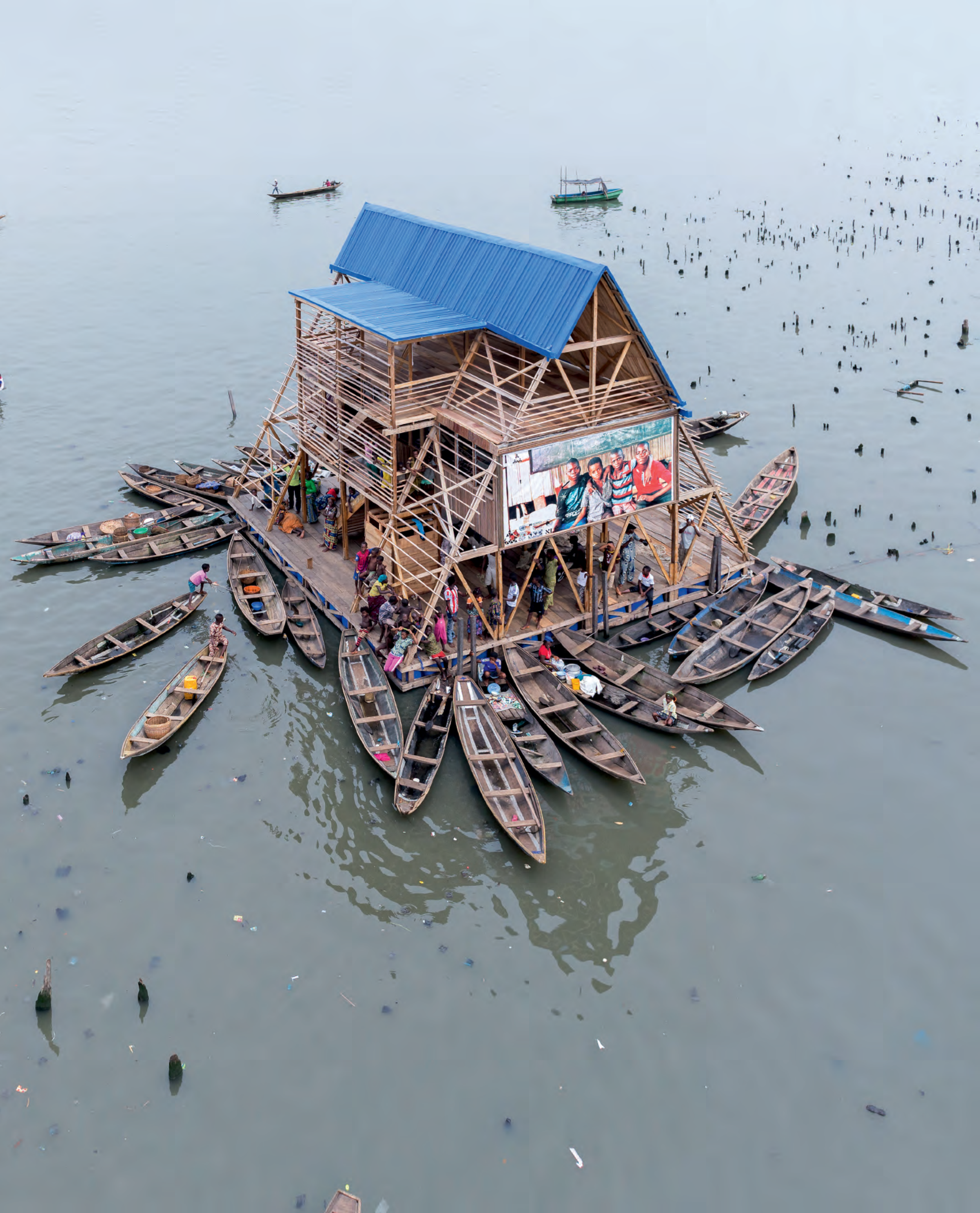
En torno a 100.000 personas viven en los palafitos de Makoko, un
barrio lacustre situado en la costa de la segunda ciudad más po-
blada de África: Lagos. Allí las construcciones son muy precarias
y apenas resisten los envites de la naturaleza (lluvias torrenciales,
crecidas, fuertes vientos...), que son especialmente agresivos en la
zona debido al cambio climático. En este contexto, el estudio NLÉ,
fundado en 2010 por el arquitecto nigeriano Kunlé Adeyemi y
localizado entre Amsterdam y Lagos, diseña la nueva escuela de la
comunidad con una doble función: por un lado, proporciona a los
vecinos una dotación educativa y una referencia cívica; por el otro,
sirve de modelo tipológico y constructivo para futuros proyectos.
El edificio, de base rectangular y diez metros de altura, está cons-
truido con una estructura de madera de forma piramidal que por su
geometría resulta muy estable al tener el centro de gravedad bajo,
además de resistente y muy rígida (está diseñada para cobijar a cien
personas en las condiciones climáticas más adversas). A diferencia
de los palafitos tradicionales cuyos postes se hincan en el fondo,
la escuela se apoya sobre una base flotante hecha de bidones de
plástico hallados en uno de los múltiples vertederos de la ciudad
que se vinculan entre sí gracias a una robusta celosía de madera.
Forman este zócalo insumergible varios módulos construidos en
tierra pero ensamblados en el agua. Y todo ello con la participación
activa de la comunidad local Makoko.
About 100,000 people live in the stilt dwellings of Makoko, a
lagoon-side neighborhood in the heart of the African continent’s
second most populated city, Lagos. Constructions here are very
precarious, hardly able to resist the inclemencies of nature (tor-
rential rains, floods, strong winds, and so on), which because of
climate change are especially aggressive in the area. In this context,
the studio NLÉ, founded in 2010 by the Nigerian architect Kunlé
Adeyemi and established between Amsterdam and Lagos, designs
the new school of the community with a double mission: to pro-
vide residents with and educational facility and a civic reference,
and to serve as a typological and constructional model for further
building. Rising ten meters over a rectangular base, the school is
built with a timber structure whose pyramid geometry, because of
its low gravitational center, is highly stable as well as resistant
and very rigid; after all, it is intended to take in a hundred people
in adverse weather conditions. Unlike traditional water structures,
where the posts are firmly set on the bottom of the body of lake or
river, the Makoko school rests on a floating base made of plastic
drums that were salvaged from one of the city’s numerous dumps,
held together with the help of a robust wooden lattice. This unsub-
mersible plinth is formed by several modules constructed on land
but assembled on water. And all this with the active participation
of Makoko local community.
Con una superficie de
220 m2, el proyecto
terminó de construirse
en 2013. Pese a estar
concebido como escuela,
el modelo constructivo
podría utilizarse para
vivienda, mercado o
hasta centro hospitalario.
The project has a total
surface of 220 m2 and
its construction finishes
in 2013. Even though
it was conceived as a
school, the constructive
prototype aims to be also
used as housing, market
or as a health clinic.
Learning on the
water in Lagos
Floating School in Nigeria
Architecture
Building
1