5
6
7
8
9
Green forests, wild rivers and snowcapped
mountains: the region around Jiri (9), a town
high up in the Himalayas, is also referred to
as the Switzerland of Nepal. A place where a
rich cultural heritage and traditional lifestyle
are still preserved. Part of that heritage is the
knowledge of how to process the Nepalese
nettle into yarn for manufacturing textiles. This
process has been refined to create 100%
plant-based rugs: a new material for the Eileen
Gray rug collection.
The native nettle (1) – also called Himalayan
nettle – grows wild and naturally in the vast
forests around Jiri. Following the summer
bloom, the dried stems are harvested in the
autumn and separated into individual fibres (2).
Back in the village, the nettle plants are pro-
cessed manually (3) and, using several diferent
stages, washed in fresh mountain rain water
without any additives (4), beaten soft and dried.
At the end of the process and for better colour
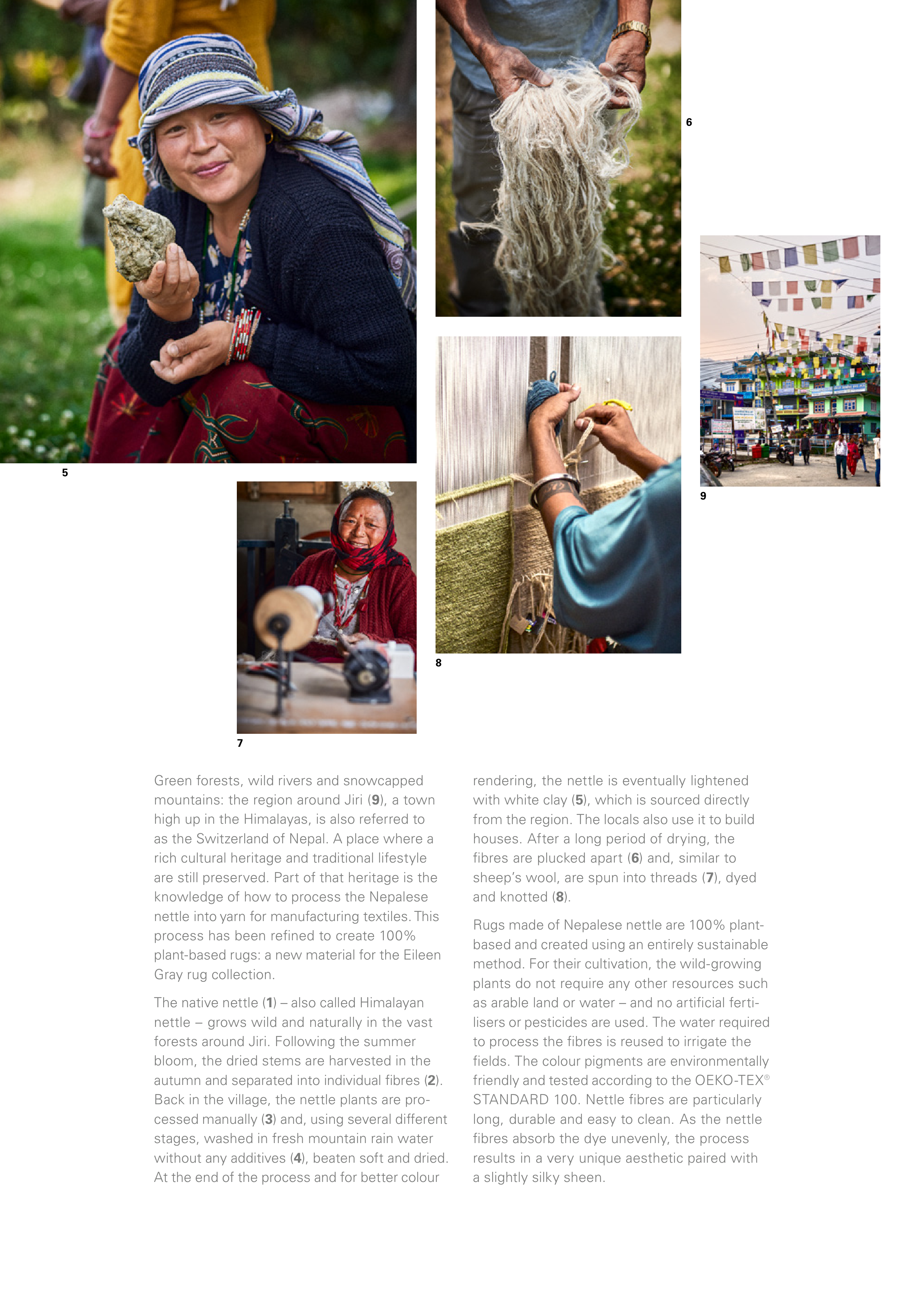
rendering, the nettle is eventually lightened
with white clay (5), which is sourced directly
from the region. The locals also use it to build
houses. After a long period of drying, the
fibres are plucked apart (6) and, similar to
sheep’s wool, are spun into threads (7), dyed
and knotted (8).
Rugs made of Nepalese nettle are 100% plant-
based and created using an entirely sustainable
method. For their cultivation, the wild-growing
plants do not require any other resources such
as arable land or water – and no artificial ferti-
lisers or pesticides are used. The water required
to process the fibres is reused to irrigate the
fields. The colour pigments are environmentally
friendly and tested according to the OEKO-TEX®
STANDARD 100. Nettle fibres are particularly
long, durable and easy to clean. As the nettle
fibres absorb the dye unevenly, the process
results in a very unique aesthetic paired with
a slightly silky sheen.