Afer the Second World War, during which Eileen Gray fell into oblivion as an architect and designer, she
continued to work in a disciplined manner until old age, even without commissions. Drawing, collage and
painting, which she pursued throughout her life, were comforting activities for her. Eileen Gray remained a
‘private painter’, she never exhibited her paintings publicly. Shortly before her death, she destroyed most of
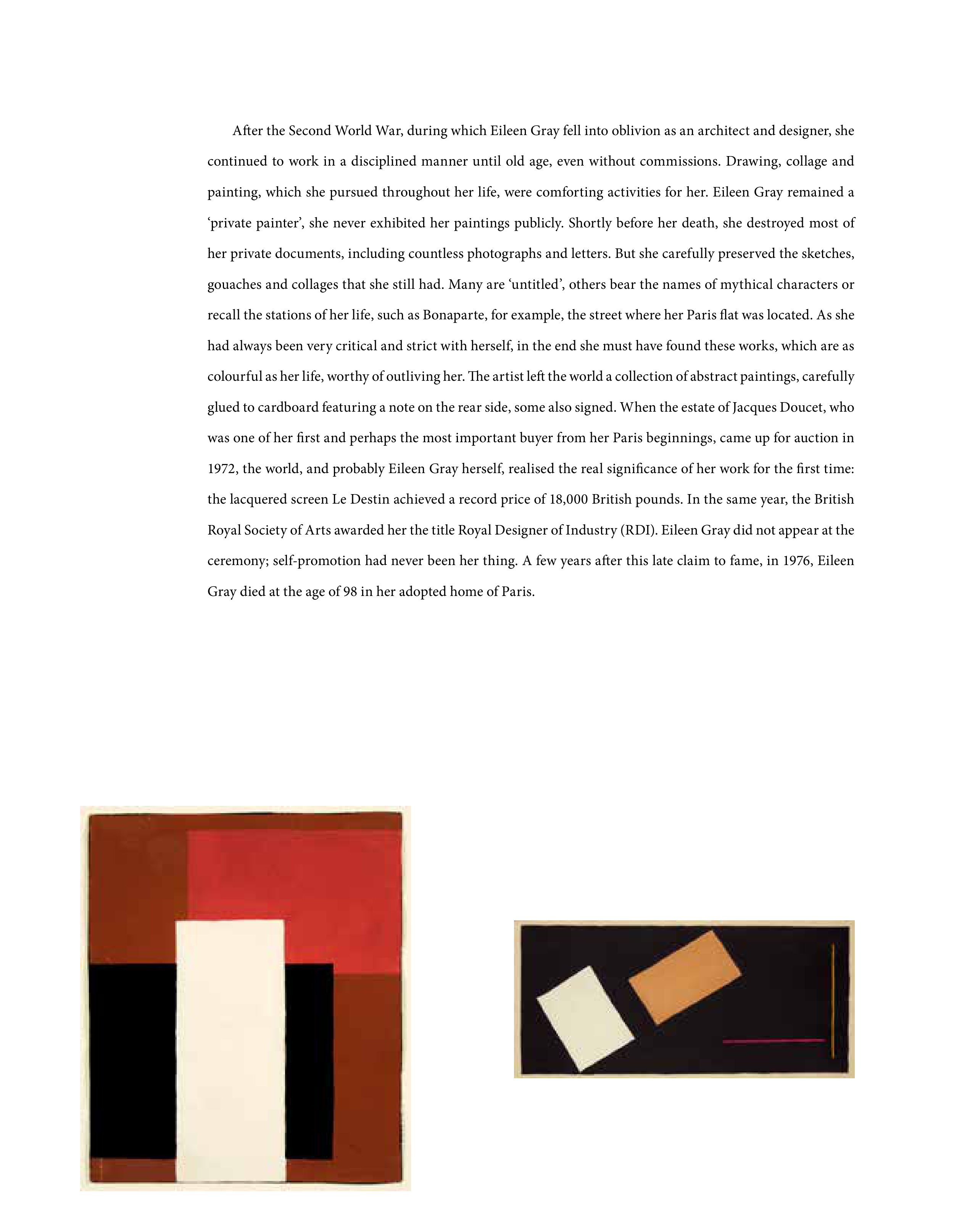
her private documents, including countless photographs and letters. But she carefully preserved the sketches,
gouaches and collages that she still had. Many are ‘untitled’, others bear the names of mythical characters or
recall the stations of her life, such as Bonaparte, for example, the street where her Paris fat was located. As she
had always been very critical and strict with herself, in the end she must have found these works, which are as
colourful as her life, worthy of outliving her. Te artist lef the world a collection of abstract paintings, carefully
glued to cardboard featuring a note on the rear side, some also signed. When the estate of Jacques Doucet, who
was one of her frst and perhaps the most important buyer from her Paris beginnings, came up for auction in
1972, the world, and probably Eileen Gray herself, realised the real signifcance of her work for the frst time:
the lacquered screen Le Destin achieved a record price of 18,000 British pounds. In the same year, the British
Royal Society of Arts awarded her the title Royal Designer of Industry (RDI). Eileen Gray did not appear at the
ceremony; self-promotion had never been her thing. A few years afer this late claim to fame, in 1976, Eileen
Gray died at the age of 98 in her adopted home of Paris.