8
MEAN TIME TO REPAIR
MTTR is the average time to recover UPS operation after
a failure. In modular UPSs MTTR is usually as low as 30
minutes since the typical failure fix consists in replacing
the whole power module. To have such a low MTTR, power
modules should be plug-in kind, that means no cabling
should be needed to connect them to the UPS unit. In
conventional UPSs, MTTR depends on the power and the
size of the system and it is typically from 1 to 4 hours (as the
average repair includes longer disassembling procedures
for the inoperative parts). The same MTTR figures can of
course be applied to routine maintenance. Although MTTR
is not critical whenever redundancy is deployed, low MTTR
is still a nice-to-have feature in Data Centers.
N+1 REDUNDANCY
“N+1” redundancy implies that there is some spare power
available in the UPS system, so that loads can be supplied
in VFI double conversion mode after a first failure or during
maintenance activities.
It must be noted that if no N+1 redundancy was provided,
maintenance could still be performed without load
shutdown, by switching the UPS unit under electronic
bypass, but even in dual fed redundant electrical systems,
this scenario is not the preferred one. To provide N+1
redundancy in modular UPSs, an additional power module
is installed on top of the required UPS rating. So, if a
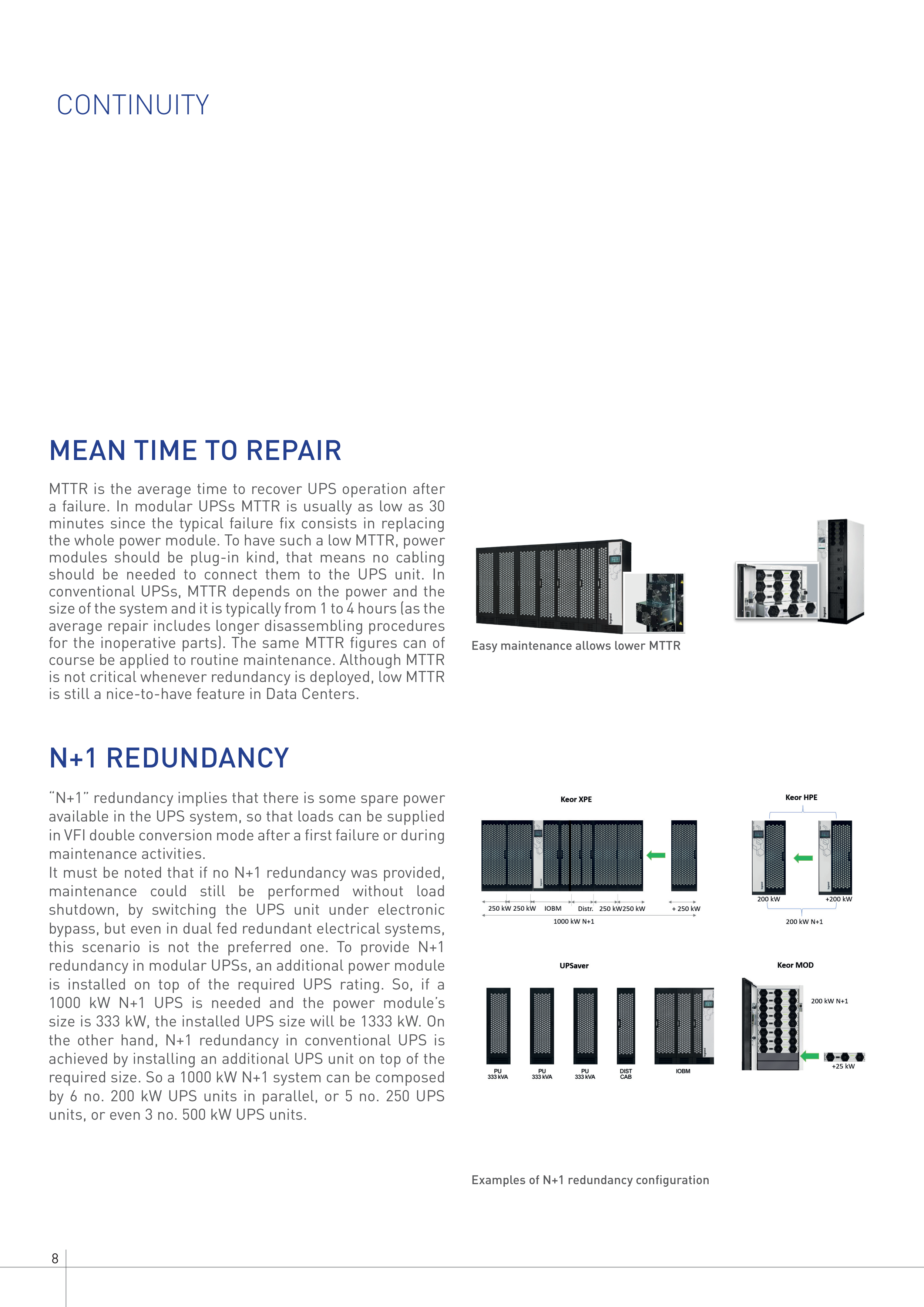
1000 kW N+1 UPS is needed and the power module’s
size is 333 kW, the installed UPS size will be 1333 kW. On
the other hand, N+1 redundancy in conventional UPS is
achieved by installing an additional UPS unit on top of the
required size. So a 1000 kW N+1 system can be composed
by 6 no. 200 kW UPS units in parallel, or 5 no. 250 UPS
units, or even 3 no. 500 kW UPS units.
CONTINUITY
Examples of N+1 redundancy configuration
Easy maintenance allows lower MTTR