4
INTRODUCTION
Compared to some decades ago, Digital Services are indispensable in daily life of the modern society. Public
Administration, Health, Finance, Telecommunications, Commerce, Industry, Entertainment and many other sectors are
deeply dependent and empowered by digital services, devices and infrastructures.
Data Centers are the hidden core behind our daily “digital life” which allows us to use and receive digital services.
Down time of Data Center means down time of digital service with consequence interruption of activities in the society,
problems for people and companies, huge money losses and, sometimes, even dangerous situations.
For this reason, in modern Data Centers, dedicated infrastructures are implemented in order to guarantee the continuity
of the operation and to provide high resilience of the system; UPS is one of the essential components in such protecting
infrastructure.
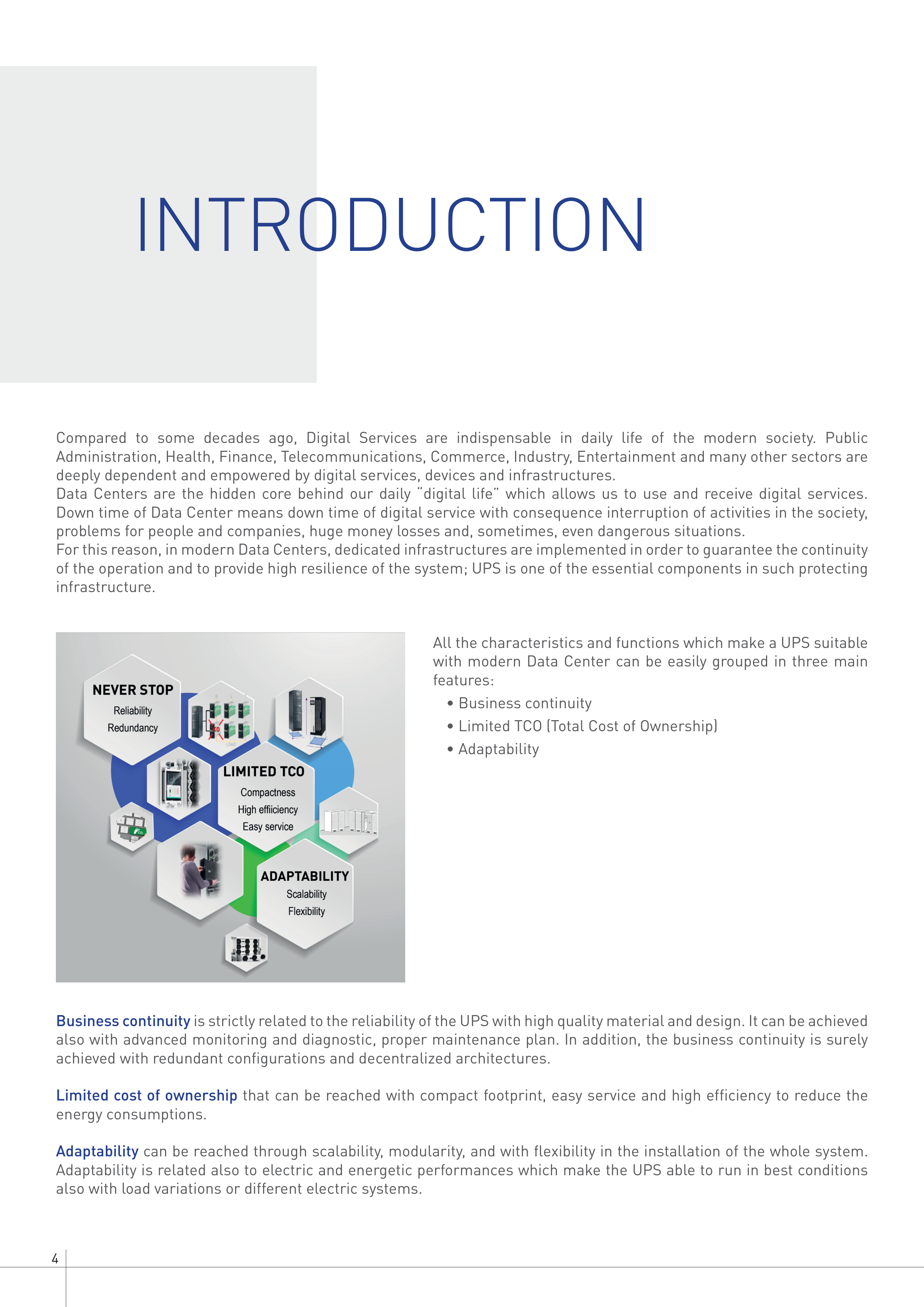
All the characteristics and functions which make a UPS suitable
with modern Data Center can be easily grouped in three main
features:
• Business continuity
• Limited TCO (Total Cost of Ownership)
• Adaptability
Business continuity is strictly related to the reliability of the UPS with high quality material and design. It can be achieved
also with advanced monitoring and diagnostic, proper maintenance plan. In addition, the business continuity is surely
achieved with redundant configurations and decentralized architectures.
Limited cost of ownership that can be reached with compact footprint, easy service and high efficiency to reduce the
energy consumptions.
Adaptability can be reached through scalability, modularity, and with flexibility in the installation of the whole system.
Adaptability is related also to electric and energetic performances which make the UPS able to run in best conditions
also with load variations or different electric systems.