DIMMING OPTIONS
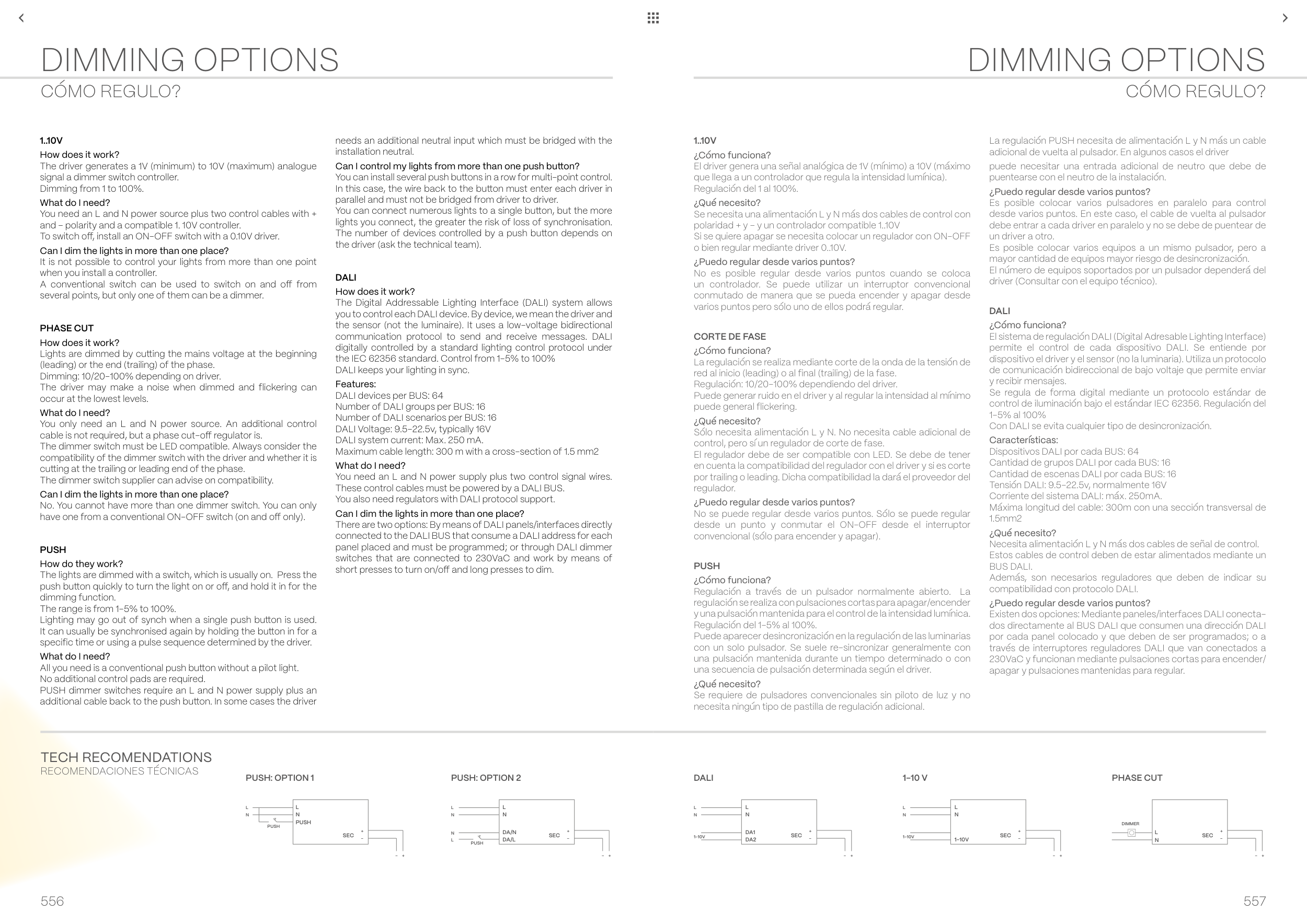
TECH RECOMENDATIONS
CÓMO REGULO?
RECOMENDACIONES TÉCNICAS
1..10V
¿Cómo funciona?
El driver genera una señal analógica de 1V (mínimo) a 10V (máximo
que llega a un controlador que regula la intensidad lumínica).
Regulación del 1 al 100%.
¿Qué necesito?
Se necesita una alimentación L y N más dos cables de control con
polaridad + y – y un controlador compatible 1..10V
Si se quiere apagar se necesita colocar un regulador con ON-OFF
o bien regular mediante driver 0..10V.
¿Puedo regular desde varios puntos?
No es posible regular desde varios puntos cuando se coloca
un controlador. Se puede utilizar un interruptor convencional
conmutado de manera que se pueda encender y apagar desde
varios puntos pero sólo uno de ellos podrá regular.
CORTE DE FASE
¿Cómo funciona?
La regulación se realiza mediante corte de la onda de la tensión de
red al inicio (leading) o al final (trailing) de la fase.
Regulación: 10/20-100% dependiendo del driver.
Puede generar ruido en el driver y al regular la intensidad al mínimo
puede general flickering.
¿Qué necesito?
Sólo necesita alimentación L y N. No necesita cable adicional de
control, pero sí un regulador de corte de fase.
El regulador debe de ser compatible con LED. Se debe de tener
en cuenta la compatibilidad del regulador con el driver y si es corte
por trailing o leading. Dicha compatibilidad la dará el proveedor del
regulador.
¿Puedo regular desde varios puntos?
No se puede regular desde varios puntos. Sólo se puede regular
desde un punto y conmutar el ON-OFF desde el interruptor
convencional (sólo para encender y apagar).
PUSH
¿Cómo funciona?
Regulación a través de un pulsador normalmente abierto. La
regulación se realiza con pulsaciones cortas para apagar/encender
y una pulsación mantenida para el control de la intensidad lumínica.
Regulación del 1-5% al 100%.
Puede aparecer desincronización en la regulación de las luminarias
con un solo pulsador. Se suele re-sincronizar generalmente con
una pulsación mantenida durante un tiempo determinado o con
una secuencia de pulsación determinada según el driver.
¿Qué necesito?
Se requiere de pulsadores convencionales sin piloto de luz y no
necesita ningún tipo de pastilla de regulación adicional.
La regulación PUSH necesita de alimentación L y N más un cable
adicional de vuelta al pulsador. En algunos casos el driver
puede necesitar una entrada adicional de neutro que debe de
puentearse con el neutro de la instalación.
¿Puedo regular desde varios puntos?
Es posible colocar varios pulsadores en paralelo para control
desde varios puntos. En este caso, el cable de vuelta al pulsador
debe entrar a cada driver en paralelo y no se debe de puentear de
un driver a otro.
Es posible colocar varios equipos a un mismo pulsador, pero a
mayor cantidad de equipos mayor riesgo de desincronización.
El número de equipos soportados por un pulsador dependerá del
driver (Consultar con el equipo técnico).
DALI
¿Cómo funciona?
El sistema de regulación DALI (Digital Adresable Lighting Interface)
permite el control de cada dispositivo DALI. Se entiende por
dispositivo el driver y el sensor (no la luminaria). Utiliza un protocolo
de comunicación bidireccional de bajo voltaje que permite enviar
y recibir mensajes.
Se regula de forma digital mediante un protocolo estándar de
control de iluminación bajo el estándar IEC 62356. Regulación del
1-5% al 100%
Con DALI se evita cualquier tipo de desincronización.
Características:
Dispositivos DALI por cada BUS: 64
Cantidad de grupos DALI por cada BUS: 16
Cantidad de escenas DALI por cada BUS: 16
Tensión DALI: 9.5-22.5v, normalmente 16V
Corriente del sistema DALI: máx. 250mA.
Máxima longitud del cable: 300m con una sección transversal de
1.5mm2
¿Qué necesito?
Necesita alimentación L y N más dos cables de señal de control.
Estos cables de control deben de estar alimentados mediante un
BUS DALI.
Además, son necesarios reguladores que deben de indicar su
compatibilidad con protocolo DALI.
¿Puedo regular desde varios puntos?
Existen dos opciones: Mediante paneles/interfaces DALI conecta-
dos directamente al BUS DALI que consumen una dirección DALI
por cada panel colocado y que deben de ser programados; o a
través de interruptores reguladores DALI que van conectados a
230VaC y funcionan mediante pulsaciones cortas para encender/
apagar y pulsaciones mantenidas para regular.
1..10V
How does it work?
The driver generates a 1V (minimum) to 10V (maximum) analogue
signal a dimmer switch controller.
Dimming from 1 to 100%.
What do I need?
You need an L and N power source plus two control cables with +
and – polarity and a compatible 1. 10V controller.
To switch off, install an ON-OFF switch with a 0.10V driver.
Can I dim the lights in more than one place?
It is not possible to control your lights from more than one point
when you install a controller.
A conventional switch can be used to switch on and off from
several points, but only one of them can be a dimmer.
PHASE CUT
How does it work?
Lights are dimmed by cutting the mains voltage at the beginning
(leading) or the end (trailing) of the phase.
Dimming: 10/20-100% depending on driver.
The driver may make a noise when dimmed and flickering can
occur at the lowest levels.
What do I need?
You only need an L and N power source. An additional control
cable is not required, but a phase cut-off regulator is.
The dimmer switch must be LED compatible. Always consider the
compatibility of the dimmer switch with the driver and whether it is
cutting at the trailing or leading end of the phase.
The dimmer switch supplier can advise on compatibility.
Can I dim the lights in more than one place?
No. You cannot have more than one dimmer switch. You can only
have one from a conventional ON-OFF switch (on and off only).
PUSH
How do they work?
The lights are dimmed with a switch, which is usually on. Press the
push button quickly to turn the light on or off, and hold it in for the
dimming function.
The range is from 1-5% to 100%.
Lighting may go out of synch when a single push button is used.
It can usually be synchronised again by holding the button in for a
specific time or using a pulse sequence determined by the driver.
What do I need?
All you need is a conventional push button without a pilot light.
No additional control pads are required.
PUSH dimmer switches require an L and N power supply plus an
additional cable back to the push button. In some cases the driver
needs an additional neutral input which must be bridged with the
installation neutral.
Can I control my lights from more than one push button?
You can install several push buttons in a row for multi-point control.
In this case, the wire back to the button must enter each driver in
parallel and must not be bridged from driver to driver.
You can connect numerous lights to a single button, but the more
lights you connect, the greater the risk of loss of synchronisation.
The number of devices controlled by a push button depends on
the driver (ask the technical team).
DALI
How does it work?
The Digital Addressable Lighting Interface (DALI) system allows
you to control each DALI device. By device, we mean the driver and
the sensor (not the luminaire). It uses a low-voltage bidirectional
communication protocol to send and receive messages. DALI
digitally controlled by a standard lighting control protocol under
the IEC 62356 standard. Control from 1-5% to 100%
DALI keeps your lighting in sync.
Features:
DALI devices per BUS: 64
Number of DALI groups per BUS: 16
Number of DALI scenarios per BUS: 16
DALI Voltage: 9.5-22.5v, typically 16V
DALI system current: Max. 250 mA.
Maximum cable length: 300 m with a cross-section of 1.5 mm2
What do I need?
You need an L and N power supply plus two control signal wires.
These control cables must be powered by a DALI BUS.
You also need regulators with DALI protocol support.
Can I dim the lights in more than one place?
There are two options: By means of DALI panels/interfaces directly
connected to the DALI BUS that consume a DALI address for each
panel placed and must be programmed; or through DALI dimmer
switches that are connected to 230VaC and work by means of
short presses to turn on/off and long presses to dim.
DIMMING OPTIONS
CÓMO REGULO?
PUSH: OPTION 1
L
L
N
N
PUSH
PUSH
SEC
+
+
-
-
L
L
L
N
N
N
PUSH
DA/N
DA/L
SEC
+
+
-
-
PUSH: OPTION 2
L
L
N
1-10V
N
DA1
DA2
SEC
+
+
-
-
DALI
L
L
N
1-10V
N
1-10V
SEC
+
+
-
-
1-10 V
L
DIMMER
N
SEC
+
+
-
-
PHASE CUT
557
556