124
125
KK47000
SAFARI CHAIR
From the wild plains of Africa to living rooms and hotels, this iconic design has come a long way.
Imagine great adventures in its simple yet sturdy construction.
The Safari Chairs in the couple’s photos were likely based
on Indian Roorkhee Chairs used by the British military
– possibly the first examples of self-assembled furniture.
The archetype featured glueless joints, tool-free assembly,
and an intelligent construction that caused the joints to
tighten when the chair was occupied, enhancing strength
and stability.
Klint delved into simplifying, clarifying and refining the
chair’s composition, exhibiting his final Safari Chair design
in 1933 at the Copenhagen Cabinetmakers’ Guild Exhibition.
While inspired by its British predecessor, Klint’s
sophisticated, lightweight chair is defined by his signature
systematic approach, fine craftsmanship, well-conceived
proportions, and remarkable material effects.
Captivated by the chairs an American cinematographer and his wife had used
on their African safari, Kaare Klint set out to transform the portable knockdown
archetype into an elegant design for modern interiors.
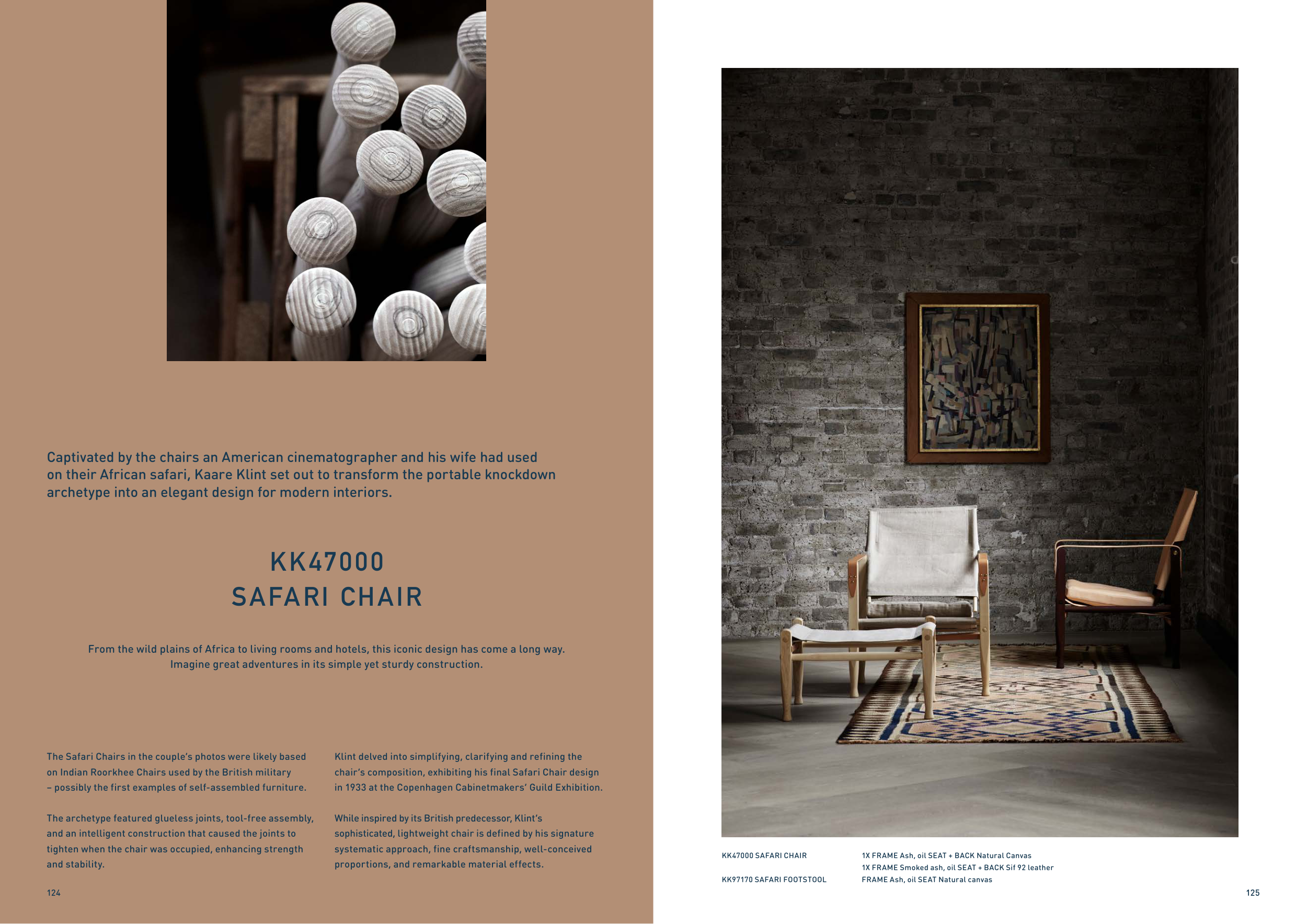
KK47000 SAFARI CHAIR
1X FRAME Ash, oil SEAT + BACK Natural Canvas
1X FRAME Smoked ash, oil SEAT + BACK Sif 92 leather
KK97170 SAFARI FOOTSTOOL
FRAME Ash, oil SEAT Natural canvas